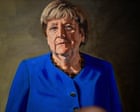
The unveiling of a former head of government’s official portrait is routinely treated by mainstream media as a lifestyle event—a mixture of aesthetic critique and human-interest anecdotes regarding the relationship between the painter and the politician. This superficial framework misses the underlying structural function of state portraiture. Official political portraiture is not an exercise in passive realism; it is a calculated mechanism of legacy engineering designed to codify an administration's grand strategy, values, and institutional positioning at a precise historical inflection point.
The presentation of former German Chancellor Angela Merkel's portrait at Berlin's Bode-Museum provides an empirical dataset for evaluating how the 16-year "Merkel Era" seeks to anchor itself in the institutional memory of the Federal Republic of Germany. By bypassing standard journalistic narratives and applying a rigorous iconographic framework, we can isolate the operational logic, strategic variables, and structural tensions embedded within the canvas painted by Jérémie Queyras.
The Three Vectors of Legacy Engineering
Political legacy is a dynamic construct subject to retroactive devaluation based on evolving macroeconomic and geopolitical realities. State portraits serve as a stabilizing variable in this equation. In Merkel’s case, the composition optimizes for three distinct vectors designed to counteract current geopolitical critiques of her tenure.
1. Generational Arbitrage
The deliberate selection of Jérémie Queyras—a 28-year-old contemporary artist who was only eight years old when Merkel assumed office in 2005—functions as a strategic decoupling mechanism. By bypassing established, institutional portraitists, the commission shifts the frame of reference from historical peer review to generational legacy. The relationship established during the sitting process creates a narrative where the subject is interpreted not by her contemporaries, but by the generation whose socio-economic reality was shaped exclusively under her governance.
2. The Rejection of Imperial Semiotics
The German Federal Chancellery’s portrait gallery—established by Helmut Kohl—serves as a spatial historical ledger. The portraits of Merkel’s predecessors rely heavily on traditional assertions of authority. For instance, Jörg Immendorff’s portrait of Gerhard Schröder employs a highly stylized, almost Roman imperial iconographic language.
Predecessor Semiotics (Schröder/Kohl):
[Imperial Metaphor] -> [Assertion of Personal Dominance] -> [High-Contrast Ego]

Merkel Semiotics (Queyras Canvas):
[Prosaic Monotone] -> [Institutional Continuousness] -> [De-escalated Authority]
The Queyras canvas systematically suppresses these tropes. By depicting Merkel in a standard blue blazer with prominent buttons, the artwork anchors her identity within the realm of the civil service rather than political aristocracy. The composition operates on a principle of anti-monumentalism, aligning with her established political brand of technocratic pragmatism.
3. Deliberate Omission as Strategic Choice
The most analytical detail of the portrait is what it explicitly excludes: the Kanzlerette-Raute (the Merkel Diamond). For over a decade and a half, this specific hand gesture served as a powerful non-verbal corporate logo for her administration, signaling stability, focus, and centralized control.
To include the Raute in the permanent oil painting would reduce the institutional legacy of a 16-year chancellorship to a fleeting internet meme or a cartoonish caricature. The omission forces the viewer to engage with the structural reality of the executive office rather than the highly manufactured branding of her re-election campaigns.
The Material Variables: Decoding the Background Matrix
Every object placed within the frame of an official portrait carries a symbolic cost function. In the Queyras painting, the background table features a curated array of office items designed to communicate specific institutional principles.
| Artifact | Structural Definition | Strategic Communication |
|---|---|---|
| Yellow Cardboard File | Analogue administrative process | Emphasizes methodical, unflashy bureaucratic governance over volatile digital populism. |
| Engraved Silver Cube | Spatial anchor / Office motto | Bears the text “In der Ruhe liegt die Kraft” (In serenity strength lies), reinforcing the strategic utility of deliberate political delays. |
| Frayed Facial Texturing | Physiological depiction of power | Signals the physical and psychological toll of crisis management (Eurozone, 2015 migration, Pandemic). |
The visual economy of these items targets the "People Also Ask" dynamic surrounding her historical legacy: Was her governance style too passive? The portrait answers by reframing passivity as deliberate, fortified serenity (Ruhe) backed by bureaucratic rigor.
Geopolitical Friction and Spatial Security
Beyond the frame of the canvas lies a complex web of modern German political anxieties. The portrait’s temporary exhibition at the Bode-Museum before its permanent relocation to the Chancellery highlights an acute institutional tension.
Reports indicate a highly unorthodox clause surrounding the long-term custody of the artwork: the painting is structurally structured as a loan to the Chancellery, ensuring that Merkel retains formal ownership. This legal firewall allows for the immediate physical extraction of the portrait from state property should domestic political volatility—specifically the ascendancy of the far-right Alternative for Germany (AfD)—threaten the institutional integrity of the gallery.
This creates a fascinating structural paradox. The painting seeks to project a sense of permanent, unshakeable democratic continuity, yet its foundational ownership agreement is explicitly optimized for a worst-case scenario of democratic backsliding and institutional decay.
The Strategic Assessment
The portrait succeeds as a piece of legacy architecture because it perfectly maps to the core tenets of Merkel’s historical doctrine: strategic ambiguity and institutional absorption. By rejecting the bold, masculine brushstrokes of her 20th-century predecessors, the painting ensures that her image cannot easily be weaponized by contemporary political critics. It presents an unyielding, flat profile of bureaucratic endurance.
The definitive forecast for this artwork is clear. As Germany navigates an increasingly fragmented European landscape and volatile domestic coalition dynamics, this portrait will serve as a visual anchor for institutional nostalgia. By presenting herself as an exhausted but unbroken civil servant, Merkel’s portrait effectively shifts the historical burden of proof onto her successors. It challenges future administrations to prove that a flashier, more ideologically rigid approach to governance can match the sheer systemic durability of her 16-year analogue status quo.
Angela Merkel's official portrait revealed
This video analysis provides critical visual context on how the specific color choices and spatial composition within the portrait are being interpreted by political analysts in Berlin.