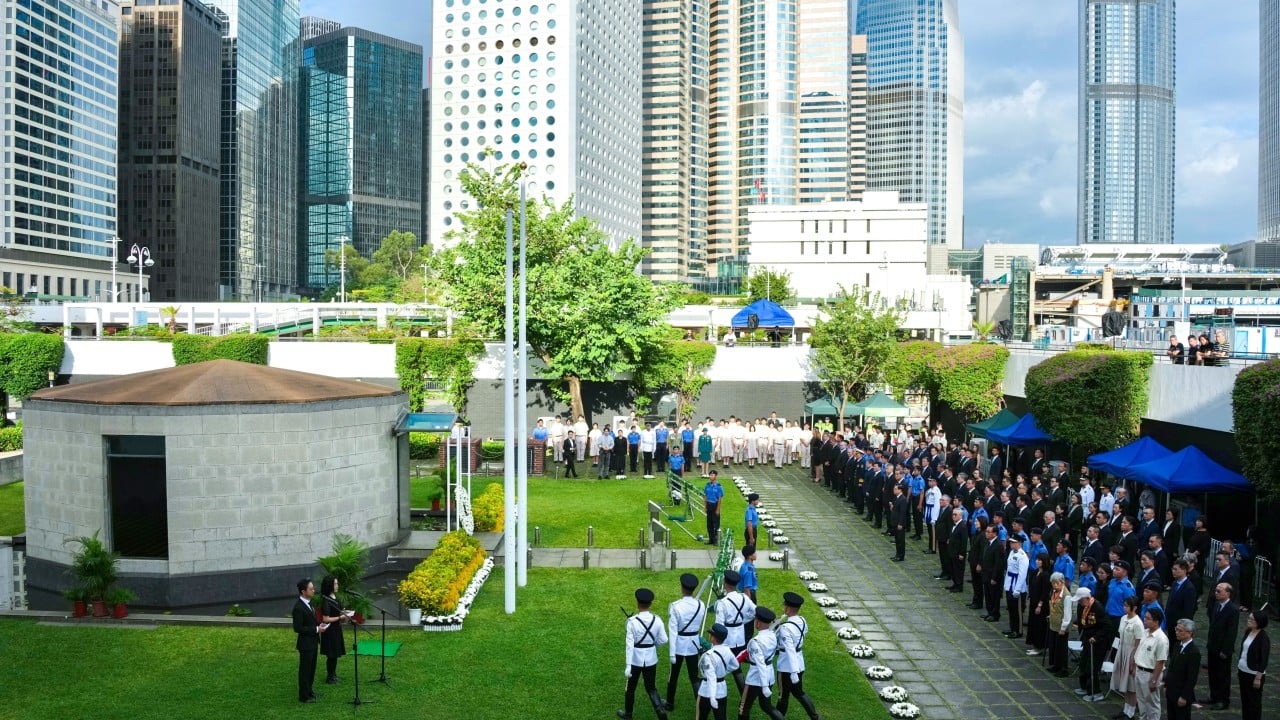
Standard reporting on Hong Kong's Chung Yeung Festival memorials treats calls for peace and stability as ceremonial platitudes rather than explicit inputs into an economic and institutional stability model. When Chief Executive John Lee addresses the public at the City Hall Memorial Garden on Chung Yeung—commemorating those who died defending Hong Kong between 1941 and 1945—the event fuses historical grief with contemporary governance signaling. A rigorous analysis moves past surface-level event summaries to map how political memory, civic order, and market expectations interact inside a high-density international financial center.
Deconstructing the Competitor Narrative
Conventional news coverage of Chung Yeung political remarks typically follows a predictable template: state the date and venue, list senior attendees, summarize the leader's call to cherish peace and stability, and attach a brief paragraph on the festival's origins. That approach captures the chronology while leaving the underlying mechanics unexamined.
The first gap in standard coverage is the conflation of two distinct concepts: social peace (the absence of large-scale public disorder or violent conflict) and institutional stability (predictability in legal enforcement, regulatory continuity, and property rights). A city can maintain quiet streets for months while multinational firms still recalculate medium-term operational risk based on shifting policy signals or external geopolitical friction.
The second gap is the failure to specify cause-and-effect chains. Saying that stability supports prosperity states a correlation or an aspiration rather than a mechanism. In an open, trade-exposed economy like Hong Kong, domestic calm interacts with cross-border capital flows, shipping and aviation logistics, talent retention, and sovereign risk pricing. Treating a ceremonial speech as a self-contained news item misses how state actors use historical commemorations to anchor expectations around public order and institutional continuity.
The third gap lies in separating verified facts from strategic interpretation. Known facts include the annual Chung Yeung memorial ceremony at City Hall Memorial Garden, attendance by senior officials, and public remarks urging residents to value peace in light of wartime sacrifices. Educated hypotheses involve how those remarks shape public sentiment over time, how investors weigh domestic calm against external shocks, and what degree of behavioral compliance officials expect from residents.
The Three Pillars of Civic Stability Signaling
Official messaging around Chung Yeung operates across three interlocking pillars. Each pillar performs a distinct function in connecting past sacrifice to present-day governance.
1. Historical Legitimacy and Moral Debt
Wartime remembrance establishes an intergenerational ledger. By honoring defenders from the 1941–1945 period during a traditional festival associated with ancestral reverence, the state frames present-day calm as something bought at high human cost rather than a natural entitlement.
In organizational and political terms, this creates a moral anchor. Public rituals reduce abstract policy goals—such as maintaining public order or social cohesion—to a shared memory of survival under extreme duress. Whether every citizen interprets that history identically is a separate question; the structural intent of the ritual is to make civic restraint feel like fidelity to past sacrifice rather than mere submission to authority.
2. Risk Compression for Economic Actors
Hong Kong's economic model depends heavily on cross-border trade, financial intermediation, and high-trust transaction execution. Any perception of domestic instability widens risk premia, raises hedging costs, and slows capital commitment.
Repeated public emphasis on stability functions as expectation management. From a decision-theory standpoint, market participants evaluate both probability and severity of disruption. Leadership statements during high-visibility public ceremonies signal an administrative commitment to preventing internal disorder, aiming to compress perceived domestic tail risk even when external geopolitical conditions remain volatile.
3. Cultural Synchronization via Traditional Calendars
Chung Yeung is not a random administrative date on the calendar. It is a deeply rooted cultural observance tied to tomb sweeping, family gathering, and ascending heights. Anchoring a governance message to a widely recognized holiday increases reach without requiring a separate policy campaign.
This creates temporal alignment. Citizens are already moving through the city, visiting cemeteries or hiking trails, and thinking about lineage and continuity. Linking civic harmony to an existing cultural rhythm allows officials to piggyback on organic social routines rather than competing for attention during routine news cycles.
Cause-and-Effect Mechanics Often Missed
Surface coverage treats rhetoric and reality as separate tracks. In practice, stability messaging interacts with system dynamics through clear feedback loops—some reinforcing, others constrained by structural limits.
The Order-Confidence-Investment Loop
When public order is visible and predictable, baseline transaction friction stays low. Lower friction supports commercial activity, tourism, and municipal tax revenues, which in turn fund public services and security apparatus. Ceremonial rhetoric reinforces this loop when it matches lived daily experience—such as reliable transit, low street crime, and smooth administrative operations.
The second limitation of rhetoric appears when external shocks dominate. A domestic call for peace cannot by itself neutralize foreign tariff shifts, supply-chain rerouting, or interest-rate cycles. Internal stability is a necessary operating condition for an open economy, not a complete shield against exogenous turbulence.
The Memory-Complacency Trade-Off
Leadership messaging around historical hardship often targets a specific behavioral hazard: complacency. Generations that did not experience war or severe civil breakdown may treat calm conditions as permanent background noise, underestimating how quickly institutions or social trust can erode.
Yet over-reliance on historical trauma carries its own friction. If public discourse frames every present challenge through existential survival or past conflict, audiences can experience message fatigue or view everyday policy disagreements as threats to order. Effective governance communication must distinguish between genuine security risks and normal administrative or economic debates.
The Cost Function of Maintaining Stability
Stability is not free; it carries a multi-part cost function across fiscal, regulatory, and social dimensions:
- Direct administrative and security outlays: Policing, emergency preparedness, infrastructure maintenance, and public event management require ongoing budget allocations.
- Compliance and friction costs: Tighter security protocols, stricter rules on public assemblies, or heightened vetting add procedural time and cost for organizers, businesses, and travelers.
- Opportunity costs of risk aversion: Over-indexing on short-term control can delay institutional adaptation, deter experimental commercial models, or narrow public feedback channels that surface early operational flaws.
Analyzing stability through a cost function—rather than treating it as a pure "free good"—explains why policymakers constantly balance reassurance with adaptability.
Operational Playbook for Evaluating Stability Signals
Analysts, executives, and policy observers covering Hong Kong or similar hub economies can evaluate stability messaging systematically using a five-step operational workflow.
- Separate ceremonial framing from policy change. Record the exact date, venue, and symbolic context (such as Chung Yeung wartime tributes), then check whether any new legislation, enforcement directive, or budget measure accompanied the remarks. Rhetoric alone alters sentiment; statutory or operational rules alter incentives.
- Map the primary audience. Identify whether the statement is aimed primarily at domestic residents (social cohesion and civic restraint), business and financial stakeholders (risk compression and predictability), or external observers (sovereign resilience).
- Cross-check high-frequency operational indicators. Pair narrative analysis with concrete system metrics: port and airport throughput, cross-border visitor arrivals, interbank liquidity conditions, public safety statistics, and labor market turnover. Narrative alignment with hard indicators strengthens credibility; divergence signals strain.
- Distinguish domestic order from external exposure. Categorize any risk factor mentioned or implied into internal governance variables versus external geopolitical or macroeconomic forces. This prevents misattributing global market swings to local civic conditions.
- Track persistence across cycles. A single holiday address carries limited analytical weight on its own. Compare themes across consecutive festivals, policy addresses, and budget cycles to spot shifts in emphasis, tone, or institutional priorities.
Common Questions Behind the Headlines
Readers searching around Chung Yeung stability remarks typically want clarity on four practical questions without wading through partisan spin.
Why link a traditional festival to modern governance? Chung Yeung combines ancestral respect with reflection on resilience and longevity. Pairing an official wartime memorial with the holiday lets leaders frame civic calm as a shared inheritance across generations.
How directly does peace and stability affect everyday life and business in Hong Kong? For residents, baseline public order shapes daily safety, commute reliability, and social predictability. For businesses, predictable legal and physical operating conditions reduce uncertainty around staffing, logistics, and capital deployment—though profitability still depends on market demand, costs, and global trade rules.
Does calling for peace and stability mean problems exist, or is it routine? Both possibilities can be true at once. Seasonal commemorations routinely include calls for unity and stability as standard diplomatic and civic practice, while heightened emphasis often reflects sensitivity to regional tensions, economic adjustment, or post-disruption consolidation.
What are the limits of relying on stability messaging? Words do not resolve structural bottlenecks such as housing affordability, demographic shifts, or external trade barriers. When lived economic or social pressures diverge sharply from reassuring rhetoric, messaging loses persuasive power.
Strategic Action for Decision-Makers
Treat official stability appeals during cultural observances like Chung Yeung as leading sentiment indicators paired with baseline operational benchmarks, never as standalone economic forecasts or complete risk assessments. Build a quarterly tracking matrix that pairs leadership messaging themes against verifiable operational metrics—capital flows, talent mobility, regulatory clarity, and public-order indicators—and stress-test business or policy plans against external shocks that domestic calm cannot control on its own.