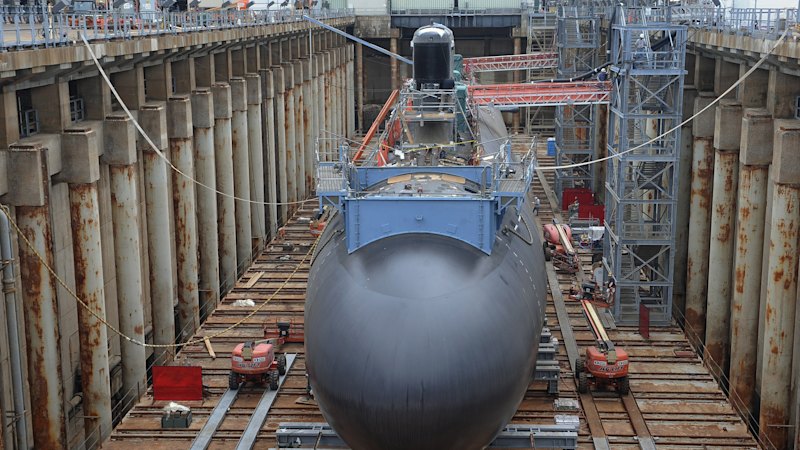
The lazy consensus in defense journalism is simple. The United States is planning to pour billions of dollars into upgrading domestic shipyards to build and maintain Virginia-class nuclear attack submarines for Australia under the AUKUS agreement, and therefore, the Indo-Pacific deterrence architecture is safely under construction.
It sounds tidy. It sounds patriotic. It is also an absolute fantasy built on industrial quicksand.
For the past three decades, I have watched defense procurement programs turn multi-billion-dollar investments into bureaucratic slipknots. Throwing federal capital at concrete pours and dry dock expansions while ignoring the structural collapse of the American manufacturing workforce is not a strategy. It is an expensive prayer.
Let us dismantle the prevailing assumption that writing a check solves a physics problem.
The Mirage of Infrastructure Funding
Washington operates on a magical-thinking loop. If a capability deficit exists, the default remedy is an appropriations bill. The current narrative assumes that modernizing facilities like Puget Sound Naval Shipyard or constructing new submarine industrial capacity is simply a matter of writing big checks for heavy machinery and structural steel.
That logic assumes the constraint is the building. The constraint is the welder.
American shipyards face a generational human capital drain. Building a nuclear-powered submarine is not an assembly-line job where you hand someone a wrench after a two-week onboarding course. It requires artisan-level welding, rigorous metallurgical quality control, and decades of institutional tribal knowledge that cannot be expedited by a PowerPoint presentation. When you inject billions into an industrial base that is already operating at a deficit of thousands of skilled tradespeople, you do not accelerate production. You bottleneck the existing supply of talent even further, driving up labor costs and delaying every hull currently on the slipways.
Furthermore, domestic naval yards are already drowning in a backlog of maintenance for the US Navy’s own fleet. Asking these same overstressed facilities to absorb the maintenance and construction overhead for a foreign navy is an exercise in administrative self-harm.
The AUKUS Delusion of Timelines
Let us look at the timeline promised by proponents of the AUKUS pact. Canberra is scheduled to receive conventionally armed, nuclear-powered submarines from the United States in the 2030s, followed by a jointly developed British-American-Australian design in the 2040s.
These dates are divorced from operational reality.
To meet the baseline maintenance and construction demands of the US Navy right now, domestic yards are struggling to maintain a delivery rate of two Virginia-class boats per year. That rate is falling short of attrition and strategic requirements. If the United States cannot reliably deliver submarines on schedule for its own naval commanders, the notion that it will divert hulls to Australia without hollowing out its own frontline deterrent is laughable.
Australia is paying billions upfront to secure an industrial promise that relies on a US shipbuilding base that has withered through decades of consolidation, procurement mismanagement, and a lack of predictable federal contracting cadence. You cannot buy industrial capacity off the shelf when the shelf is bare.
What Washington Gets Wrong About Industrial Depth
The core misconception is treating shipbuilding like an electronic supply chain. You cannot nearshore or quick-scale a nuclear submarine shipyard the way you spin up a semiconductor fab or an aerospace component plant.
A nuclear submarine is arguably the most complex machine ever devised by humanity. It contains millions of parts sourced from a specialized tier-one, tier-two, and tier-three vendor network. When a single small-valve manufacturer or specialty steel supplier goes out of business or suffers a labor shortage, the entire multi-billion-dollar hull stalls.
Pouring federal capital into prime contractor shipyards while the downstream supply chain remains brittle and hollowed out accomplishes nothing. The money pools at the top, gets absorbed by administrative overhead and shareholder buybacks or margin protections, and leaves the actual floor-level manufacturing constraints completely unaddressed.
If the architects of this agreement actually wanted to build genuine deterrence in the Pacific, they would stop pretending that a massive domestic infrastructure spending bill fixes a structural human capital and supply chain crisis.
The real solution requires radical, politically unpalatable steps. It means treating trade apprenticeships with the same prestige and financial compensation as Ivy League degrees. It means streamlining archaic defense acquisition regulations that treat every single bolt as a classified bureaucratic trial. And most importantly, it means being honest with allies about what is physically possible instead of selling them a geopolitical bedtime story.
Stop pretending that writing a check creates a submarine. Build the people first, or stop digging the dry docks.