The rubber is the first thing that breaks you.
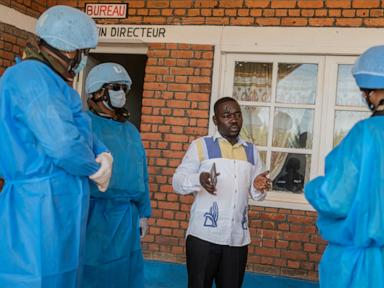
Before the fever, before the blood, before the exhausting politics of international aid, there is the simple, suffocating reality of the yellow biohazard suit. It does not breathe. Within ten minutes of pulling the heavy hood over your head in the equatorial heat of the Democratic Republic of Congo, the sweat has nowhere to go. It pools in your boots. It runs into your eyes, stinging and blinding, but you cannot wipe it away. To touch your face is to court a horrific death. You must simply stand there, drowning in your own fluids, trying to save someone else from drowning in theirs. For a different perspective, check out: this related article.
We hear about outbreaks in numbers. The World Health Organization releases updates detailing hundreds of cases, fatality rates hovering around fifty percent, and the geographical spread across North Kivu or Equateur province. It sounds clinical. It sounds managed.
But the data hides the people holding the line. Similar reporting on this trend has been published by Everyday Health.
Consider a nurse named Alphonse. He is a hypothetical composite of the dozens of local health workers who form the actual spine of the Ebola response, men and women whose real names are often withheld to protect them from community stigma. Alphonse has not been paid in four months. When he goes home at night, if he goes home at all, he has to look at his children and explain why a man who risks his life every day cannot afford to buy cassava flour for dinner.
The international community pours millions of dollars into Ebola responses. Vehicles are bought. Logistics hubs are built. High-level consultants fly into Kinshasa and stay in hotels with reliable air conditioning. Yet, at the actual epicenter, the local laboratory technicians, the grave diggers, and the nurses are working on promises. They are told the funds are delayed in bureaucratic pipelines. They are told to be patient.
Patience is a luxury you do not have when you are staring at a hemorrhagic virus.
The Geography of Exhaustion
The Congolese forest is beautiful, dense, and unforgiving. When Ebola strikes a remote village, the distance is measured not just in kilometers, but in hours of physical torment. Roadways are often nothing more than deeply rutted mud tracks cut through the jungle.
When a notification comes in about a suspected case three villages over, a team must move. They load motorbike trailers with heavy plastic tarps, chlorine sprayers, and personal protective equipment. If it rains, the tracks turn into waist-deep soup. The motorbikes sink. The workers must dismount and push hundreds of pounds of machinery through the mire, already exhausted before they even see a patient.
Why do they do it? It is not for the glory. In many of these villages, the arrival of the Ebola response team is met not with relief, but with terror and hostility.
Imagine living in a community where healthcare has been virtually nonexistent for decades. The clinics are empty shells without aspirin or clean bandages. Then, suddenly, a mysterious illness appears. Days later, strange vehicles arrive filled with people clad in terrifying, alien-looking yellow suits. They take your sick relatives away to a fenced-off enclosure. Often, those relatives never return. The bodies are buried in plastic body bags by strangers, denying the family traditional burial rites.
To the local population, the response team does not look like salvation. It looks like a death squad.
Alphonse understands this anger. He grew up in a similar village. He knows that when a mother screams at him to leave her sick child alone, she is not acting out of ignorance; she is acting out of a fierce, protective love amplified by deep historical distrust. He has to stand in the heat, the sweat blinding him inside his mask, and use his voice—soft, local, using the right dialect—to de-escalate the tension. He has to persuade her to trust him with her child’s life, knowing that if the child dies in the treatment center, he will be blamed for the death.
This is the invisible labor of the outbreak. It is the psychological warfare waged against fear, distrust, and exhaustion, all while wearing a suit that feels like a portable sauna.
The Chemistry of Risk
To understand the sheer terror of a breach in protocol, you have to understand how the virus operates. Ebola is not an airborne threat like influenza, but it is hyper-contagious through bodily fluids. In the advanced stages of the disease, the patient suffers from severe vomiting, diarrhea, and internal and external bleeding. Every surface around them becomes a minefield.
A single droplet of fluid can contain millions of viral particles. If a health worker has a microscopic tear in their glove, or if they accidentally touch their neck while stripping off their wet gear at the end of a twelve-hour shift, the virus finds an entry point.
The process of taking off the protective suit—the "doffing" phase—is the most dangerous part of the day. It requires absolute concentration when the brain is entirely depleted.
- You spray your gloved hands with chlorine.
- You peel back the hood, careful never to let the outer surface touch your skin.
- You step out of the suit, rolling it inside out.
- You spray your boots.
- You wash your hands again.
One slip. One momentary lapse in focus because you are thinking about your hungry children or the patient you just watched die, and you become the next casualty.
The local workers see their colleagues fall. They attend the funerals of the very people they sat next to in the break room the week before. The psychological toll is a heavy, ambient dread that sits on the chest of every doctor, nurse, and cleaner in the zone. They are entirely aware that the line between being the caregiver and being the patient is as thin as a layer of latex.
The Economy of Neglect
But the real problem lies elsewhere, far from the isolation wards and the muddy roads. The deepest systemic failure is economic.
During an outbreak, international agencies arrive with massive budgets, but the distribution of those funds reveals a stark hierarchy. Foreign experts receive hazard pay, comfortable accommodations, and guaranteed medical evacuation plans if they fall ill. The local Congolese staff, who handle the vast majority of direct patient care and community engagement, face a completely different reality.
Their base salaries are meager, often paid months late due to administrative incompetence or corruption within the provincial health systems. Hazard pay—the extra compensation meant to balance the immense risk of working with Ebola—is frequently shaved down, delayed, or withheld entirely under the guise of verification processes.
Consider what happens next: a strike.
It is a desperate, heartbreaking measure. Imagine being a nurse, knowing that patients in the isolation ward need round-the-clock hydration and monitoring, but choosing to walk out because your family is facing eviction. The international media often frames these strikes as a disruption to the medical response, a failure of local cooperation. The narrative shifts the blame onto the victims of the system.
The truth is much simpler. You cannot feed a family with global solidarity. You cannot pay rent with a certificate of appreciation signed by a foreign dignitory.
When the local staff strikes, the response grinds to a halt. Contact tracing stops. Safe burials cease. The virus catches its breath, finds new hosts, and begins to spread rapidly through the markets and neighborhoods once again. The failure to pay a hundred local nurses a few hundred dollars on time can end up costing the global health community tens of millions of dollars in extended emergency response operations. It is a spectacular, tragic loop of short-sightedness.
The Silence of the Ward
Inside the treatment center, the world shrinks. The ambient noise is a mix of low moans, the rhythmic hiss of chlorine sprayers, and the heavy, labored breathing of the staff inside their suits.
The patients are isolated from everything they know. They cannot see the faces of the people treating them; they only see plastic visors and eyes crinkled with exhaustion or pity. For a young child, this environment is a living nightmare. They are surrounded by giants in yellow space suits while their bodies burn with fever.
This is where the clinical data completely fails to capture reality. A standard report might state that a patient was admitted on a Tuesday and succumbed to the illness on a Thursday.
It does not mention how a nurse sat on the edge of that cot for three hours, holding a dying child's hand through two layers of heavy rubber gloves, singing a local lullaby so the child wouldn't have to die surrounded only by the terrifying sounds of a medical isolation unit. It does not record the nurse's silent tears, mixing with the sweat inside the goggles, completely invisible to the outside world.
When the shift ends, the suit comes off. The skin underneath is white, wrinkled, and pruned from hours of being soaked in sweat. The workers sit on wooden benches, drinking rehydration solutions, staring blankly at the dirt floors.
They know they have to do it all again tomorrow. They will return to the ward, breathe in the hot, chemical air, and face the anger of the community and the indifference of the bureaucrats. They will continue to hold the line between a localized crisis and a global catastrophe, waiting for a paycheck that may never arrive, driven forward only by a stubborn, quiet refusal to let their people die in the dark.