The cargo ship sitting off the coast of Mombasa isn’t just carrying grain. It is carrying a gamble.
For three weeks, its hull has bobbed against the horizon, waiting for a clearance stamp that keeps moving behind a screen of shifting regulations. Down in the belly of the vessel, the temperature is rising. If the bureaucratic deadlock lasts another five days, forty tons of wheat will begin to spoil. For the captain, it is an administrative headache. For a logistics manager named Joseph sitting in an office three miles away, it is an ulcer. For thousands of families reliant on the local supply chain, it is the difference between a full plate and an empty evening.
This is what happens when uncertainty is turned into a chess piece.
For decades, the global economy operated under a flawed but predictable set of rules. You built a factory where labor was efficient, bought raw materials where they were cheap, and sold the finished product to whoever had the money. It was cold, mathematical, and remarkably stable.
That stability is gone.
Today, the world is fracturing into competing geopolitical blocs. Washington, Beijing, and Brussels are rewriting the terms of engagement daily, using trade routes, critical minerals, and financial networks as levers of coercion. When these superpowers flex, the shockwaves do not stop at their borders. They ripple outward, crashing hardest against the shores of the Global South. Countries that simply want to trade and grow are being forced to navigate a minefield of conflicting sanctions, sudden export bans, and shifting alliances.
Development used to be a steep hill to climb. Now, the hill itself is moving.
The Ghost in the Boardroom
To understand how abstract geopolitical tension translates into real-world stagnation, you have to look at the math of fear.
Imagine a mid-sized solar energy company based in Nairobi. Let's call the founder Amina. She doesn't care about the cold war over semiconductor supremacy or naval posturing in the South China Sea. She cares about keeping the lights on in rural villages. To expand her operations, she needs a capital injection of five million dollars.
She pitches to an international venture capital firm. The numbers make sense. The demand is undeniable. The local talent is ready.
But the investment committee says no.
They don't say no because Amina’s business model is weak. They say no because they cannot calculate the risk of political fallout five years from now. Will the Chinese-manufactured components Amina relies on face a sudden embargo from Western markets? Will the local currency collapse if the government signs a security pact that triggers international financial restrictions?
When major powers weaponize economic policy, they create a fog that chokes out long-term planning. Investors do not look at this fog and see opportunity; they see a trap. They pull their money back to safer, familiar shores.
This capital flight isn't a statistical abstraction. It is a silent drain. Money that should be building bridges, laying fiber-optic cables, and funding clinics is instead sitting in low-yield bonds in New York or London, hiding from the storm. The Global South is left to pay the price for a conflict it did not start.
The Double-Edged Sword of Neutrality
Many nations across Africa, Latin America, and Southeast Asia are trying to play a delicate game. They call it non-alignment.
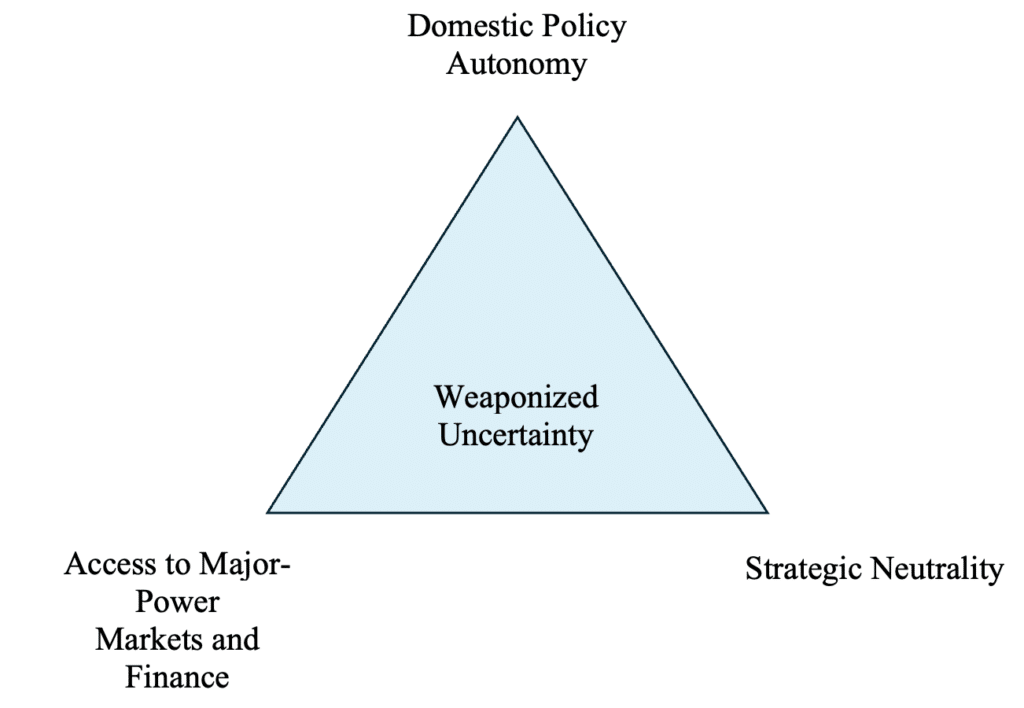
It sounds deeply pragmatic on paper. Why choose a side when you can do business with everyone? Take infrastructure loans from Beijing, buy agricultural technology from the West, and import energy from whoever offers the lowest rate. It is a strategy designed to maximize autonomy.
But neutrality is becoming an expensive luxury.
Consider what happens next when the pressure intensifies. The major blocs are no longer satisfied with passive partners. They are practicing what policy analysts call "friend-shoring"—restricting trade and investment to nations that share explicit ideological or strategic alignments.
If a nation accepts a digital infrastructure package from one superpower, it suddenly finds itself locked out of advanced technology transfers from another. If it votes the wrong way on a United Nations resolution, a critical trade preference agreement disappears overnight under the guise of an administrative review.
This leaves developing economies in a permanent state of whiplash. They are forced to build redundant systems just to keep their options open. They must conform to two entirely different sets of technical standards, two different financial clearing mechanisms, and two different sets of compliance laws.
Efficiency is sacrificed on the altar of geopolitical insulation. Every dollar spent duplicating a supply chain to appease rival superpowers is a dollar that cannot be spent on public education or clean water.
The Cost of the Missing Blueprint
We often talk about economic development as a matter of resources. If a country has oil, copper, or fertile soil, we assume growth is inevitable.
It is a lie. Resources are useless without predictability.
The greatest casualty of this fragmented era is not the flow of goods, but the loss of a shared blueprint. When international institutions like the World Trade Organization are marginalized by unilateral tariffs and national security exceptions, the rule of law is replaced by the rule of the strongest.
For a nation trying to lift its population out of poverty, the lack of an enforceable rulebook is catastrophic. Small and medium-sized economies do not have the leverage to negotiate favorable bilateral deals with economic titans on their own. Without a stable, multilateral framework, they are price-takers in a market dictated by raw power.
The stakes are entirely human. When a supply chain breaks because of a diplomatic spat halfway across the globe, it is the smallholder farmer in Peru who watches their fertilizer prices triple. It is the factory worker in Vietnam who gets laid off because a sudden tariff has made their export market non-viable.
These are not minor market corrections. They are structural fractures that delay progress by a generation.
The View from the Shore
Back on the coast of Mombasa, the sun is beginning to dip below the horizon, casting long, dark shadows across the water.
The cargo ship hasn't moved.
Joseph stands at the window of his office, looking at his phone. A new notification pops up: another regulatory update from a maritime authority thousands of miles away, reacting to a fresh round of trade restrictions. He sighs, rubbing his temples, knowing he will have to spend the night recalculating shipping routes that might change again by morning.
The world’s most powerful capitals view this friction as a necessary cost of doing business in a dangerous age. They measure success in terms of strategic leverage, technological dominance, and spheres of influence.
But out here on the periphery, where the margins of survival are razor-thin, the perspective looks entirely different. There is no glory in the grand chessboard when you are the piece being moved. For the billions of people living in the gaps between the shifting blocs, the weaponization of uncertainty is not a masterstroke of statecraft. It is a slow, quiet theft of their future.