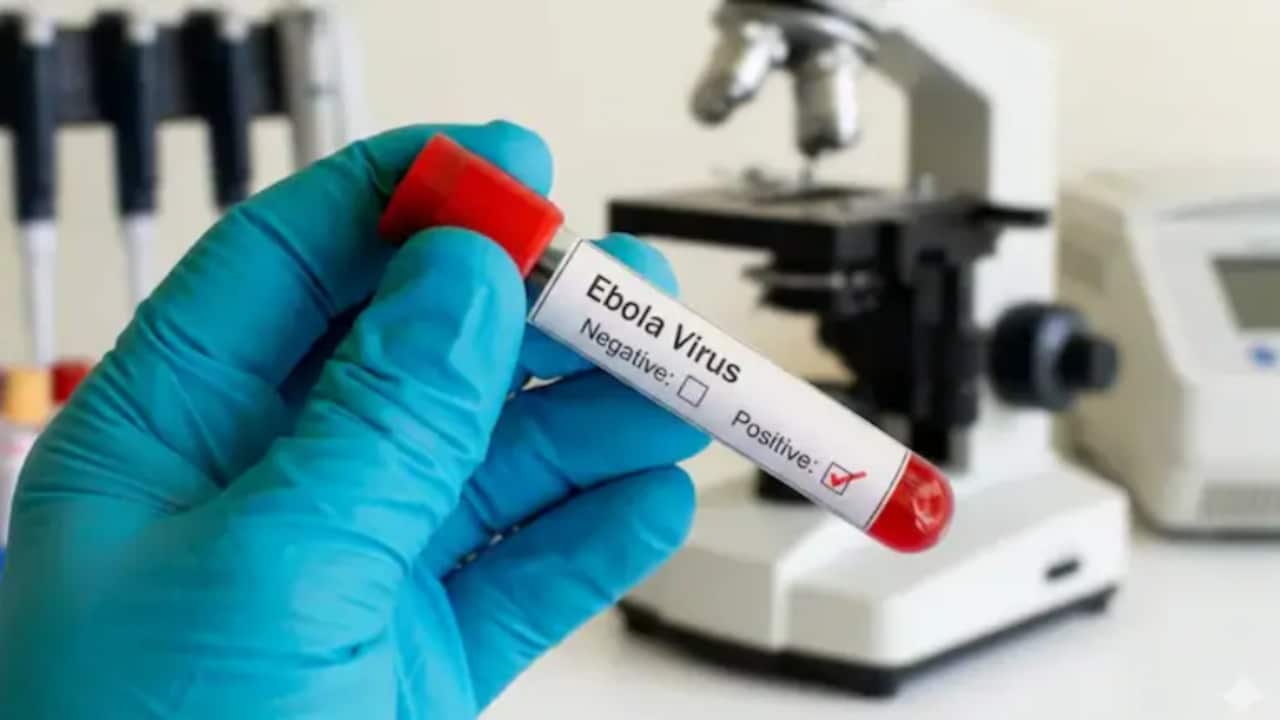
The rain in the eastern forests of the Democratic Republic of Congo does not fall; it heavy-drops, a relentless sheet of water that turns red clay into a thick, suffocating paste. For a health worker navigating the steep terrain outside Beni, the mud is more than an inconvenience. It is a clock ticking backward. Every delayed hour on these washed-out roads allows an invisible, microscopic predator to find another host, another family, another crowded market.
We tend to look at global health crises through the sterile lens of currency and bureaucracy. We read headlines about allocations, response packages, and warnings issued from pristine offices in Geneva. But numbers do not bleed. Numbers do not watch their children slip into a fever so intense it dissolves the body from the inside out.
To understand why a sudden infusion of $38 million from the United States government matters, you have to leave the spreadsheets behind. You have to stand in the humidity of a stabilization center, listening to the plastic rustle of heavy hazmat suits, knowing that the thin membrane of personal protective equipment is the only thing standing between a healthcare worker and a agonizing death.
The World Health Organization recently issued a stark, trembling warning: the current Ebola outbreak threatens to mirror the devastation of the 2014 epidemic. For those who remember that nightmare, the announcement sent a cold shiver through the global medical community.
Fear is a powerful teacher, but humans are terribly forgetful students.
The Anatomy of a Panic
In 2014, the world learned what happens when complacency meets a highly contagious hemorrhagic fever. West Africa became a graveyard. More than 11,000 peoplehttp://googleusercontent.com/image_content/217
died, not just because the virus was lethal, but because the global response was slow, fragmented, and paralyzed by disbelief. By the time international aid mobilized in earnest, the virus had already crept into dense urban centers, turning crowded apartments and public taxis into engines of transmission.
Now, history is attempting to repeat itself in the DRC.
The mechanics of Ebola are brutally efficient. It begins with a deceptive simplicity—a headache, a sore throat, a wave of fatigue that feels like a standard bout of malaria. This is where the trap snaps shut. Because the early symptoms mimic everyday tropical ailments, a patient seeks comfort from their family. They lie in their own bed. Their mother bathes them. Their siblings sit by their side.
By the time the defining characteristics of the disease appear—the vomiting, the diarrhea, the terrifying internal and external bleeding—the circle of infection has already widened.
Consider a hypothetical community health worker named Alphonse. He is not a doctor; he is a local schoolteacher who volunteered to monitor his village. Alphonse possesses no advanced medical degrees, but he owns a digital thermometer and a notebook. When a neighbor falls ill, Alphonse is the first line of defense. If he misdiagnoses the fever as malaria, the village faces catastrophe. If he recognizes it as Ebola, he must convince a terrified, skeptical family to let a burial team in white space-suits take their loved one away, denying them traditional funeral rites that involve washing the body—a sacred ritual that doubles as a super-spreader event.
This is the frontline. It is not fought with silver bullets. It is fought with trust, patience, and absolute exhaustion.
The High Cost of Hotzones
When the United States Agency for International Development (USAID) announces a $38 million surge in funding, it is easy to view it as a political gesture or a drop in the bucket of a trillion-dollar federal budget. But on the ground, that capital undergoes a profound transformation.
It transforms into liters of chlorine disinfectant. It becomes thousands of pairs of nitrile gloves that must be discarded after a single use. It pays for the fuel required to fly experimental vaccines into remote jungle airstrips where commercial planes cannot land.
Without this funding, the logistics of containment collapse.
- The Supply Chain: A single Ebola treatment unit consumes hundreds of gallons of clean water daily just to maintain decontamination zones.
- The Human Resources: Local nurses and burial teams risk their lives daily; without consistent hazard pay, the workforce evaporates.
- The Surveillance Network: Tracking a virus requires contact tracers—individuals who track down every single person an infected patient encountered over a three-week period. This requires motorbikes, satellite phones, and endless hours of dangerous travel.
The international community does not provide this aid out of pure altruism. There is a sharp, pragmatic calculus at play. In an age of global aviation, a virus in a remote Congolese village is less than twenty-four hours away from London, Paris, or New York.
Distance is an illusion.
We learned this painfully in 2014 when cases popped up in Texas and Spain, sparking domestic panics that shut down schools and dominated news cycles for weeks. Spending millions to contain an outbreak at its source is not merely humanitarian; it is self-preservation.
The Friction of Faith and Science
The greatest obstacle to defeating Ebola is never just the biology of the virus. It is the psychology of the survivors.
Imagine living in a region that has endured decades of civil conflict, political neglect, and systemic poverty. Suddenly, an unknown disease begins killing your neighbors. Days later, foreign trucks arrive. Strange people who look like astronauts descend upon your village, erecting plastic fences, isolating your sick relatives, and telling you that your traditional grief rituals are deadly.
Conspiracy theories thrive in the soil of historical trauma. Rumors spread like wildfire: The foreigners brought the virus. The isolation centers are organs-harvesting factories. The vaccine is a curse.
This is where the $38 million must do its most delicate work. A significant portion of these funds does not go toward medical hardware, but toward communication. It funds local radio broadcasts in native languages. It pays for religious leaders—priests, imams, and traditional healers—to be trained in biosafety so they can speak to their congregations with authority and reassurance.
If you cannot win the psychological war, the medical war is lost before it begins. When health workers are viewed with hostility, patients hide. They die at home, in secret, infecting everyone who cares for them. The virus retreats into the shadows, multiplying in the dark until it explodes across a province.
The Horizon of the Unseen
The warning from the World Health Organization is a fire bell ringing in the night. It reminds us that our victory over previous outbreaks was temporary, a fragile truce bought with billions of dollars and hundreds of lost lives.
The current surge in cases is testing the limits of a global health architecture that is already fatigued by years of navigating rolling pandemics and economic instability. The $38 million injection from the US is an acknowledgment that the dam is cracking. Whether it will be enough to reinforce the structure remains an open, terrifying question.
Behind the political grandstanding and the official press releases, the reality remains starkly human. It lives in the quiet, sterile rooms where doctors sweat through four layers of protective gear. It lives in the anxiety of a mother waiting for the lab results of her child’s blood test, knowing that a positive result means she may never touch her child again.
The red clay roads of the DRC are still slick with rain. The motorbikes are still trying to push through the mire, carrying the cold boxes filled with vaccines that must be kept at sub-zero temperatures in places without electricity. The machinery of global health is moving, creaking under the weight of the stakes, trying desperately to outrun the ghost of 2014 before the forest path clears and the virus finds its way to the highway.


