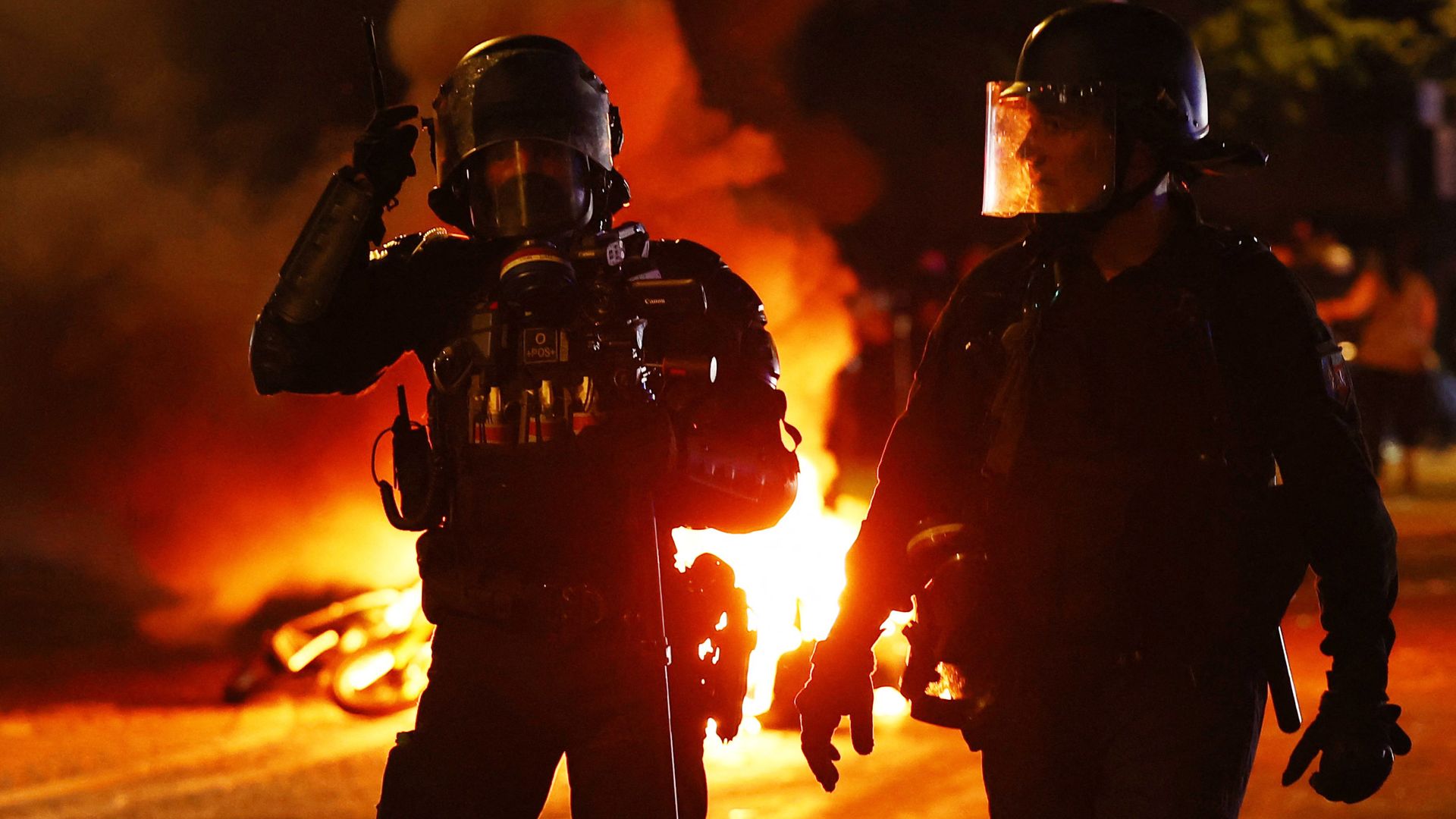
The siren does not wail; it cuts. It starts as a low, mechanical hum in the belly of the 17th arrondissement, then sharpens into a blade of sound that slices through the thick, celebratory smoke of burning red flares.
To understand what happened in France the night Paris Saint-Germain finally lifted the Champions League trophy, you have to understand the smell. It was not the smell of champagne or green grass. It was the acrid, metallic tang of melted plastic trash cans, stale beer pooling on ancient cobblestones, and tear gas. Tear gas tastes like copper and pennies on the back of your tongue. It turns a night of historic athletic triumph into a chaotic, suffocating blur in a matter of seconds.
For decades, French football fans have chased a phantom. The Champions League trophy—the glittering silver cup with the oversized handles—has long been an obsession for Paris, a city that treats football not just as a pastime, but as a reflection of its geopolitical ego. When the final whistle blew in Budapest, securing PSG’s victory over Arsenal, a dam broke. But water doesn't just irrigate when a dam breaks. It floods. It destroys.
The Two Cities Inside the Stadium Gates
Consider a hypothetical fan. Let’s call him Lucas. Lucas is twenty-four, lives in the northern suburb of Saint-Denis, and wears an authentic jersey that cost him a week’s worth of groceries. For ninety minutes, Lucas was not a gig worker or a face in the crowd of France's fractured economy. He was a titan. Every strike from the pitch in Budapest vibrated through his chest via a cracked smartphone screen outside a café near the Place de la République.
When the victory was sealed, Lucas wept. He hugged strangers. This is the beautiful game in its purest, most intoxicating form—a secular religion that can bind a fractured society together, if only for the length of a referee's injury time.
But thirty yards away, another reality was already hardening.
As the euphoria peaked, a different energy took over the boulevards. It always does. It is a predictable, almost ritualistic shift that happens in major European cities when massive crowds meet high stakes. The celebration curdled. What began as a chorus of football anthems degenerated into a rhythmic, thudding confrontation between the margins of the city and the state itself.
Windows shattered. The sound of high-end boutique glass breaking is remarkably musical before the reality of looting sets in. By midnight, the Champs-Élysées was no longer a postcard. It was a tactical grid.
The Balance Sheet of a Riot
The cold data provided by the Ministry of the Interior tells a story of mathematical precision, but it strips away the blood. Across France, law enforcement officers arrested hundreds of individuals in the chaotic hours following the match. In Paris alone, the number of detainees climbed rapidly as the night wore on, filling holding cells to capacity with young men still draped in the red and blue colors of their club.
More than 50 police officers were injured in the skirmishes.
Think about that number. Fifty. That is not an abstract statistic; it is fifty individuals who put on heavy body armor as dusk fell, knowing they were stepping into a human meat grinder. It is fifty families waiting for a text message confirming that a spouse, a father, or a daughter was only bruised by a flying cobblestone, not blinded by a commercial firework launched at chest level.
The tactics used by the crowds were not accidental. This was not a collective loss of control, but a weaponization of numbers. Groups of youths, moving with the fluid agility of urban guerillas, used the dense celebration as human shields. They would emerge, launch heavy projectiles—concrete fragments, glass bottles, heavy flares—and dissolve back into the sea of chanting, innocent supporters.
The police responded with what they know best: overwhelming physical containment. Charges. Flashbangs. Cloud after cloud of chemical irritants that drifted into open apartment windows, forcing families who cared nothing for football to cough in their sleep.
Why the Beautiful Game Bleeds
Why does a ball crossing a white line in Hungary cause a car to burn in Lyon?
To blame football is too easy. It is a lazy diagnosis. The sport is merely the catalyst, the one cultural event capable of gathering fifty thousand volatile chemical elements in one space at one time. The underlying friction has been humming beneath the surface of French society for years. It is a tension born of economic stagnation, a deep-seated distrust of authority, and a generation of young people who feel invisible until they hit something.
When Paris Saint-Germain wins, the club’s billionaire ownership validates a massive corporate investment. They bought the best players in the world to achieve this exact moment. But for the people on the street, that victory is a proxy. It is an brief, artificial injection of pride into a life that often lacks it. When the whistle blows and the screen goes dark, the reality of tomorrow morning remains unchanged. The riot is the refusal to let the high die. It is an attempt to prolong the feeling of power, even if that power is purely destructive.
The irony is cruelest for the shopkeepers. On the morning after the match, a woman named Marie—a hypothetical but entirely accurate representation of the city's commercial spine—stood outside her bakery near the Bastille. Her front window was gone, replaced by a jagged frame of teeth-like shards. The specialty cakes she spent the previous afternoon preparing were covered in fine glass dust and soot.
Marie does not hate football. She simply cannot afford the deductible on her insurance policy to fix a window broken by someone celebrating a multi-billion-dollar team's success.
The Hangover in the City of Light
By dawn, the smoke had cleared, chased away by a brisk wind off the Seine. The municipal street sweepers were already out, their green plastic brooms sweeping away the remnants of the night: broken glass, crushed aluminum cans, charred remnants of scooters, and discarded club scarves soaked in beer and tears.
The victory remains in the record books. Paris Saint-Germain are the kings of Europe. The stars on the jerseys are real, and the pride of the true fans who simply watched and cheered from their couches cannot be diminished by the violence on the asphalt.
But the streets remember a different scoreline. They measure the cost in the bruises on an officer’s ribs, the shattered livelihood of a neighborhood baker, and the heavy, lingering smell of gas that stays trapped in the stone arches of the city long after the trophies have been locked away in the trophy room. The celebration is over, but the city is left to sweep up the pieces of a glory that burned far too hot.