The paint under Robert Kuzovkov’s fingernails was probably still fresh when the first bullet tore through his chest.
It was just before ten o'clock on a Monday morning in Biała Podlaska, a quiet Polish town that sits thirty kilometers from the Belarusian border. To his neighbors, he was a 44-year-old Russian immigrant living quietly in exile since 2021. To the internet, and to the authorities in Moscow, he was Semyon Skrepetsky: a satirical hand grenade of a painter whose neo-primitivist art mocked the absolute rulers of his homeland.
He was walking down a pedestrian path near his home when a man stepped out of the morning shadows. No argument. No warning. The gunman fired three times. Kuzovkov hit the asphalt. Then, with the methodical detachment of a worker stamping a passport, the shooter stepped closer and fired twice more into his head and chest.
Five shots. Dead before the echoes cleared.
We often treat political dissidence as a grand, intellectual abstraction. We read about it in clean news columns over morning coffee. We talk about freedom of speech as if it were a legal clause neatly filed away in a European treaty. But for the people who actually pick up the brush or the microphone, dissent is a sensory experience. It smells like turpentine in a cramped apartment. It feels like the cold sweat that breaks out when your phone screen lights up with another anonymous threat at three in the morning.
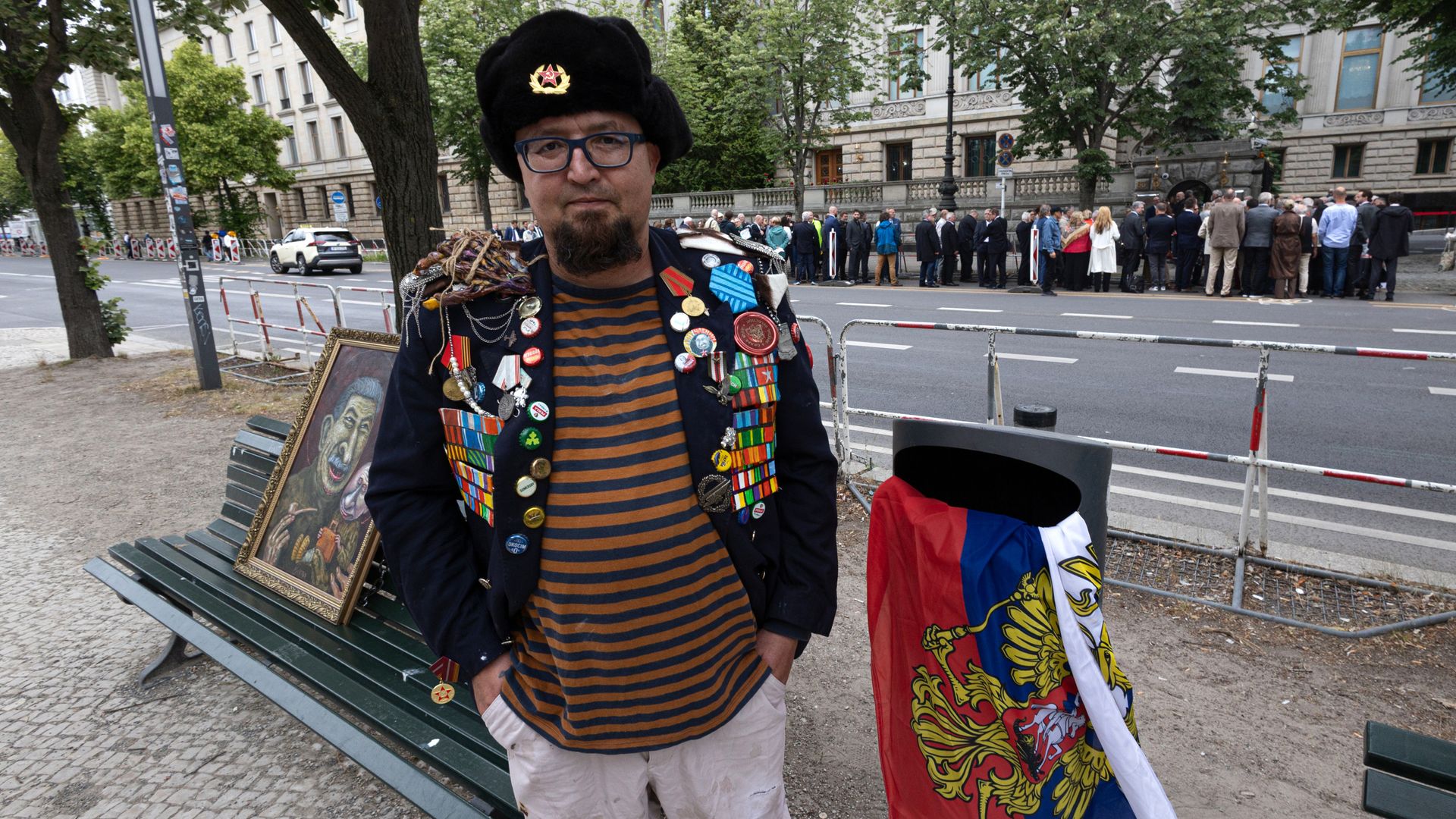
Consider what happened just three days earlier. On June 12, Russia celebrated its national day. While the state media in Moscow broadcasted displays of military might, Kuzovkov stood outside the Russian Embassy in Berlin. He was a polarizing man, often abrasive, but he possessed an undeniable, reckless courage. He held up a painting he had just finished. It was styled like a holy icon, but it depicted Soviet dictator Joseph Stalin cradling an infant Vladimir Putin.
It was a piece of art designed to cut through the noise of state propaganda, to link the present regime directly to the bloodiest ghosts of Russia's past. The images of his protest went viral.
Hours before he walked out into that Polish parking lot on Monday, Kuzovkov logged onto his Telegram channel. He told his followers that the threats had started again. Chechen trolls and loyalists of Ramzan Kadyrov had tracked his IP address. They knew his home. They wanted retribution for the Berlin performance.
He went outside anyway.
Now, Polish investigators are left combing through the physical remnants of a life lived on the run. They have secured surveillance footage, set up roadblocks, and detained two Belarusian citizens near the local consulate. Prosecutors say it is too early to declare a definitive motive. The official state machinery must move slowly, checking every box. But the geography of the crime speaks a language of its own.
Biała Podlaska is not just a random European town. It is a frontier outpost in an ongoing, invisible conflict. For years, Poland has found itself on the front lines of what security experts call hybrid warfare. The border with Belarus is a place of perpetual tension, marked by orchestrated migrant crises, cyberattacks, and sudden acts of sabotage. To live as an exiled dissident in a town like this is to live with a target painted on your back, knowing that the apparatus of the state you fled is lingering just a short drive down the highway.
This is the terror of modern autocracy. It does not stop at national borders. It does not respect the sovereignty of a European Union neighbor. It follows you into the grocery store parking lot. It turns the quiet street where you walk your dog into a firing squad zone.
Pina Picierno, the vice-president of the European Parliament, pointed out that this killing fits into a deeply disturbing, historical pattern of operations targeting the Kremlin's opponents far beyond Russia's borders. It forces a terrifying question onto the Western world: Is anywhere actually safe for those who choose to speak truth to power?
We like to think that when an artist leaves a totalitarian state, the story hits a happy ending. They cross the border, they breathe the air of a democracy, and they are safe. But the reality is far more fragile. Exile is a geographic shift, not an emotional escape. The fear stays. The paranoia becomes a roommate. You look at every passerby on the sidewalk a little longer than you used to. You wonder if the car idling at the curb has been there since yesterday.
To understand why someone would continue to paint under those conditions, you have to understand the sheer weight of the compulsion to create. Kuzovkov did not just target Putin. His caricatures spared no one. He painted Alexander Lukashenko, Kadyrov, and even figures within the Russian opposition like the late Alexei Navalny. His work was messy, loud, and intentionally provocative. He used art as a mirror to show the absurdities and the horrors of the world he left behind.
He knew the risks. He had seen what happened to Anna Politkovskaya. He knew about the poisonings in Salisbury and the mysterious falls from hotel windows. He knew the cost of a paintbrush in his line of work could be exacted in lead.
The police operations will continue for weeks. The forensics teams will analyze the bullet casings. The politicians will issue statements about European security and democratic values. But back in that apartment in Biała Podlaska, the easel still stands, surrounded by tubes of acrylics and the sharp smell of oil thinner.
A human being is gone, reduced to a collection of entry and exit wounds in a coroner's report. What remains is the terrible silence of an interrupted life, and the stark reminder that the ultimate price for a few strokes of satire is still paid in blood on the streets of Europe.