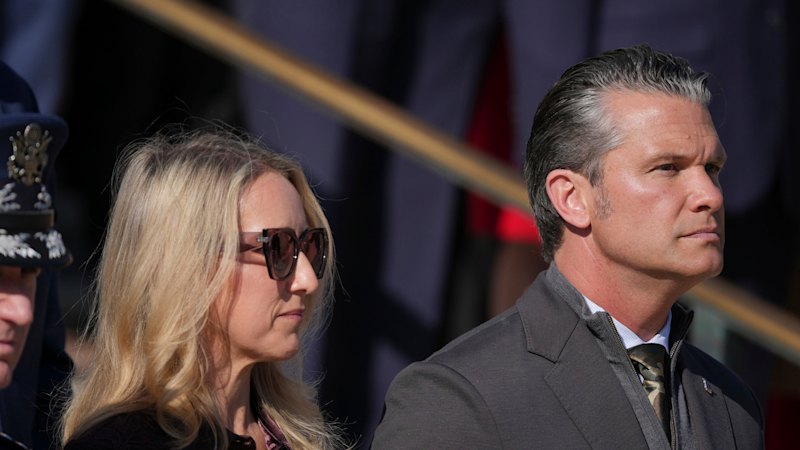
Ceremonial protocol at Arlington National Cemetery operates as a strict command-and-control system where military guard authority supersedes civilian political rank inside the acoustic perimeter. When a Tomb Guard issues a verbal command for silence toward a group accompanying Secretary of Defense Pete Hegseth, the interaction is not an interpersonal dispute or a partisan media event; it is the predictable execution of standard operating procedures designed to preserve absolute institutional reverence.
Standard coverage of such incidents reduces a complex operational enforcement mechanism into viral spectacle. By stripping away political framing and analyzing the event through institutional design, acoustic physics, and chain-of-command friction, the incident exposes the exact mechanics governing how the 3d U.S. Infantry Regiment (The Old Guard) maintains operational control over high-profile VIP delegations.
The Institutional Architecture of Tomb Guard Authority
The Tomb of the Unknown Soldier is governed by a specialized regulatory framework rooted in federal law and military tradition. Under 32 CFR Part 553, Arlington National Cemetery enforces strict behavioral standards to prevent conduct that detracts from the dignity of the grounds. Within this framework, the Sentinels of the 3d U.S. Infantry Regiment operate under delegated command authority that temporarily overrides standard military and civilian deference protocols.
Normally, enlisted personnel—typically Specialists, Corporals, and Sergeants—render immediate deference to the Secretary of Defense, who sits at the top of the Department of Defense chain of command directly beneath the President. However, while posted on the mat at the Tomb of the Unknown Soldier, a Sentinel is on active guard duty protecting a national shrine. Under the Uniform Code of Military Justice (UCMJ) and historical guard orders, a sentinel on post holds supreme operational authority over their immediate sector regarding security and decorum, regardless of the rank or civilian office of the individuals present.
This creates a deliberate structural inversion:
- Standard Command Hierarchy: Secretary of Defense $
Protocol Enforcement and Reputational Risk at Arlington National Cemetery
news
Ceremonial protocol at Arlington National Cemetery operates on a zero-tolerance enforcement model where institutional authority supersedes political rank. When a Tomb Sentinel issues a verbal challenge to a high-profile delegation—such as the reported reprimand directed at Pete Hegseth’s group for audible laughter near the Tomb of the Unknown Soldier—the event is rarely a mere etiquette lapse. Instead, it represents a collision between two distinct operational systems: the rigid, depersonalized execution of military sacredness and the informal, media-centric dynamics of modern political actors. Understanding this friction requires analyzing the mechanics of Sentinel enforcement, the asymmetry of political optics, and the structural vulnerabilities that arise when high-visibility figures enter strictly controlled ceremonial environments.
The Mechanics of Tomb Sentinel Enforcement
The 3d U.S. Infantry Regiment (The Old Guard) maintains continuous guard over the Tomb of the Unknown Soldier through a strict set of standard operating procedures (SOPs) designed to eliminate ambiguity. Unlike civilian security details or standard military police, Tomb Sentinels operate under an absolute mandate to preserve an atmosphere of silence and dignity. This operational framework relies on three specific mechanisms:
- Rank-Neutral Jurisdiction: Within the plaza of the Tomb, the Sentinel’s authority is absolute regarding conduct and decorum. Military rank, political appointment, and VIP status confer zero immunity from correction. The system is engineered to prevent deference to authority from eroding the sanctity of the site.
- Escalation Protocols: Verbal interventions by Sentinels follow a calibrated progression. The initial step involves halting the ceremonial march, executing a sharp facing movement toward the source of the disruption, and delivering a loud, standardized command—typically "Silence" or "It is requested that all visitors maintain an atmosphere of silence and respect." This public correction functions as an immediate behavioral reset, utilizing social pressure and acoustic sharpness to restore order without physical intervention.
- Behavioral Standardization: Every movement of a Sentinel—the 21-step march, the 21-second pause, the weapon transfer—is predictable. Any external noise or movement outside the established perimeter introduces variance into a zero-variance environment. From an operational standpoint, laughter from an entourage is categorized identically to a tourist dropping a metal barrier: both are unauthorized acoustic intrusions that degrade the mission parameter.
The reported reprimand of Hegseth’s group demonstrates the reliability of this system. When an entourage transitions from a political or media environment into the Tomb plaza without undergoing a behavioral recalibration, the Sentinel’s SOP acts as an automated circuit breaker.
Optical Asymmetry in Ceremonial Environments
For public figures, particularly those positioned within defense policy, veterans' affairs, or conservative media ecosystems, appearances at Arlington National Cemetery carry high symbolic value alongside severe downside risk. This dynamic is governed by optical asymmetry: the potential reputational upside of a routine respectful visit is marginal, whereas the reputational cost of a public protocol violation is disproportionately large.
In political communications, presence at a national monument is typically used to signal alignment with institutional values—duty, sacrifice, and reverence. However, because the baseline expectation for any visitor at the Tomb of the Unknown Soldier is complete silence and solemnity, meeting that standard generates zero earned media advantage. It is the expected minimum.
Conversely, a breach of decorum creates an immediate narrative contradiction. When a figure whose public brand relies on military advocacy or institutional respect is associated with a disruption at a war memorial, the resulting friction is easily weaponized by critics. The mechanism driving this damage is visual and auditory contrast:
- The Institutional Anchor: The Tomb Sentinel represents apolitical, self-sacrificing discipline.
- The Political Entourage: An accompanying group laughing or conversing represents casualness, entitlement, or a lack of situational awareness.
Even if the principal figure was not the individual laughing, proximity dictates attribution. In media ecosystems, an entourage functions as an extension of the principal. A Sentinel’s public rebuke does not distinguish between the primary figure and an aide or guest; the acoustic correction envelops the entire party, creating a unified media artifact that frames the principal as disrespectful.
Entourage Dynamics and Situational Blindness
Why do experienced political operators, veterans, and media figures repeatedly fail to manage basic decorum in high-stakes ceremonial zones? The failure is rarely rooted in deliberate malice; rather, it stems from structural flaws in how VIP movements are managed.
The Bubble Effect of Escorted Transit
High-profile delegations move through public spaces inside an insulated operational bubble. Escorts, security personnel, and staffers manage logistics, clear pathways, and maintain conversational momentum to keep the principal briefed and engaged. This creates a localized social environment where normal public cues are muted. Members of an entourage are frequently focused inward—on the principal, on upcoming talking points, or on capturing content for social media—rather than outward on the environmental rules of the venue they are entering.
Transition Friction
Arlington National Cemetery is a vast, multi-use operational facility. Visitors and delegations transition rapidly from administrative zones, parking areas, or active burial sections into the hyper-regulated space of the Memorial Amphitheater and the Tomb plaza. Without a dedicated "hard stop" briefing prior to crossing the threshold into the plaza, the conversational tone of a transit vehicle or a casual walk carries over into the silent zone.
The Principal-Agent Problem in Staff Management
A principal relies on advance teams and staffers to enforce environmental compliance. However, junior staffers or invited guests often lack the authority or situational awareness to police the behavior of peers within the group. If an advance lead fails to explicitly establish a zero-talking rule before approaching the plaza, nobody within the group assumes the role of internal enforcer. Consequently, enforcement is outsourced to the Tomb Sentinel, resulting in a public reprimand rather than a private correction.
Media Amplification and Narrative Framing
Once a Sentinel issues a verbal correction to a recognizable figure’s group, the event transitions from an internal protocol enforcement action to an external media narrative. The velocity and reach of this narrative depend on three variables:
- Brand Irony: The wider the gap between a subject's stated values (e.g., reverence for military tradition) and their perceived behavior (e.g., laughing at a war memorial), the higher the engagement metrics on social platforms. Algorithms reward perceived hypocrisy because it triggers rapid emotional reactions from both detractors and defenders.
- Verification Ambiguity: In incidents occurring in public spaces without continuous broadcast audio, initial reports often rely on eyewitness accounts, bystander video, or brief pool reports. This creates an information vacuum where the exact offender within the group may remain unidentified. Critics attribute the infraction directly to the principal, while defenders argue the principal was uninvolved or that the event was exaggerated. Both responses amplify the core story, extending its shelf life in the news cycle.
- Institutional Credibility: The Old Guard possesses near-universal public trust. Unlike disputes between political figures and journalists—where partisans can dismiss criticism as media bias—a rebuke from a Tomb Sentinel cannot be easily attacked without incurring severe public backlash. Attempting to criticize the Sentinel or downplay the sanctity of the Tomb is politically untenable, leaving the affected party with almost no viable counter-offensive options.
Limitations of Crisis Mitigation
When a ceremonial protocol breach occurs, standard political crisis communications strategies fail. Attempting to spin, contextualize, or deflect a Tomb Sentinel’s rebuke typically compounds the reputational damage.
- Denial is Counterproductive: Because Tomb plaza operations are heavily observed by tourists, cemetery staff, and often press pools, outright denial invites the release of corroborating bystander footage.
- Justification Reads as Entitlement: Explaining that the laughter was unrelated to the Tomb, or that it involved a private joke among staffers, fails to address the core violation. The rule at the Tomb is not "do not laugh at the dead"; the rule is absolute acoustic silence regardless of intent. Offering context demonstrates a fundamental misunderstanding of the venue's operational rules.
- Counter-Attacking is Disqualifying: Any attempt to frame the Sentinel's reaction as overzealous immediately alienates veteran demographics and institutionalists, destroying the exact brand equity the visit was intended to build.
The only viable mitigation is immediate, unqualified deference to the institution—acknowledging the strict standards of the Tomb, affirming respect for the Sentinels, and eliminating any public debate over the incident.
Operational Protocol for High-Visibility Delegations
To prevent ceremonial friction and eliminate the reputational risks associated with public protocol corrections, communications directors and advance teams must treat high-security memorial sites as hostile optical environments requiring strict operational controls.
- Implement a Mandatory Holding Buffer: Advance teams must establish a physical pause point at least 100 meters outside any silent ceremonial perimeter. Before crossing this threshold, the advance lead must execute a mandatory, explicit briefing to every member of the delegation—including principals, security, guests, and photographers—mandating zero conversation, muted devices, and strict visual focus.
- Decouple Entourage Size from Ceremonial Access: Reduce the footprint of the delegation entering the immediate plaza to the absolute minimum required for the event. Every additional staffer or guest increases the statistical probability of an acoustic infraction or a spatial boundary violation. Non-essential personnel must remain in designated holding areas outside the plaza.
- Assign an Internal Compliance Officer: Designate a single senior staff member whose sole responsibility during the transit through the ceremonial zone is monitoring the behavior of the entourage. This individual must have explicit authority from the principal to immediately silence or remove any guest or staffer who breaches decorum before a Sentinel is forced to intervene.
- Eliminate Real-Time Content Capture: Prohibit internal staff and guests from using smartphones to capture casual photos or video within the plaza. Rely exclusively on official pool photographers or cemetery media assets. Removing personal devices eliminates the casual, distracted posture that consistently triggers informal chatter and spatial drift among VIP groups.