Silence.
That is the thing nobody tells you about the control room when a billion-dollar machine is hurtling toward a mountain of loose rubble at fourteen thousand miles per hour. You expect cheering, or at least the frantic shouting of Hollywood movies, yet on September 26, 2022, inside the Johns Hopkins Applied Physics Laboratory in Laurel, Maryland, the air was so thick you could practically chew it. You might also find this connected coverage useful: The Man Who Built the Machine (And the Rebellion to Bring Him Back).
I remember watching the live feed from my cramped apartment kitchen, a mug of cold coffee sweating against my palm, transfixed by a grainy, black-and-white image updating once every second. On that screen, a tiny, egg-shaped moonlet named Dimorphos grew from a smudge of pixels into a jagged, terrifyingly real landscape of boulders and dust. Then, the signal went red. The screen froze. Humanity had just intentionally crashed a spacecraft—NASA’s Double Asteroid Redirection Test, or DART—into an asteroid, and for the first time in the four-and-a-half-billion-year history of our solar system, a species had deliberately altered the orbit of a celestial body.
We celebrated. We toasted to our own cleverness. We told ourselves that the dinosaurs went extinct because they didn't have a space program, and we did. As extensively documented in latest articles by MIT Technology Review, the implications are significant.
Except there was a catch. A massive, blind-spot-sized catch.
When you throw a pebble at a pile of sand in your backyard, you don't truly understand what happened until you walk over, kneel down, and look closely at the crater. From Earth, using ground-based telescopes, astronomers could measure that Dimorphos’s twelve-hour orbit around its larger parent asteroid, Didymos, had shrunk by thirty-three minutes. That was huge—far exceeding the seventy-three seconds NASA had set as its minimum threshold for success. Yet from nearly seven million miles away, Dimorphos was still just a single point of light. We had no idea if we had left a neat, circular dent, blown off a massive chunk of the moonlet, or rearranged its entire shape like a squished stress ball.
Enter Hera.
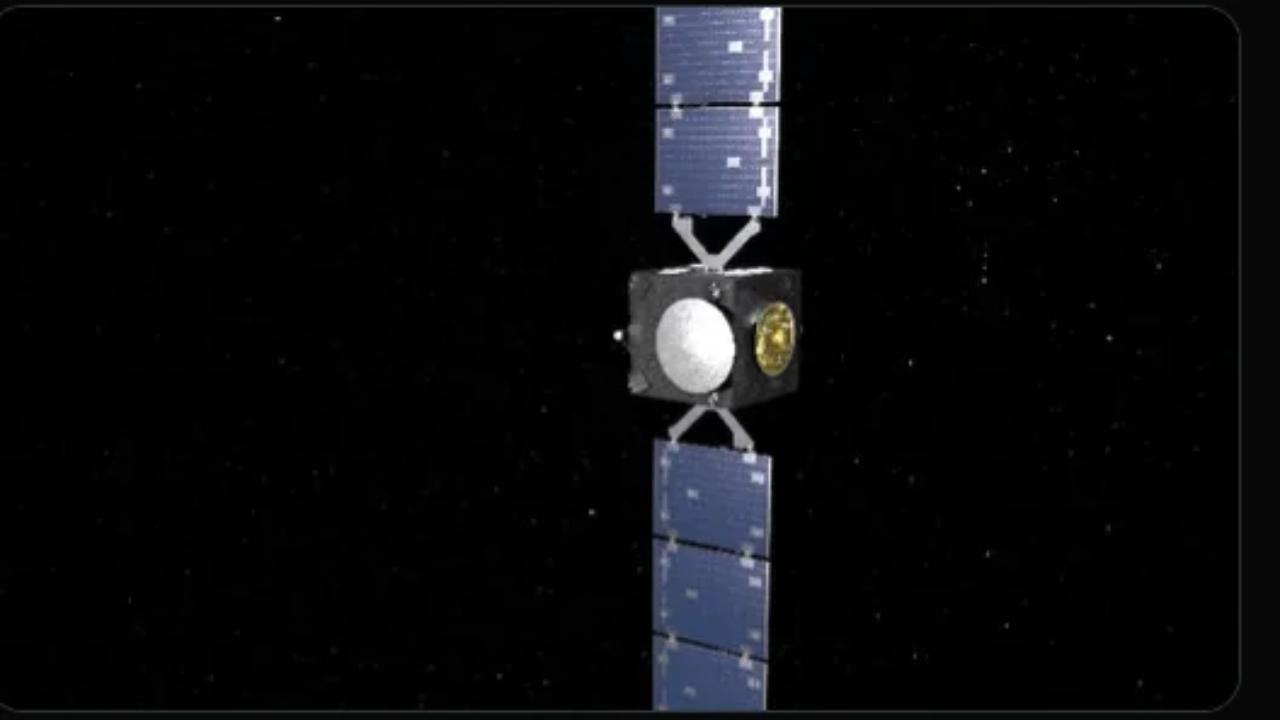
In late 2026, after a two-year journey across the black void, the European Space Agency’s Hera spacecraft finally arrived at the scene of the cosmic crime. If DART was the blindfolded boxer throwing a haymaker in the dark, Hera is the forensic investigator arriving with a magnifying glass, a tape measure, and a high-resolution camera to inspect the bruise.
The Invisible Lottery We Play Every Night
To understand why a European probe poking around a harmless, five-hundred-foot rock matters to your Tuesday morning commute, you have to reckon with an uncomfortable truth about where we live. We inhabit a cosmic shooting gallery.
Consider a hypothetical scenario. Picture Elena, a civil engineer living in a coastal city—say, Lisbon or Seattle—waking up to a push notification on her phone at 6:15 AM. The alert isn't about traffic or weather. It’s a dry, bureaucratic bulletin from an international planetary defense network: astronomers have tracked a newly discovered object, roughly the size of the Great Pyramid of Giza, on a trajectory that intersects Earth's orbit in seven years. Not a planet-killer. It won't boil the oceans or blot out the sun. Instead, it is what scientists call a "city-killer"—an object capable of unleashing the energy of hundreds of nuclear warheads, flattening a metropolitan area and triggering regional tsunamis.
Elena’s mortgage, her daughter’s school district, the bridge she spent three years designing—suddenly, every mundane anchor of human civilization hangs on a single mathematical variable: porosity.
That is not a metaphor. It is the literal nightmare keeping planetary defense scientists awake at night.
When NASA slammed the 1,260-pound DART spacecraft into Dimorphos in 2022, the impact was a kinetic push. Think of a game of cosmic billiards, except the cue ball is a vending-machine-sized probe and the eight-ball is a five-million-ton pile of gravel held together by gravity so weak you could jump off its surface and never come back. When DART hit, it didn't just transfer its own momentum; it blasted more than two million pounds of rocky debris—what physicists call ejecta—outward into space. That spray of rocks acted like a giant rocket engine firing in reverse, giving Dimorphos an extra shove.
Here is the problem. Without knowing the exact mass, density, and internal structure of Dimorphos, scientists cannot calculate the precise efficiency of that push. If an asteroid is a solid iron bowling ball, hitting it with a spacecraft produces one result. If it is a fluffy, loosely bound rubble pile—more like a cosmic beanbag chair—it absorbs the energy differently, squishing and scattering debris in ways that are notoriously hard to model on a supercomputer.
If Elena’s hypothetical city-killer ever shows up on a telescope, world leaders won't have the luxury of guessing whether they are aiming at a bowling ball or a beanbag chair. Shoot too hard, and you risk shattering the asteroid into a shotgun blast of smaller, equally lethal fragments. Shoot too softly, and you merely nudge the impact zone from the middle of the Atlantic Ocean directly onto a populated coastline.
A Crime Scene Seven Million Miles Away
Before Hera’s arrival, the entire field of asteroid deflection rested on a single data point observed through the blurry lens of Earth’s atmosphere. We knew the before—captured in the final, frantic seconds of DART’s onboard camera—and we knew the after orbital speed. Everything in between was educated guesswork.
Hera was built to erase that guesswork.
Roughly the size of a compact car, the European spacecraft didn't travel alone. Tucked inside its cargo bay were two tiny companions, CubeSats no larger than shoeboxes, named Milani and Juventas. Think of Hera as the mothership hovering safely a few miles above the asteroids, while Milani and Juventas act like fearless scout drones, daring to fly dangerously close to the jagged, spinning debris field—and eventually, touching down on the surface itself.
This is where the engineering turns genuinely breathtaking. Navigating around a pair of tiny asteroids is an exercise in extreme delicacy. Gravity out there is whisper-thin; a sneeze could alter a spacecraft’s trajectory. Hera relies on autonomous navigation systems—essentially teaching the probe to recognize boulders and craters on its own, much like how you navigate a dark bedroom using the faint glow of a hallway light, without waiting twenty minutes for radio commands to travel back and forth from mission control in Darmstadt, Germany.
Once in position, Hera’s suite of instruments goes to work like a medical team performing a full-body scan:
- The Visuals: High-resolution cameras map the surface down to a few inches, looking for the exact scar left by DART. Did the impact leave a crisp crater, or did the entire asteroid deform like a drop of water?
- The Chemistry: Milani’s hyperspectral imager sniffs out the mineral composition of the dust, confirming whether Dimorphos and its larger partner, Didymos, were born from the same parent body or forged in separate corners of the early solar system.
- The Interior: Juventas carries the smallest radar system ever flown in space. By beaming low-frequency radio waves straight through Dimorphos, it performs the first-ever internal ultrasound of an asteroid, revealing whether the inside is solid rock, packed gravel, or hollow voids.
Perhaps most crucially, Hera will measure the exact mass of Dimorphos by feeling the tiny gravitational tug the moonlet exerts on the spacecraft as it flies past. Once you know the mass, you know the density. Once you know the density, the math of DART’s 2022 collision suddenly snaps into sharp, undeniable focus.
The Humble Art of Cosmic Humility
It is easy to look at missions like DART and Hera through the lens of human bravado—a triumphant tale of primates conquering the heavens with calculus and rocket fuel. Yet when you talk to the engineers who actually build these machines, you rarely hear chest-thumping. You hear vulnerability. You hear people acutely aware of how fragile our place in the universe truly is.
"We are essentially trying to hit a bullet with another bullet, in the dark, using equations we've never tested in the real world," one trajectory designer confessed to me years ago, rubbing tired eyes after a twelve-hour simulation shift. "Every time we run the models, nature finds a way to surprise us."
History backs him up. In February 2013, a sixty-foot asteroid—barely the size of a six-story building—slipped completely undetected past every telescope on Earth, approaching from the blind spot of the rising sun. It exploded over Chelyabinsk, Russia, with the force of roughly thirty Hiroshima bombs. The shockwave shattered windows across six cities, collapsed factory roofs, and sent over a thousand people to hospitals, mostly with gashes from flying glass. Nobody saw it coming. Not one alarm sounded.
Chelyabinsk was a whisper compared to the Tunguska event of 1908, when a larger space rock flattened eighty million trees across eight hundred square miles of Siberian forest. Had that object arrived four hours later, Earth’s rotation would have placed Saint Petersburg directly beneath the blast.
We like to think of extinction and catastrophe as ancient history, trapped safely behind museum glass next to fossilized ferns and tyrannosaur skulls. We forget that the crater in Mexico’s Yucatán Peninsula—the scar left by the six-mile-wide asteroid that ended the Cretaceous period—is still there, buried beneath limestone and turquoise water. The universe has not signed a peace treaty with us. It simply operates on a clock where centuries are blinks and millennia are breaths.
Turning a Blind Experiment into a Blueprint
What makes the partnership between NASA’s DART and ESA’s Hera so profound is not the hardware itself, though the engineering is extraordinary. It is the shift in human psychology that these two missions represent.
For the vast majority of our existence, humanity stared up at streaks of light in the night sky and saw omens—portents of war, famine, or the wrath of angry gods. We were passive observers, helpless passengers clinging to a spinning blue marble hurtling through the dark. Even after we learned the physics of orbits, asteroids remained an abstract threat, something for disaster movies starring Bruce Willis and oversized oil drills.
DART proved we could throw a punch. Hera ensures we know how to aim.
By combining NASA’s kinetic impact data with ESA’s forensic measurements, scientists are transforming a one-off stunt into a repeatable, mathematical blueprint. If a dangerous asteroid is spotted ten or twenty years out—which is why simultaneous investments in infrared space telescopes like NASA’s NEO Surveyor are just as vital—planetary defenders will finally have a calibrated playbook. They will be able to plug in an asteroid’s size, spin rate, and spectral signature, consult the Hera-verified equations, and build a deflection mission with predictable results rather than crossed fingers.
It is an unglamorous, patient kind of heroism. There are no flags planted on Dimorphos. There are no astronauts beaming smiling portraits back to Earth. Just a quiet European robot circling a dusty, potato-shaped rock millions of miles away, meticulously counting boulders and measuring tiny shifts in gravity so that a future generation might never have to experience Elena’s terrifying 6:15 AM push notification.
Tonight, if you step outside away from the glare of streetlights and look up at the constellation Taurus, you won't be able to see Didymos or Dimorphos. They are far too faint for the naked eye, lost in the velvet dark between stars. Yet out there in that cold silence, a machine built by human hands is carefully tracing the edges of a wound we made four years ago—proving that for the first time since life crawled out of Earth’s ancient oceans, the creatures looking up at the sky are finally learning how to look out for themselves.