Conventional wisdom in Washington suggests that Democratic gains in the United States midterm elections have fatally wounded any chance of renewed nuclear diplomacy with North Korea. The standard narrative argues that a fractured American government leaves Kim Jong Un without a strong negotiating partner, forcing Pyongyang into a defensive crouch. That reading is backward. North Korea is not retreating because summit hopes are dead; Pyongyang is actively leveraging American domestic gridlock to buy time, expand its tactical nuclear arsenal, and cement a geopolitical alliance with Moscow that renders Washington’s partisan shifts largely irrelevant.
For decades, analysts have treated the Korean Peninsula like a pendulum that swings solely based on who occupies the Oval Office or controls the House of Representatives. When Republicans hold power, the expectation leans toward maximum pressure or high-stakes personal diplomacy. When Democrats gain ground, the assumption shifts to strategic patience, strict human rights scrutiny, and multilateral sanctions enforcement. If you found value in this article, you might want to read: this related article.
Pyongyang understands this cycle better than most Capitol Hill staffers. And right now, a gridlocked Washington is the exact environment Kim Jong Un needs.
The Myth of the Missed Summit
To understand why North Korea is digging in, you have to discard the romanticized notion that Pyongyang is waiting around for another Singapore or Hanoi. Those summits were exploratory probes designed to test whether an American president would trade major sanctions relief for partial, reversible freezes at the Yongbyon nuclear complex. When that gambit failed in 2019, North Korea rewrote its entire strategic doctrine. For another look on this development, refer to the recent update from TIME.
A divided U.S. Congress after the midterms does not frustrate Kim's plans. It validates them.
With Democrats holding leverage on oversight committees and foreign policy appropriations, any hypothetical White House attempt to offer rapid sanctions relief without verifiable, irreversible denuclearization faces an immediate legislative wall. Pyongyang knows this. Rather than mourning a lost diplomatic window, the regime uses the resulting political paralysis in Washington as domestic propaganda and diplomatic cover. They can point to American internal dysfunction as proof that the United States cannot be trusted to honor long-term security guarantees, no matter who sits in the White House.
Consider the mechanics of American treaty ratification and sanctions relief. Even if a president wanted to lift core economic restrictions via executive waiver, those waivers are temporary. A subsequent administration, or a hostile congressional majority, can snap them back into place overnight. From the perspective of the Workers' Party of Korea, trading away hard-won nuclear deterrent capabilities for temporary, reversible American political promises is a sucker's bet.
Sanctions Evasion Through the Moscow Pipeline
The biggest blind spot in mainstream coverage of the US-North Korea standoff is the assumption that Washington still holds the primary economic levers over Pyongyang. That era ended when Russia invaded Ukraine and desperately needed artillery shells, ballistic missiles, and labor.
While pundits in Washington debate how midterm results will affect State Department envoy appointments, North Korea has effectively bypassed the American sanctions regime through a direct, bilateral lifeline with the Kremlin.
This is not a minor black-market operation. It is a state-to-state logistical pipeline. In exchange for millions of rounds of conventional munitions and short-range ballistic missiles sent to the Russian front lines, Pyongyang receives what sanctions were specifically designed to deny it: refined petroleum, hard currency, agricultural commodities, and potentially advanced technical assistance for its satellite and submarine programs.
When you have a permanent member of the United Nations Security Council actively violating the very sanctions it once voted to impose, the composition of the U.S. Congress becomes secondary.
- Financial Insulation: Russian banking channels and barter arrangements shield North Korean state enterprises from the U.S. Treasury Department's traditional dollar-clearing chokeholds.
- Diplomatic Shield: Russia's veto power at the UN ensures that no new punitive resolutions will pass, regardless of how many intercontinental ballistic missiles Pyongyang tests over the Sea of Japan.
- Technological Acceleration: Access to Russian aerospace and propulsion expertise allows North Korean engineers to solve complex technical bottlenecks—like warhead reentry vehicles and solid-fuel rocket motors—in months rather than years.
Washington's partisan shifts do not disrupt this supply chain. Whether a hawkish Republican or a multilateral Democrat chairs the Senate Foreign Relations Committee, neither can unilaterally stop cargo ships crossing the Tumen River or traversing the Sea of Japan between Rajin and Vladivostok.
The Doctrine of Tactical Deterrence
Look closely at what North Korea is actually building, and the absurdity of expecting imminent denuclearization talks becomes obvious. Pyongyang is no longer just building a small, crude arsenal meant to deter an existential invasion by threatening the American homeland. They are mass-producing tactical nuclear weapons designed for actual warfighting on the Korean Peninsula.
In 2022, North Korea codified a new nuclear force policy law that explicitly lowered the threshold for nuclear use. The doctrine authorizes preemptive nuclear strikes if the leadership perceives an imminent threat to its command-and-control structure, even during a conventional conflict.
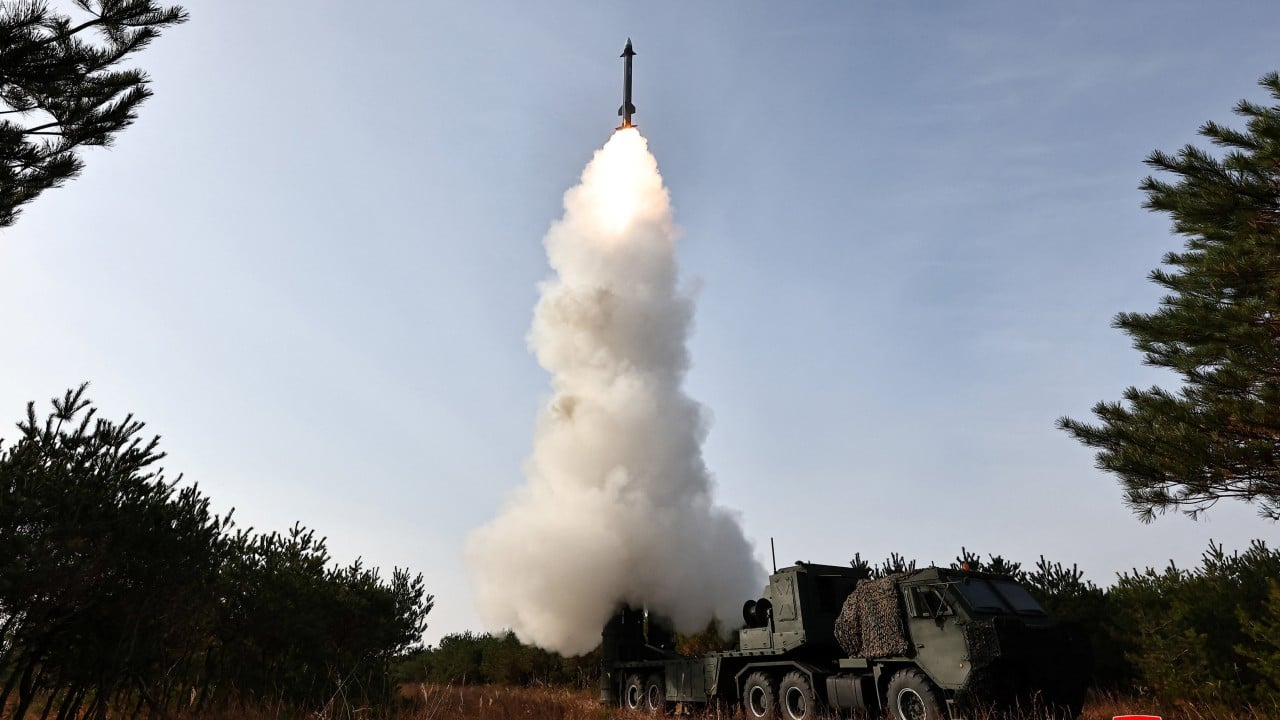
You do not spend billions of dollars developing solid-fuel, road-mobile tactical missiles, nuclear-capable multiple launch rocket systems, and miniaturized warheads just to trade them away at a summit table in exchange for diplomatic recognition. These weapons are integrated into forward-deployed military units. They are the core of North Korea's asymmetrical defense strategy against the vastly superior conventional forces of the South Korean and U.S. militaries.
Democrats gaining ground in the midterms typically signals a renewed emphasis on alliance management, extended deterrence, and joint military exercises with Seoul and Tokyo. Pyongyang anticipates this. By digging in now, conducting aggressive artillery drills near maritime boundaries, and normalizing missile launches, North Korea is establishing a new baseline of operational readiness. They are forcing Washington and Seoul to accept a nuclear-armed North as a permanent geographic reality, much like India or Pakistan, rather than a temporary proliferation crisis to be solved.
The Domestic Calculus in Seoul and Beijing
A Washington distracted by domestic legislative battles also creates friction within the trilateral alliance between the United States, South Korea, and Japan. Pyongyang excels at exploiting these seams.
In South Korea, every flare-up of North Korean aggression intensifies a fierce domestic debate over whether Seoul needs its own independent nuclear deterrent. When Washington appears gridlocked and focused inward following midterm elections, South Korean anxiety spikes. Conservatives in Seoul question whether an American president would truly risk Los Angeles or New York to save Busan or Incheon—the classic Cold War dilemma of extended deterrence.
North Korea feeds this doubt deliberately. Every missile test timed to coincide with American political milestones is a psychological operation aimed at driving a wedge between Seoul and Washington. If South Korea loses faith in the American nuclear umbrella and pursues its own bomb, the global non-proliferation regime collapses, and the US-ROK alliance suffers a potentially fatal blow. That is a strategic victory for Pyongyang that requires zero diplomatic concessions.
Meanwhile, Beijing watches the standoff with calculated patience. China does not want a war on its border, nor does it particularly enjoy Kim Jong Un's unpredictable nuclear tests, which inevitably push Japan and South Korea closer to the American military orbit. However, a North Korea locked in a controlled, chronic standoff with a distracted United States serves Beijing's broader strategic interests. It ties down American intelligence assets, missile defense interceptors, and naval strike groups in Northeast Asia, keeping them away from the Taiwan Strait and the South China Sea.
Beijing has zero incentive to pressure Pyongyang back to the negotiating table while Washington is consumed by post-midterm political warfare. Chinese border trade with North Korea has quietly resumed, providing a steady economic floor that prevents the regime from collapsing while keeping Kim dependent enough on Beijing to avoid total recklessness.
Why Diplomatic Playbooks Are Obsolete
The fundamental flaw in how Western media covers the Korean Peninsula is the assumption that diplomacy is the default state and a standoff is an anomaly. In reality, for the Kim dynasty, the standoff is the policy.
To see how this plays out in practice, consider a hypothetical scenario where a newly empowered Democratic congressional bloc pushes the White House to appoint a high-profile special envoy to restart talks without preconditions. In the 1990s or early 2000s, Pyongyang might have pocketed the diplomatic prestige, attended a few preliminary meetings in Geneva or Beijing, extracted shipments of heavy fuel oil, and stalled for two years before resuming enrichment.
Today, Pyongyang wouldn't even bother taking the meeting unless Washington first agreed to lift all sanctions and permanently halt joint military drills with South Korea—demands no American administration could ever survive politically.
The price of admission has changed because the balance of power has shifted. North Korea survived the maximum pressure campaign, weathered the self-imposed isolation of the COVID-19 pandemic, and emerged on the other side with a booming arms-export business and a nuclear arsenal capable of saturating regional missile defenses.
Washington's internal political battles are merely background noise to a regime that has spent seventy years mastering the art of survival under siege. Treating the midterm elections as a decisive turning point for Korean diplomacy flatters American self-importance while ignoring the hard material realities on the ground. Pyongyang isn't waiting for Washington to get its act together; it is busy building a world where Washington's gridlock no longer matters.