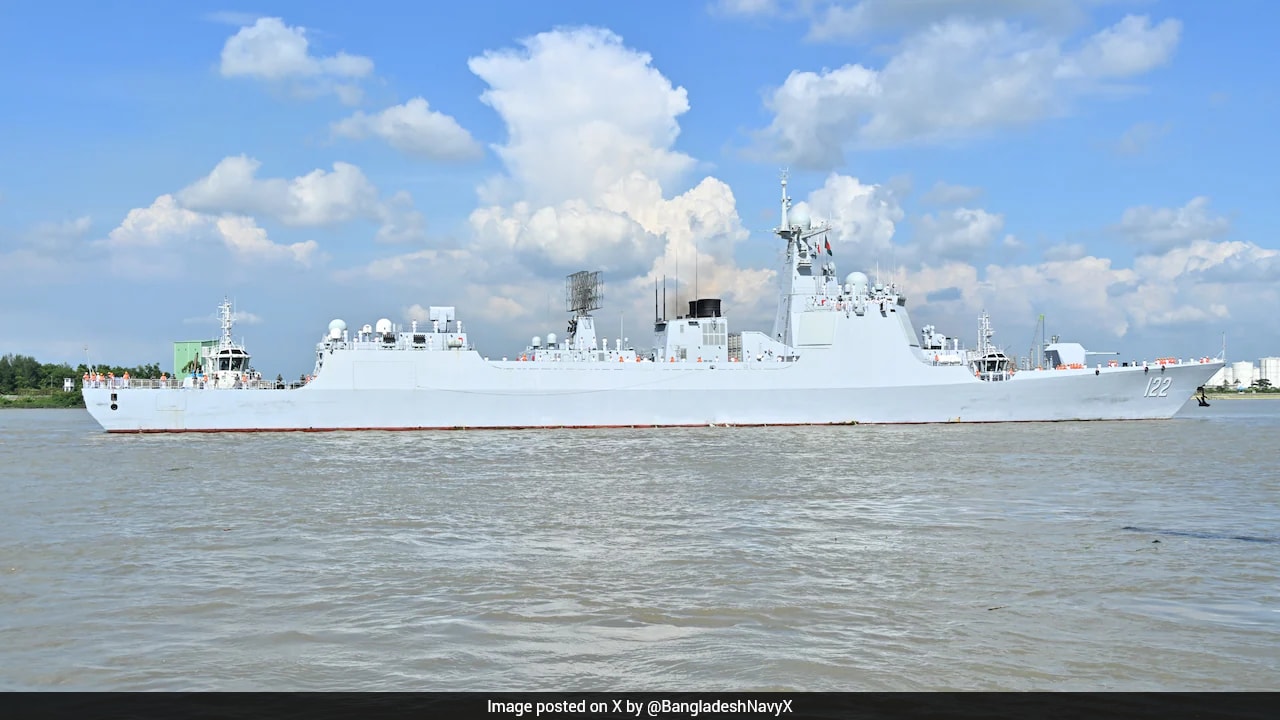
The water at Chittagong does not look like the sea. It looks like liquid earth, heavy with silt swept down from the Himalayas, stained the color of rust and wet brick. Through that thick, opaque broth, three gray shapes materialized just after dawn.
They did not arrive with the thunder of breaking blockades or the sharp, frantic signaling of a disputed frontier. They slipped in with the dull thrum of heavy diesel engines, low and patient. Hull numbers painted in stark white stood out against the weathered steel. Three ships of the Chinese People's Liberation Army Navy had crossed the Bay of Bengal, cutting through the swells of the Indian Ocean to drop anchor on a five-day goodwill mission.
To a satellite overhead, it was a vector of movement. To the harbor pilots guiding them through the congested shipping lanes, it was simply traffic. But to stand on the concrete pier as the morning fog burned off is to understand that steel never travels alone. It carries history. It carries intention. It carries the weight of a changing map.
Consider what happens next: the gangways drop. Ceremonial white uniforms emerge against the soot and salt of a bustling commercial port. Hands shake. Microphones catch the hollow ring of diplomatic pleasantries about mutual respect and regional stability.
Yet the real story is never spoken into a microphone.
(Note: All specific accounts of individual protocol and harbor logistics below are drawn from standard naval reception patterns and historical precedent for port calls of this scale.)
The Architecture of Quiet Influence
Diplomacy rarely smells like parchment anymore. Sometimes, it smells of bunker fuel and hot iron.
When a naval squadron docks in a foreign port, the immediate spectacle is predictable: brass bands playing uneven marches, local dignitaries sweating through formal suits, and young sailors standing at rigid attention along the flight deck, their faces scrubbed clean of the watch's exhaustion. It is theater, beautifully and meticulously choreographed.
Strip away the braid and the speeches, however, and you find a language older than modern states. Ships are mobile pieces of sovereign territory. When they tie up to a pier in Bangladesh, they are broadcasting a simple, persistent message across the maritime commons: We are here. We can reach here. We can stay.
For decades, the waters surrounding South Asia were treated as a singular strategic backyard. Patterns of dominance were worn deep into the seabed by generations of naval patrols, supply lines, and historical alliances. Every port call had a predictable rhythm.
Then the geometry shifted.
China’s naval modernization is no longer a footnote in defense white papers; it is a physical reality displacing water across the globe. A five-day goodwill visit is not merely about exchanging plaques and touring engine rooms. It is about normalization. It is about making the presence of foreign grey hulls in the northern Indian Ocean feel as ordinary as a container ship from Singapore.
The View from the Waterline
Imagine standing on the deck of one of those arriving frigates, looking out over the forest of cranes lining the Chittagong coastline.
The air is thick, saturated with the unique perfume of a delta port—coal dust, fish meal, mangrove mud, and sulfur. For the sailors leaning against the rail, this is the culmination of weeks of rolling swells, salt-crusted optics, and endless blue monotony. They are thousands of miles from home ports in the South China Sea, operating in waters where every movement is scrutinized through binoculars from neighboring capitals.
Down on the pier, dockworkers pause with their lunch pails to stare up at the towering superstructure. A crane operator kills his engine, wiping grease from his forehead with a rag, watching the foreign sailors muster on deck.
What does he see? He does not see abstract geopolitical competition or the shifting balance of power in the Indo-Pacific. He sees massive machines. He sees power that can project itself across oceans, touching a coast that has historically looked elsewhere for its primary partnerships.
This is the invisible stakes of modern maritime strategy. It is won and lost in the quiet spaces between major conflicts. It accumulates slowly, grain by grain, port call by port call, until the extraordinary suddenly feels mundane.
The Long Game of the Sea
Navies are instruments of patience. Armies hold ground; navies shape access.
Bangladesh occupies one of the most strategically coveted pieces of coastline on the planet. Squeezed between the two regional giants of Asia, Dhaka has mastered the art of non-aligned navigation, balancing relationships with New Delhi, Beijing, Washington, and Western capitals with the delicate grace of a tightrope walker in a gale.
Every defense procurement, every joint exercise, every harbor visit is weighed on invisible scales in government offices. When these three Chinese ships arrived, observers in foreign intelligence bureaus immediately began counting hulls, estimating fuel capacities, and analyzing electronic emissions signatures. They were looking for secrets.
They were missing the point. The secret is out in the open.
The secret is that infrastructure dictates destiny. Over the past twenty years, Chinese firms have built roads, bridges, tunnels, and deep-water berths across South Asia. They have dredged channels and modernized logistics nodes. A navy does not operate in a vacuum; it requires a circulatory system of ports, fuel depots, repair facilities, and friendly diplomatic weather.
When a squadron can pull into a Bangladeshi port for five days of refueling, cultural exchanges, and joint drills, it demonstrates that the circulatory system is maturing.
The Human Core Beneath the Steel
It is easy to lose sight of the human scale when talking about defense corridors and maritime chokepoints. We talk about tonnage, missile cells, and sonar ranges as if these things exist in a vacuum of numbers.
Yet, late at night, after the official banquets have ended and the toasts to eternal friendship have grown quiet, the reality is much simpler.
A young Chinese sailor sits on his rack, nursing a cup of lukewarm tea, looking at a small screen where a pixelated video call connects him to a family member thousands of miles away in a Henan village. Half a mile away, a Bangladeshi harbor guard leans against a concrete barrier, smoking a cigarette in the humid dark, watching the anchor lights of the foreign warships rise and fall with the oily swell of the river.
They do not hate each other. They do not know each other. They are simply collateral participants in a vast, systemic realignment of global power that neither of them asked to direct.
They are the ones who will maintain the engines. They are the ones who will paint the hulls when the salt air begins to pit the steel. They are the ones who live with the consequences when the diplomatic weather shifts from cooperative warmth to sudden frost.
The ships will not stay in Chittagong forever. Five days pass quickly in the life of a fleet. Soon, the lines will be cast off, the heavy diesels will roar back to life, and the brown water of the delta will churn as the gray shapes turn their bows toward the open horizon.
They will steam out into the vast, indifferent expanse of the Indian Ocean, leaving behind a slightly modified reality. The water will settle back into its muddy calm. The dockworkers will return to their cranes. But the tracks have been laid, the paths have been tested, and the sea remembers every keel that cuts across its surface.