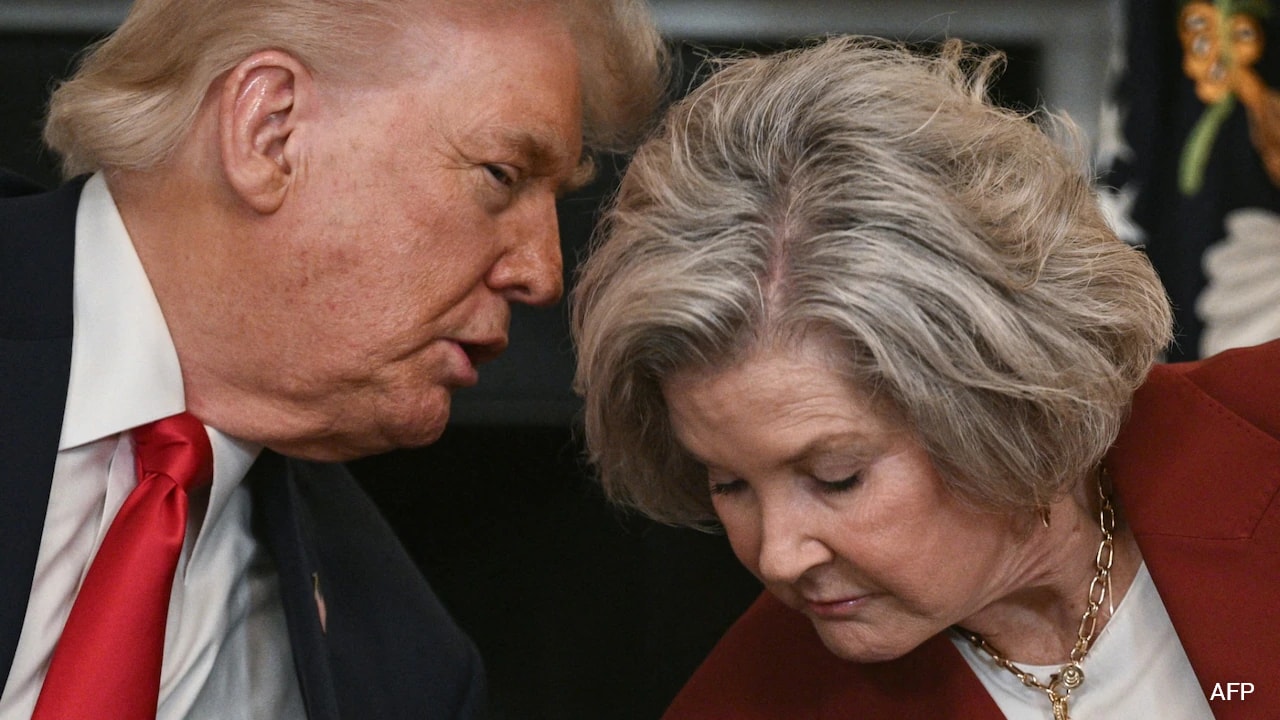
Silence.
In the deafening, permanent carnival of modern American politics, silence is the rarest currency, and Susie Wiles spent four decades hoarding it like gold while everyone else around her screamed into microphones for pennies.
I remember walking the corridors of Washington campaign headquarters during the brutal autumn cycles of the last decade, watching young press secretaries practically vibrate with the need to be quoted, to see their names tucked into a morning newsletter, to feel the brief, intoxicating warmth of proximity to power. You could smell the stale coffee, the desperation, and the cheap cologne of men who thought volume equaled influence. Then there was Wiles. While the loudest voices in Donald Trump’s orbit fought each other on cable news panels for a sliver of his affection, she stood just outside the camera frame, holding a clipboard, watching the doors, managing the storm without ever stepping into the rain.
She was the Ice Maiden. The adult in the room. The disciplined daughter of broadcasting legend Pat Summerall who understood, down to her marrow, that the best way to survive a hurricane is to build the barometer rather than stand on the roof shaking your fist at the clouds.
Yet by late 2026, the woman who engineered one of the most improbable political resurrections in American history—and who became the first female White House Chief of Staff—found herself standing in the cold, staring at the locked gates of the very fortress she had drawn the blueprints for. Accused of leaking to the press. Blamed for the stinging midterm defeats that fractured a fragile governing coalition. Stripped of the quiet authority that had once made her the most feared and respected operator in the West Wing.
How does the person who knows where every body is buried end up in a shallow grave of her own?
To understand the fall of Susie Wiles, you have to understand the fundamental, tragic flaw of being the indispensable fixer in a court built on absolute loyalty and perpetual grievance. You can tame the chaos for a year. You can tame it for four. Eventually, however, the chaos demands a sacrifice, and when the fire runs out of kindling, it burns the architect.
The Architecture of Restraint
Before the whispers of betrayal began echoing through the halls of Mar-a-Lago and the West Wing, Wiles was celebrated for doing what dozens of seasoned operatives had failed to do. She put guardrails on Donald Trump without letting him feel the steel.
Think of a master watchmaker working inside a ticking bomb. Every previous Chief of Staff or campaign manager—Reince Priebus, John Kelly, Mick Mulvaney, Corey Lewandowski—tried to either wrestle the mechanism into submission or wind it faster until the springs snapped. Priebus tried to impose traditional Republican order and lasted six months. Kelly tried military discipline and ended up alienated, trading insults in the press. They all made the fatal mistake of making themselves the story.
Wiles did the opposite. Taking the reins of Trump’s political operation after the wreckage of January 6, when donors had fled and the brand looked toxic, she practiced an art of radical self-erasure. During the 2024 campaign, when Trump invited her to the podium on election night to speak to the roaring crowd in West Palm Beach, she physically stepped back, shaking her head, refusing the microphone. That single gesture told every political veteran watching everything they needed to know. She did not want the spotlight. She wanted the results.
And the results were undeniable. Under her steady, unsentimental hand, the 2024 operation avoided the chaotic staffing purges that had defined 2016 and 2020. She brought in Chris LaCivita as a co-pilot, enforced message discipline where none had existed, and turned a sprawling, erratic movement into a lean, data-driven machine that swept the battleground states. When Trump named her White House Chief of Staff in November 2024, Washington breathed a collective, cautious sigh of relief. Here, finally, was someone who knew how the levers of government actually worked. Someone who had cut her teeth in the Reagan White House, rescued Rick Scott’s long-shot gubernatorial bid in Florida, and salvaged Ron DeSantis’s flailing 2018 campaign before watching him turn on her—a betrayal she later avenged with surgical, ruthless precision during the 2024 primaries.
She knew how to win. She knew how to punish enemies. What she underestimated was what happens when there are no external enemies left to conquer, and the court turns inward.
When the Fortress Turns Inward
Power inside a populist movement operates differently than power in a traditional administration. In a normal White House, the Chief of Staff is the sun around which the cabinet orbits; if you want time with the President, you go through the Chief. Information flows up through structured memos, options are weighed, and decisions are executed through a chain of command.
In Trump’s second term, that neat organizational chart collided violently with human nature.
Consider a hypothetical young aide—let’s call him Marcus—arriving in the West Wing in early 2025. Marcus didn’t get his job because he understood congressional appropriations or regulatory law. He got his job because he spent three years defending the boss on podcasts, attacking perceived RINOs on social media, and proving his devotion through pure, unfiltered aggression. To Marcus, Susie Wiles wasn't a revered strategist; she was a gatekeeper standing between him and the throne. When Wiles enforced vetting protocols, blocked unscheduled walk-ins to the Oval Office, or killed half-baked policy rollouts before they could embarrass the administration, Marcus didn't see competent management. He saw obstruction.
Multiply Marcus by fifty.
Throughout 2025 and into the grueling 2026 midterm cycle, the West Wing became a pressure cooker of competing factions. On one side stood Wiles and the institutionalists, trying to govern a divided country, manage Senate confirmations, and keep the legislative agenda on the rails. On the other stood the ideological purists, the online agitators, and the family-adjacent power brokers who viewed every compromise as treason and every process as a Deep State trap.
Wiles tried to hold the line. She restricted access. She demanded that leaks stop. She told cabinet secretaries to clear their media appearances through her office. For a time, it worked. The early months of the administration moved with a startling, disciplined velocity that caught Democrats flat-footed.
But discipline creates friction. And friction creates heat.
As the administration pushed aggressive executive actions and tangled with congressional leadership over spending bills and tariff policies, public backlash began to mount in swing districts. Poll numbers softened. Suburban voters—the very coalition Wiles had painstakingly stitched together in 2024—began to fray. Inside the building, panic set in, and in Washington, panic always looks for a scapegoat before it looks for a solution.
The Anatomy of a Whisper Campaign
If you have never watched a smear campaign unfold inside a political inner circle, it is a masterclass in psychological warfare. Nobody walks into the Oval Office and says, "Fire the Chief of Staff." That is too crude. It triggers the boss’s defensive instincts.
Instead, you plant seeds. You drop a stray comment during a late-night phone call. You leave a printed-out news article on the Resolute Desk with a single paragraph highlighted in yellow. You ask innocent, poisoned questions.
Isn't it strange how that reporter knew what was said in the residence last night? Who was even in the room?
Why are we running such defensive ads in Pennsylvania? Who signed off on that strategy?
Did you see how the New York Times framed Susie as the real power behind the throne? Sounds like somebody is protecting their own reputation at your expense.
Look closely at those three questions. They strike at the exact three vulnerabilities that govern Donald Trump’s political psychology: paranoia about disloyalty, intolerance for losing, and intense sensitivity to anyone else taking credit for his success.
By the autumn of 2026, the whisper campaign against Wiles had hardened into conventional wisdom among the populist right. Whenever an unflattering behind-the-scenes story appeared in Politico, The Washington Post, or Axios—detailing internal doubts about tariffs, or friction between the White House and Senate Republicans—Wiles’s enemies pointed straight at her office. Because she maintained civil, professional relationships with veteran political reporters, a standard and necessary tool for any competent Chief of Staff trying to manage coverage, her rivals weaponized those very contacts as proof of treachery.
Never mind that Wiles had spent forty years being famously tight-lipped, earning the nickname "Ice Maiden" precisely because she refused to gossip with journalists. In an ecosystem fueled by suspicion, nuance dies first. If a story came out, and Wiles wasn't publicly screaming at the press on Fox News, then clearly, the whispers went, she was feeding the beast.
The Midterm Reckoning
Then came November 2026, and the cold, hard math of democracy delivered a verdict nobody in the West Wing wanted to read.
Midterm elections are historically brutal for the party in power. Since the end of World War II, the president's party has lost seats in the House of Representatives in nearly every single midterm cycle—an average loss of roughly 26 seats. It is political gravity. When one party holds the White House, voters inevitably use the two-year mark to register frustration over inflation, cultural exhaustion, or legislative gridlock.
Yet inside Trump’s orbit, political gravity is never accepted as an explanation. Someone has to be at fault.
When Republicans suffered painful losses in key suburban House districts and fell short in critical Senate battlegrounds in November 2026, stripping the administration of the unified legislative cushion it needed for the second half of the term, the finger-pointing began before the final ballots were even counted in California.
Hardliners argued that the campaign had been too cautious, too focused on traditional swing-voter messaging, and too willing to accommodate establishment Republicans in vulnerable districts. They looked at the candidate recruitment decisions, the allocation of super PAC money, and the cautious tone of the autumn messaging—all areas where Wiles’s strategic fingerprints were visible—and declared them a disaster.
It was a convenient rewrite of reality. In truth, the candidates who struggled worst in 2026 were often the very firebrands championed by the populist wing, candidates who alienated moderate independents in swing states just as they had in 2022. Meanwhile, Wiles had spent months quietly warning that overreaching on divisive social issues and uncoordinated economic rhetoric would alienate the exact voters who put Trump back in the White House.
She was right. In politics, however, being right after a loss is the most dangerous position you can occupy. Nobody wants to hear "I told you so" from the person holding the clipboard when the house is on fire.
The Invisible Rules of Proximity
I must admit, watching this pattern repeat itself over the years leaves a strange, heavy ache—a mix of fascination and grim predictability. Why do brilliant, seasoned operators keep stepping onto this conveyor belt, convinced that this time, their competence will save them?
Because proximity to absolute power is a narcotic, and competence is the lie smart people tell themselves to justify taking the hit.
Every Chief of Staff believes they are the exception. They look at the wreckage of their predecessors and think, He was too weak, or He was too loud, or He didn't understand the boss like I do. Wiles had more reason than anyone to believe she had cracked the code. She had survived longer than any top strategist in Trump’s history. She had navigated the legal storms of 2023, the primary wars of 2024, and the transition into power. She had proved her loyalty in the trenches when almost everyone else had abandoned ship.
Yet she ran headfirst into an iron law of court politics that stretches back to the Roman Empire and the Tudor court: the qualities required to conquer a kingdom are the exact qualities that get you executed once the throne is secure.
During a campaign, the leader needs a cold-eyed realist. He needs someone who will look at bad polling data without flinching, tell him hard truths behind closed doors, and enforce ruthless discipline on a chaotic staff. Once inside the palace, however, reality becomes an inconvenience. Surrounded by flatterers who tell the king that every decree is genius and every setback is sabotage, the realist starts sounding like a doubter. The gatekeeper starts looking like a jailer.
When Trump began bypassing Wiles—taking late-night calls directly from outside agitators, greenlighting impromptu policy announcements without her sign-off, and openly questioning the loyalty of his senior staff—the end was already written. You do not need a formal firing to destroy a Chief of Staff. The moment the building realizes that the door to the Oval Office no longer runs through her desk, her authority evaporates like water on hot asphalt. Cabinet secretaries stop returning her calls. Congressional leaders go around her. Young aides like our hypothetical Marcus smirk in the hallways as she walks past.
The fall is quiet, humiliating, and absolute.
What Remains After the Storm
Stepping back from the daily palace intrigue of Washington, the collapse of Susie Wiles’s standing tells a story much larger than one woman’s career. It is a warning flare about what happens to any institution—a government, a corporation, a movement—when loyalty replaces competence as the sole metric of value.
When an organization punishes the messenger for bringing bad news, people stop bringing news. When it blames the architect for the storm, nobody volunteers to build the next shelter. In the wake of Wiles’s marginalization, the vacuum in the West Wing was rapidly filled by louder, more theatrical voices—men and women skilled at television hits and ideological purity tests, but utterly unequipped for the unglamorous, grinding labor of actual governance.
And Susie Wiles? Knowing her history, she will not write a breathless, score-settling tell-all memoir next month. She will not go on cable news to cry about betrayal or leak text messages to prove her innocence. That was never her currency.
Picture her instead on a quiet evening back in Ponte Vedra Beach, Florida, hundreds of miles away from the fluorescent lights and frantic whispers of Pennsylvania Avenue. The ocean air smells of salt and rain. Her phone, which once buzzed three hundred times an hour with the demands of presidents, senators, and billionaires, sits silent on the wooden table beside her. For the first time in years, nobody is asking her to fix an unfixable mess, absorb someone else's blame, or hold back a tide that refuses to be stopped.
She built the castle, brick by brick, in the dark. And as the gates finally swung shut behind her, locking her out in the cold, the loudest sound in Washington was the sudden, terrifying realization among those left inside that nobody remaining actually knew how to keep the roof from caving in.