Fluorescent lights hum differently at four in the afternoon. Anyone who has ever worn a company-issued polo shirt and stood on concrete floors for eight hours knows that specific, low-frequency buzz. It settles into your lower back. It dries out your eyes. It turns the simple act of stocking frozen pizzas into a test of quiet endurance.
For a man known online simply as Walt Z, that hum was just the soundtrack to an ordinary shift. He was doing what millions of retail and food-service workers do every single day in America—keeping the shelves full, keeping his head down, and trying to make it to clock-out without incident.
Then came the camera.
In the economy of the modern internet, human patience has become a raw material to be mined for engagement. A content creator walked into the store, aimed a lens at Walt, and began a calculated routine of harassment disguised as a prank. The mechanics of these videos are painfully familiar to anyone who has worked behind a counter or in an aisle. The instigator invades personal space, asks nonsensical or provocative questions, and waits for the target to snap. If the worker loses their temper, the creator gets a viral meltdown. If the worker stays calm, the creator pushes harder.
Walt did not snap. He stood there, absorbing the intrusion with a weary, grounded composure that felt almost foreign on a social media feed built on outrage. When the footage hit the internet, millions of viewers watched it—and felt a collective jolt of recognition. They saw their own fathers, their own coworkers, or their own younger selves standing under those harsh lights, trapped between the need to keep a paycheck and the basic human desire to be treated with respect.
And almost immediately, a second wave of internet machinery kicked in.
The Anatomy of a Viral Rumor
When a video sparks widespread sympathy, the internet rarely leaves the story where it ends. People want resolution. They want a hero to swoop in, write a check, and balance the cosmic scales.
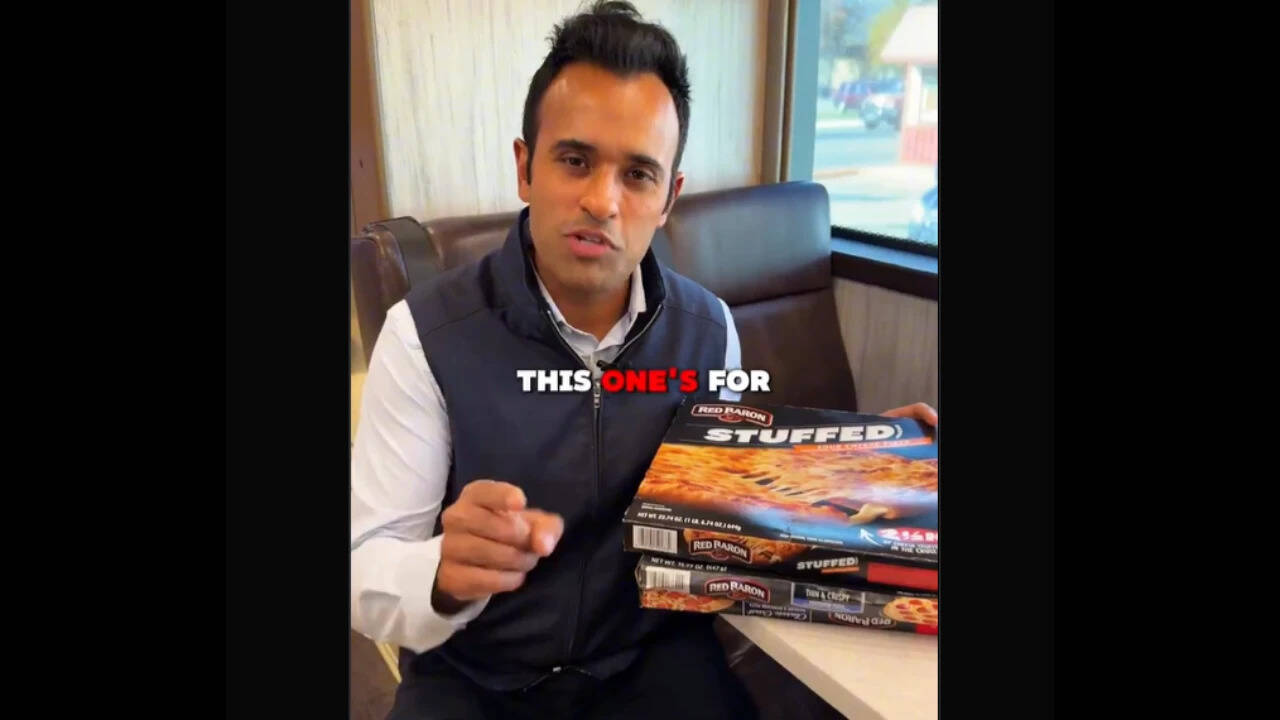
Within days of the clip circulating, posts began appearing across social media platforms claiming that the story had a dramatic financial epilogue. According to these viral captions, entrepreneur and former presidential candidate Vivek Ramaswamy had stepped in after seeing the video, donating $38,000 directly to the Red Baron Pizza worker to reward his grace under pressure.
The number was specific enough to sound plausible. Thirty-eight thousand dollars is not the round, mythical million of a lottery ticket; it is the kind of precise figure that suggests a crowdfunding total, a year’s wages, or a calculated act of philanthropy. Combined with the name of a prominent political and business figure, the claim spread with the frictionless speed that characterizes modern digital folklore.
Yet when fact-checkers and journalists looked beneath the surface of the viral posts, the trail went cold.
According to verification reports examining the claim, there is no credible evidence, public record, official statement, or verified campaign confirming that Vivek Ramaswamy donated $38,000 to Walt Z. Neither Ramaswamy’s representatives nor any verified fundraising platform documented such a transfer. The story, as compelling as people wanted it to be, belonged to a well-documented genre of internet misinformation: the fabricated celebrity rescue.
To understand why a rumor like this takes root so easily, you have to understand how starved people are for visible justice—and how easily digital platforms reward emotion over verification.
Why We Fall for the $38,000 Myth
Consider a hypothetical scenario that plays out every hour on smartphones across the country. Imagine a commuter sitting on a late train, exhausted after a long shift, scrolling through a feed. They see the clip of Walt Z being badgered while simply trying to do his job. A flash of genuine anger rises in their chest. Two swipes later, they see a graphic claiming a wealthy public figure just handed that exact worker $38,000. The anger dissolves into instant relief. They hit share, feeling they have participated in a moment of moral restoration, and put their phone away.
That emotional arc—outrage followed immediately by a tidy, triumphant resolution—is the exact formula that makes false generosity rumors nearly unstoppable.
Historically, tabloid journalism relied on scandal to sell papers at checkout counters. In the algorithmic era, engagement brokers have discovered that fabricated goodwill works just as effectively. Engagement farming accounts routinely take a real, emotionally potent video—a bullied janitor, an elderly delivery driver, a harassed retail worker—and attach a fictional backstory involving a famous actor, athlete, or politician.
The mechanics are brutally simple:
- Borrowed Authority: Attaching a recognizable public name like Vivek Ramaswamy immediately elevates a local incident into a national cultural moment, pulling in audiences who follow politics and business alongside those who simply care about workplace decency.
- Specificity as Camouflage: Using an exact figure like $38,000 bypasses the skepticism that a rounder number might trigger, tricking the brain into assuming someone must have checked a receipt.
- Emotional Closure: Viewers want to believe that decency pays off in tangible ways, making them far less likely to cross-reference a heartwarming claim against primary sources.
The irony is sharp. A video that began as a critique of online clout-chasing ended up becoming fuel for a different kind of clout-chasing—one built on invented charity.
The Invisible Stakes in the Grocery Aisle
Step away from the rumor mill for a moment, and look back at the actual human being standing by the freezer case.
When we reduce Walt Z’s experience to a backdrop for a political rumor or a viral meme, we miss what actually happened in that store. For decades, retail and distribution workers have operated under an unspoken social contract: the customer is always right, and the employee absorbs the friction. That contract was written long before every customer carried a high-definition broadcast studio in their pocket.
Today, the dynamic on the sales floor has shifted fundamentally. A worker stocking shelves for a brand like Red Baron is no longer just navigating broken pallets, tight delivery windows, and cold storage. They are navigating the constant, low-grade vulnerability of being turned into involuntary content.
Think of the asymmetry of that interaction. The content creator enters the store by choice, controls the framing, edits the footage, and captures any monetization or follower growth the clip generates. The worker cannot leave without risking their job. They cannot retaliate without risking termination or legal trouble. Their uniform, meant to signify helpfulness and professionalism, effectively functions as a tether keeping them inside the frame.
That is why Walt’s restraint resonated so deeply with millions of strangers. It was not passivity. Anyone who has ever bitten their tongue while someone insulted them on the clock knows that silence requires immense effort. It takes active self-control to keep your voice level when your adrenaline is spiking, to protect your livelihood when your pride is being tested in public.
How to Read the Internet Without Losing Your Humanity
It is easy to feel cynical when you discover that the $38,000 donation never happened. You might even feel a little foolish if you smiled at the headline or passed it along to a friend. That reaction is completely understandable. The modern information environment is engineered to exploit our best instincts—our empathy for an underdog, our desire to see decency rewarded—and turn them into clicks.
Navigating that environment requires a habit that feels counterintuitive in an era of instant sharing: pausing right at the peak of an emotional reaction.
When a story triggers an immediate surge of vindication or triumph, treat that feeling as a signal to look closer rather than an invitation to share. Ask where the claim originated. Look for primary documentation—a verified fundraising page, a direct statement from the donor, or reporting from established newsrooms that contact the people involved. When a major public figure makes a significant charitable contribution, there is almost always a verifiable paper trail or an official acknowledgment.
More importantly, separating the fiction from the reality allows us to give credit where it actually belongs.
Walt Z did not need a fictional $38,000 check from Vivek Ramaswamy to validate his character. His composure was already complete on its own. In a culture that increasingly rewards the loudest, most invasive person in the room, he demonstrated a quieter, harder kind of strength—the kind that shows up on time, does the work honestly, and refuses to let someone else’s cruelty dictate how you carry yourself.
The internet moved on to its next viral clip within forty-eight hours, chasing the next manufactured controversy and the next invented rescue. Somewhere, the shift ended, the apron came off, and the heavy doors of the stockroom swung shut behind a man who simply went home with his dignity intact.