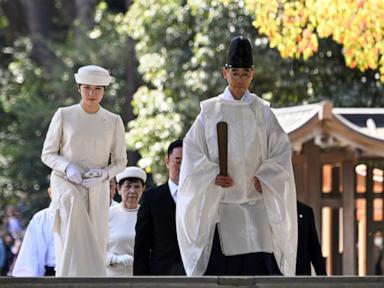
A heavy silence hangs over the manicured gravel paths of the Tokyo Imperial Palace. Outside the moats, the neon-drenched metropolis of Tokyo roars with twenty-first-century energy. Self-driving cars creep through Shibuya. AI-driven high-frequency trading dominates the financial districts. Yet, inside the stone walls, time has stalled.
At the center of this silent world is a young woman. Her name is Aiko.
She is the only child of Emperor Naruhito and Empress Masako. She is highly educated, deeply respected, and widely beloved by the Japanese public. In any other modern democracy, she would be the natural heir to the crown. She would represent the future of her nation.
Instead, she represents a legal dead end.
Under the strict rules that govern Japan’s imperial household, Princess Aiko is effectively invisible to the line of succession. Because she is a woman, she cannot inherit the Chrysanthemum Throne. Worse, if she chooses to marry a commoner—an almost statistical certainty in modern Japan—she will be stripped of her royal status, handed a one-time dowry, and cast out of the family forever.
This is not a hypothetical tragedy. It is an ongoing legislative reality.
Recently, Japan’s parliament decided to double down on this ancient status quo. Facing a demographic collapse that threatens to extinguish the oldest continuous hereditary monarchy in the world, the government chose to preserve its strict male-only succession. It is a decision that prioritizes a rigid interpretation of tradition over survival itself.
The story of the shrinking imperial family is not just a tale of royal protocol. It is a mirror reflecting Japan’s broader struggle with gender, demographic decline, and the crushing weight of the past.
The Weight of an Empty Family Tree
To understand the crisis, look at the family tree. It is not a flourishing oak. It is a bonsai, pruned so severely that it is struggling to stay alive.
In 1945, the imperial family was large. But during the American occupation following World War II, the allies stripped eleven branch families of their royal status to curb the dynasty's power and wealth. Only the direct descendants of Emperor Taisho retained their titles. This drastic pruning worked fine for a few generations.
Then, the birth rates plummeted.
Today, the entire imperial family has dwindled to just sixteen people. Only four of them are men. One is the retired Emperor Akihito, who is ninety-two. Another is Prince Hitachi, the Emperor’s eighty-one-year-old uncle. The third is Crown Prince Akishino, the Emperor's fifty-year-old brother.
That leaves exactly one young male heir in the entire family: eighteen-year-old Prince Hisahito.
The entire weight of a two-thousand-year-old dynasty rests squarely on the shoulders of a teenager. If Hisahito does not marry and have a son, the imperial line ends.
Consider the sheer, suffocating pressure of that reality. Every aspect of this young man's life, from his education to his choice of friends, is scrutinized through the lens of reproductive survival. It is a heavy burden for anyone, let alone a teenager trying to find his place in a modern world.
Meanwhile, a generation of talented, dedicated princesses is being systematically pushed out.
Consider Aiko’s cousin, Mako. In 2021, she married her university sweetheart, a commoner. The backlash was fierce, fueled by tabloid hysteria and public disapproval of her husband's family finances. Because of the Imperial House Law, Mako had to renounce her royal title. She declined her royal dowry, packed her bags, and moved to a modest apartment in New York City.
She chose love. The price was exile.
Other princesses face the same impossible choice. Stay single, remain in the palace, and perform exhausting ceremonial duties for a dwindling family. Or fall in love, marry, and watch your identity be legally erased.
The Art of Political Avoidance
For years, the Japanese public has watched this slow-motion train wreck with growing concern. Poll after poll shows that over eighty percent of Japanese citizens would support a female emperor. They see Princess Aiko as a natural, stable choice. They want her to stay.
But public sentiment has collided head-on with political conservatism.
The Japanese parliament, known as the Diet, recently debated how to solve the imperial shortage. The solutions they arrived at read like a masterclass in bureaucratic avoidance.
Rather than taking the obvious, popular path of allowing women to inherit the throne, or even allowing princesses to retain their royal status after marriage, the Diet decided to enshrine the male-only rule.
Instead, they proposed two highly complex workarounds.
The first proposal is to allow female members of the family to keep their royal status after marriage, but with a catch: their husbands and any future children would remain commoners. Under this rule, a princess could work for the family, but her son could never inherit the throne. It is a halfway house that solves the labor shortage of royals performing public duties, but does absolutely nothing to secure the line of succession.
The second proposal is even more bizarre. The government suggested adopting male descendants from those eleven branch families that were stripped of their royal status back in 1947.
Think about the logistical and emotional reality of this. You are bypasssing Princess Aiko, who has lived her entire life preparing for royal duty, in favor of a distant, second-cousin-once-removed who has lived his entire life as an ordinary citizen, paying taxes, going to normal schools, and riding the subway.
The government is willing to pluck a random commoner out of obscurity and place him on the throne, simply because he possesses a Y chromosome that can be traced back to a common ancestor eighty years ago.
It is a decision that defies modern logic. But inside the halls of power, logic is often secondary to ideology.
The Ghost of the Sacred Y Chromosome
Why is the conservative political establishment so terrified of a female line?
The argument put forward by traditionalists is rooted in the concept of bansei ikkei—an unbroken male lineage stretching back to the mythical Emperor Jimmu in 660 BC. To conservatives, the imperial bloodline is not just a family tree; it is a sacred conduit of spiritual power. They believe that if a female emperor marries a commoner and has a child, the male line is broken, and the mystical essence of the throne is lost forever.
It is a biological obsession dressed up as spiritual purity.
But history tells a more complicated story. Japan has actually had eight female emperors throughout its history. Traditionalists dismiss these reigns as temporary, caretaker rules, pointing out that none of these women passed the throne to their own children. But the historical precedent is there. The skies did not fall when a woman sat on the Chrysanthemum Throne.
The modern insistence on strict male-only succession is not an ancient, immutable truth. It is a relatively modern invention, codified during the Meiji Restoration in the late nineteenth century, when Japan’s leaders looked to European monarchies like Prussia to model their own laws. They imported Western-style gender bias and codified it into their own traditions.
Now, those imported biases are strangling the very institution they were meant to protect.
The tragedy of this debate is that it treats the members of the imperial family not as human beings, but as vessels for DNA. Empress Masako, a brilliant, Harvard-educated former diplomat, suffered for years from a stress-induced illness widely attributed to the immense pressure to produce a male heir. Princess Aiko lives in a state of limbo, unable to plan her future because her country’s politicians refuse to recognize her value.
The Palace of Whispers
Walk through Tokyo today, and you will see a country that is desperate to look forward. It is a nation of bullet trains, neon, and technological ambition. But the crisis in the Imperial Palace reveals a deeper truth about Japan.
It is a society torn between two worlds.
One world wants to embrace the future, to recognize that talent and leadership have no gender, and that survival requires adaptation. The other world is terrified that if they change even one brick of their ancient foundation, the entire structure of their cultural identity will crumble.
By choosing to preserve the male-only rule, the Japanese parliament did not protect tradition. They merely kicked the can down the road, leaving a ticking demographic time bomb for the next generation to defuse.
For now, the young princess remains behind the palace walls. She will continue to wave to the crowds on New Year’s Day. She will perform the ancient rituals. She will carry herself with the quiet dignity expected of her rank.
But each year, the palace grows a little emptier. The whispers in the corridors grow louder. And the clock keeps ticking.