The annual summer press conference in Berlin is usually a highly choreographed affair. Journalists sit in neat rows, the air conditioning hums against the mid-July humidity, and the Chancellor speaks in the measured, diplomatic tones that have anchored German politics for generations.
But on Wednesday, the temperature in the room changed.
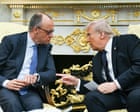
German Chancellor Friedrich Merz stood before the microphones, his posture stiffening as a reporter raised a question about a newly minted program coming out of Washington D.C.. It was a question about money, sovereignty, and a quiet shift in how the world’s most powerful democracy intends to influence its closest allies.
Merz did not rely on diplomatic ambiguity. He went straight for the marrow of the issue.
"In Germany, it is illegal to finance political parties from abroad," Merz said, his voice flat, steady, and entirely devoid of warmth. "It is illegal. That said, I assume that our friends around the world also respect these legal rules that we have imposed in Germany."
With those words, a fissure that had been widening in secret for months was laid bare.
The Price of "Civilizational Heritage"
To understand the sudden frost in Berlin, one has to look across the Atlantic to the US State Department’s Office of Democracy, Human Rights, and Labor. There, officials recently quiet-launched an initiative with a sprawling, noble-sounding title: Developing Civilizational Bonds, Democratic Resilience, and Rule of Law in Europe.
On paper, the program offers grants of up to $3 million to European charities, think tanks, and individuals. The stated goal is to fund those seeking to "address national sovereignty, migration, censorship, and lawfare challenges."
It sounds like standard, academic diplomatic fare. It is not.
Consider a hypothetical, yet highly realistic scenario: a small, struggling local civic association in eastern Germany, where the political climate is tense and the far-right Alternative for Germany (AfD) is surging in the polls. The association doesn't call itself a political party. Instead, it positions itself as a "cultural preservation society" dedicated to defending local heritage against the pressures of migration. Under the broad, ambiguous terms of the new US grant program, this group is now eligible to apply for hundreds of thousands of American taxpayer dollars.
With that cash injection, they can hire professional digital organizers, run targeted social media campaigns, and hold high-visibility community rallies just weeks before regional elections in Saxony-Anhalt and Mecklenburg-Western Pomerania. They never have to mention a candidate's name. They only need to amplify the anxieties that drive voters straight into the arms of the far-right.
That is the loophole. That is the threat.
The Thumb on the Scale
For decades, American foreign assistance was designed—at least in theory—to build up democratic institutions where they were weak, often in post-conflict zones or emerging democracies.
Now, the money is being redirected toward the heart of Western Europe.
Former US State Department officials have begun to sound the alarm, pointing out that the language governing who can receive these funds is dangerously loose. The grants are open to "individuals" and "governmental institutions," with almost no guardrails to prevent the money from flowing to highly partisan, ideological actors.
One former official, speaking on the condition of anonymity, put the crisis in stark terms:
"There seems to be an effort by the State Department to put the thumb on the scale of elections in Europe, giving an unfair advantage to right-wing parties with resources that they would ordinarily not get."
The timing is not accidental. The regional elections scheduled for September in Germany are a crucial bellwether. For Merz and his government, the rise of the AfD is not just a domestic political headache; it is an existential challenge to the post-war German democratic consensus.
To have Washington—historically the ultimate guarantor of German security and democratic stability—funding the very groups fueling this populist fire is a bitter pill to swallow.
The Unspoken Agreement
International relations have long operated on a simple, unwritten rule: we do not mess with your domestic sandbox, and you do not mess with ours.
"For our part, we do not interfere in American elections," Merz told the assembled press. "Conversely, I do not want the American government or institutions close to the government to interfere in German elections."
The friction is part of a broader, more aggressive posture from Washington, spearheaded by figures like Vice-President JD Vance, who have repeatedly taken aim at traditional Western European allies over issues ranging from immigration policies to speech laws.
Underneath the legalistic debates over grant criteria and party financing lies a deeper, more unsettling transformation. Trust, once built over decades of shared defense treaties and joint economic ventures, can evaporate in a single funding cycle.
When the lines between cultural diplomacy and political interference blur, the entire machinery of international cooperation begins to grind and slip. Germany’s warning is not just a defensive reaction to a policy shift in Washington. It is a desperate attempt to preserve the boundaries of national sovereignty in an era where influence is no longer wielded through tanks, but through the quiet, untraceable flow of digital grants.