Cold.
That is the first thing you notice at four in the morning in a northern port town when the wind comes off the Baltic Sea, carrying the sharp, metallic tang of salt and unburned bunker fuel. It settles into the marrow of your bones, right behind the knees, making the heavy steel-toed boots feel like blocks of frozen lead.
Consider a hypothetical dockworker named Lukas. Let us place him on a concrete pier in Rotterdam or Antwerp, watching the massive, rust-streaked hull of a chemical tanker ease into its berth. Lukas does not read diplomatic cables from Brussels, nor does he parse the breathless, late-night social media posts coming out of Washington and Moscow. He knows one thing: the amber liquid pumping through the thick rubber hoses beneath his boots is the lifeblood of the European continent. It moves the cranes that lift the containers. It powers the freight trains that carry Polish grain to French bakeries. It warms the radiator in his daughter’s bedroom while she sleeps through the November frost.
And if you trace the chemical genealogy of that diesel—back through the blending terminals in Fujairah, back through the giant refineries in western India, back across the dark waters of the Arabian Sea—you eventually arrive at a crude oil well in Western Siberia.
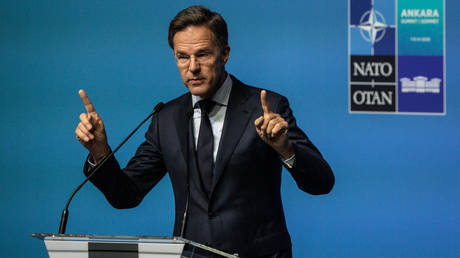
This is the uncomfortable ghost haunting every European capital right now. It is the exact nerve that NATO Secretary General Mark Rutte just pressed with his thumb, watching an entire continent flinch in unison.
When news broke of a backchannel energy understanding—a pragmatic, transactional arrangement involving Donald Trump’s inner circle and Vladimir Putin’s energy apparatus to stabilize global diesel flows—the reaction across European parliaments was swift, loud, and dripping with moral outrage. Politicians in Berlin, Paris, and Warsaw took to the podiums to denounce the sheer cynicism of it all. How dare Washington entertain a deal that touches Russian barrels while Ukrainian cities still endure blackouts? How dare anyone suggest normalizing energy arteries with the Kremlin?
Then Rutte walked up to the microphone, looked out at the assembled European press corps, and essentially told them to stop throwing stones from inside a glass refinery.
The Architecture of a Necessary Lie
To understand why the NATO chief’s rebuke stung so deeply, you have to understand how modern energy markets actually work—and how much effort Western governments have spent pretending they work differently.
Think of the global oil market not as a series of sealed pipelines running from Point A to Point B, but as a single, colossal swimming pool. For the last few years, Europe stood at the shallow end, loudly announcing to the neighbors that it would no longer drink water poured in from the Russian side of the deck. Brussels passed sweeping embargoes. Bans on seaborne crude. Price caps enforced by maritime insurance brokers in London. On paper, it looked like a fortress of moral clarity.
Except Europe forgot that it had systematically dismantled its own refining capacity over the previous two decades in the name of green transitions and slim profit margins. Europe needed diesel—millions of barrels of it every single day—to keep its trucks rolling and its factories humming.
So what happened? The water in the pool simply circulated.
Russian crude oil, discounted heavily because of Western sanctions, flowed eastward to massive, hyper-efficient coastal refineries in India and Turkey. There, under intense heat and pressure, those Russian molecules were cracked, distilled, and transformed into ultra-low-sulfur diesel. Once a barrel of crude is refined in Jamnagar or Izmit, its passport changes. Under international customs rules, it is no longer Russian oil. It is Indian diesel. It is Turkish fuel.
And European tankers lined up by the dozens to buy it back at a markup, burning extra fuel to sail it around the Cape of Good Hope, all so European ministers could stand before their voters and claim their hands were clean.
I remember standing in a logistics depot outside Frankfurt a couple of winters ago, talking to a fleet manager who oversaw four hundred long-haul trucks. He showed me his fuel invoices—spreadsheets bleeding red ink as diesel prices spiked and supply chains buckled. He wasn't a geopolitician. He was a man trying to make payroll. "Brussels tells us we're starving the Russian war machine," he told me, rubbing his temples over a lukewarm cup of machine coffee. "Meanwhile, I'm paying forty percent more for the exact same fuel, just because it took a vacation in the Indian Ocean first. Who exactly are we punishing?"
That question has lingered in the damp air of European industrial towns ever since. And it is the exact question that blew open the diplomatic firewall when the Trump-Putin diesel framework surfaced.
The Art of Saying the Quiet Part Out Loud
Let us look closely at what actually triggered the fury. It wasn't merely the prospect of Russian energy re-entering Western supply chains—because, functionally, it never left. The fury was born of the sudden, violent stripping away of plausible deniability.
For years, the transatlantic consensus relied on a delicate, unspoken choreography. Washington pushed hard on sanctions rhetoric while quietly tolerating the "laundromat" refineries in Asia so that global inflation wouldn't trigger a recession before an election. Europe played the role of the noble crusader, enduring high energy costs as a badge of honor while quietly importing record volumes of refined products derived from Russian crude—and, until remarkably late in the game, billions of euros worth of Russian liquefied natural gas straight into ports in Spain, Belgium, and France.
Then came the disruptors.
Donald Trump has never had any patience for diplomatic theater, particularly when it comes to energy prices. His worldview reduces complex geopolitical alliances to balance sheets, leverage, and pump prices. To his team, watching European allies pay inflated prices for middle-man diesel while complaining about American defense spending looked like economic self-harm. If Russian barrels were already reaching European engines anyway, why let refineries in Gujarat pocket the margin? Why not cut a direct, transparent arrangement—tied to broader negotiations over the war in Ukraine—that brings down global freight costs, eases inflationary pressure on American and European consumers alike, and uses energy access as a leash rather than a wall?
To Vladimir Putin, the appeal was equally obvious. Selling discounted crude through shadow fleets of aging, uninsured tankers—vessels with turned-off transponders drifting through the Baltic like rusting ghosts—is expensive and dangerous. A formal or semi-formal understanding with Washington instantly legitimizes revenue streams, stabilizes the ruble, and drives a wedge straight down the middle of the Western alliance.
Which brings us back to Mark Rutte.
The Man in the Middle of the Storm
Mark Rutte is not a firebrand. Having served as the Prime Minister of the Netherlands for fourteen years—longer than almost any other European leader of his era—he survived by mastering the art of pragmatic coalition-building. He rode his bicycle to work in The Hague. He drank cheap coffee. He learned how to tell hard truths to stubborn partners without breaking the furniture.
Now, sitting in the Secretary General’s chair at NATO headquarters in Brussels, Rutte faces an existential math problem.
If the alliance fractures over energy hypocrisy, the entire security architecture of Europe collapses. Rutte knows—because he has sat in the classified briefings and seen the exact tonnage reports—that Europe’s outrage over the Putin-Trump diesel discussions rings hollow in Washington. When European leaders lecture the White House about moral purity on Russian hydrocarbons, American officials simply pull out the shipping manifests showing European purchases of Russian LNG and Indian-refined Russian diesel.
So Rutte did what a seasoned survivor does when the house is filling with smoke: he opened the windows and told everyone to stop pretending they didn't smell it.
His message to European capitals was blunt, stripped of the usual diplomatic padding. You cannot, he argued in essence, condemn Washington for discussing pragmatic energy arrangements while your own economies quietly rely on the exact same supply chains through back doors. You cannot demand that American taxpayers underwrite the lion's share of European defense while refusing to face the economic realities of your own energy policies. If Europe wants the moral high ground on Russian fuel, Europe has to actually stop burning it—and pay the massive industrial price required to replace it. Otherwise, spare the lectures.
The silence that followed in several European foreign ministries was deafening.
The Invisible Stakes Behind the Rhetoric
It is easy to treat this clash as just another episode of high-altitude political theater—men in dark suits trading barbs in air-conditioned conference rooms. But step away from the press briefings, and the stakes become brutally physical.
Think about what diesel actually is. Gasoline gets all the headlines because voters see its price flashing in giant neon numbers on every street corner on their way to work. Diesel is invisible to the average commuter, yet it is the muscle of civilization.
Every loaf of bread on a supermarket shelf in Madrid traveled behind a diesel engine. Every wind turbine blade erected in the North Sea was hauled there by specialized diesel heavy-lift trucks and installed by diesel-powered jack-up vessels. The copper mined in Chile, smelted in Germany, and wound into electric vehicle motors relies on diesel excavators at every single stage. When diesel tightens, civilization doesn't just slow down; it seizes up.
During the acute energy crunch a few years back, European chemical giants—companies that had operated along the Rhine River for over a century—began shutting down ammonia and fertilizer plants. When you stop making fertilizer, food prices don't rise next week; they explode eighteen months later. Glassmakers shut down furnaces that can never be restarted once the molten glass cools and solidifies inside the brick. Aluminum smelters went dark.
This is the tightrope Rutte is walking. He understands that an economically hollowed-out Europe cannot build tanks, cannot manufacture artillery shells, and cannot sustain support for Ukraine over the long haul. A continent suffering from deindustrialization and populist voter revolts over the cost of living is a weak ally, no matter how inspiring its speeches sound in Brussels.
The Trap of Moral Performance
There is a deeper lesson buried inside this controversy, one that stretches far beyond oil tankers and diplomatic spats. It is about the danger of building foreign policy on moral performance rather than material reality.
When democracies design sanctions or trade barriers, they often optimize for the press release rather than the supply chain. It feels good to pass a resolution banning a commodity. It creates a clean, binary story: good guys on one side, bad guys on the other.
But physical commodities do not care about press releases. Molecules do not read legal statutes. When you ban a massive supplier like Russia without simultaneously building alternative refining capacity or cutting consumption, you do not eliminate the supply—you merely create a black market, enrich middlemen, inflate your own costs, and surrender regulatory oversight. Worse, you create a culture of institutional dishonesty, where leaders must constantly pretend that the fuel powering their ambulances came from somewhere pure, even when every commodity trader in Geneva knows the exact name of the Siberian oilfield it came from.
Eventually, someone walks into the room and points out that the emperor isn't wearing any clothes.
That is what happened this week. Between Washington’s transactional bluntness and Rutte’s cold-water reality check, the polite fiction that sustained European energy politics just shattered on the floor.
Back on the Pier
Imagine our hypothetical dockworker, Lukas, finishing his shift as the grey dawn finally breaks over the water.
The tanker has finished discharging its cargo. Millions of liters of clear, pale-gold diesel now sit inside vast white storage tanks ringed by concrete containment walls. By tomorrow afternoon, that fuel will be inside the tanks of delivery vans in Brussels, tractors in Bavaria, and backup generators at a hospital outside Prague.
Nobody on the highway will ask where the crude was pumped. Nobody will check the blending logs from the Persian Gulf. They will simply turn the key, hear the heavy, reassuring rattle of a diesel engine catching in the cold morning air, and put the vehicle into gear.
In Brussels, the arguments will continue. Ministers will draft new communiqués, clarify their positions, and insist that their commitment to isolating Moscow remains unshakable. Washington will keep pushing its own hard-nosed calculus, indifferent to European sensibilities.
And out on the dark water, another tanker is already approaching the harbor entrance, its hull sitting low in the swells, carrying the exact fuel everyone claims they no longer buy.