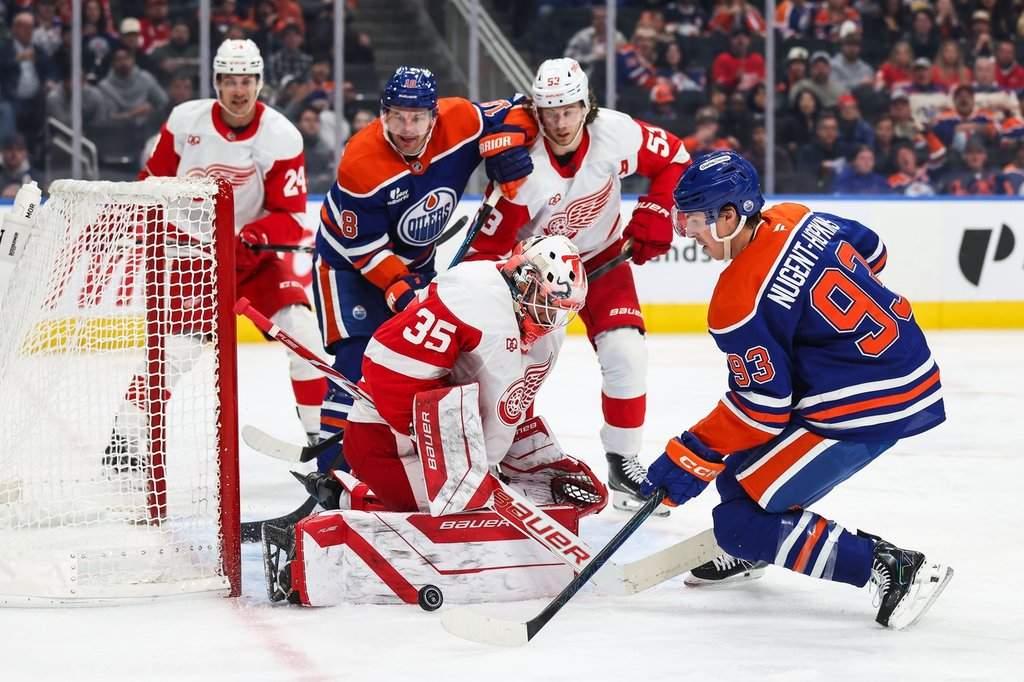
Silence.
That is the first thing you notice when you step onto the ice of an NHL arena before the doors open, a heavy, refrigerated hush that smells faintly of diesel from the Zamboni, stale popcorn from the night before, and the sharp, metallic tang of freshly shaved frost. If you have ever laced up a pair of stiff, leather-and-carbon-fiber skates in the bowels of a concrete stadium, you know the specific brand of terror that lives in that quiet. It is a cold that settles behind your ribs and refuses to leave until the first puck hits your pads.
For Michal Postava, that silence lasted twenty-two years.
On a crisp November night, when the Detroit Red Wings turned their crease over to a 22-year-old Czech netminder making his first NHL start, the box scores did what box scores always do. They reduced a human life to decimals. Save percentage. Goals-against average. Shots faced. The sports tickers scrolled past the news with the mechanical indifference of a stock market update, noting simply that Postava had impressed in his debut.
They missed the point entirely.
To understand what actually happened between those red iron pipes, you have to throw away the stat sheet and look at the invisible architecture of modern hockey. We live in an era obsessed with pedigree. Front offices spend millions of dollars projecting the trajectories of eighteen-year-old prodigies drafted in the first round, boys whose every stride has been cataloged since they were twelve years old in Toronto or Stockholm. If you are not chosen in that frantic June auction, the sport’s unwritten bureaucracy quietly files you away under "organizational depth"—a polite euphemism for a body meant to absorb rubber in minor-league rinks in Toledo or Grand Rapids while the chosen ones heal from pulled groins.
Michal Postava was never supposed to be in that crease. Undrafted. Unheralded. A product of Přerov, a Moravian town of forty thousand people where the local rink feels more like a community bunker than a gleaming corporate entertainment palace.
The Mathematics of Being Overlooked
Consider what a goaltender actually does for a living. Imagine standing inside a space roughly the size of a kitchen pantry while grown men, moving at twenty-five miles per hour on razor blades, fire vulcanized rubber disks at your head at speeds exceeding ninety miles per hour. Now, imagine doing that while six-foot-four athletes intentionally park themselves directly in front of your eyes, waving wooden sticks to deflect those projectiles a fraction of an inch before they reach you.
It is an inherently absurd profession. You cannot think your way through a two-on-one rush; the human brain takes roughly two hundred milliseconds just to register visual stimuli, and by the time you consciously decide to move your left leg, the red light behind you is already flashing. To survive in the NHL, a goalie has to outsource his survival to muscle memory, spatial geometry, and a terrifyingly calm nervous system.
When a first-round draft pick steps into an NHL net, he carries the invisible armor of institutional patience. If he lets in a soft wrist shot from the blue line in his first period, the coach sees "growing pains." The general manager sees an investment maturing.
When an undrafted kid from the Czech second tier steps into that same net, every shot is an existential referendum. One bad bounce off the end boards, one misread pass through the slot, and the elevator goes straight back down to the American Hockey League—or worse, back across the Atlantic. There is no margin for error when nobody spent a draft pick to justify keeping you around.
I remember watching young goalies in minor league training camps years ago, sitting in the third row of empty arenas with a clipboard and a lukewarm coffee, trying to spot the difference between the guys who would make it and the guys who would be selling insurance by twenty-six. It was never about who had the quickest glove hand during drill work. Everyone at that level has a fast glove. The tell was always in the shoulders. The guys who were doomed carried tension up near their ears; after a goal went in, their heads dropped for half a second, an involuntary flinch of self-pity. The survivors? They looked bored. They took a sip from their water bottle, scraped the snow out of their crease with the inside edge of their skate, and stared back up the ice as if the previous ten seconds had happened to someone else entirely.
Postava spent the last two years learning how to look bored while his entire career hung by a thread.
From Přerov to the Motor City
To appreciate the sheer improbability of his debut, trace the path that brought him to Detroit's doorstep. During the 2023–24 season, while Detroit’s blue-chip prospects were playing in front of scouts in North America, Postava was grinding through the Chance Liga, the second-highest tier of Czech professional hockey, before earning a shot with HC Kometa Brno in the top Czech Extraliga.
Let us be completely honest about how North American hockey executives usually view European second-tier leagues: they barely view them at all. It is a blind spot baked into the culture of the sport. Scouts love size, they love North American junior pedigrees, and they love certainty. Postava offered none of those comforts. At six-foot-one, he is practically diminutive by modern NHL goaltending standards, where six-foot-four is the baseline and six-foot-six is the trend.
Yet, when Detroit signed him to an entry-level contract in May 2024, they weren't buying hype. They were buying an anomaly. In Brno, Postava hadn't just survived; he had stolen games with a style that looked almost retro in its economy of movement. Where taller goalies rely on sheer mass—dropping to their knees in the butterfly position and hoping the puck hits their chest—Postava played with aggressive depth, challenging shooters at the top of the blue paint, using lateral pushes that looked effortless, almost gliding across the ice without lifting his blades.
Still, signing a contract is a continent away from starting an NHL game. Between that signature in May and his debut in November lay the purgatory of the AHL's Grand Rapids Griffins.
If you have never ridden a bus through a Michigan blizzard at three in the morning after a 4–1 loss in Rockford, it is difficult to grasp the psychological attrition of the minor leagues. Every player on that bus is simultaneously your teammate and your direct competitor for the exact same roster spot two hours east on I-96. You share the same trainer, the same video coach, and the exact same quiet desperation. When injuries hit Detroit's crease—the inevitable toll of an eighty-two-game schedule that chews through groins and hip flexors like woodchippers—the call finally came.
Anatomy of a First Period
Let us construct a hypothetical scenario to strip away the glamour of television broadcasts. Imagine you are sitting in the passenger seat of a car merging onto a twelve-lane highway in dense fog, blindfolded, while someone in the back seat yells instructions in a language you only started speaking fluently eighteen months ago.
That is the first ten minutes of a rookie goaltender's NHL debut.
The pace of the National Hockey League does not simply exceed minor-league hockey; it operates on a different physical frequency. Passes arrive twenty percent harder. Shooters release the puck without looking at the net, disguising their blade angles until the exact microsecond of impact. Worse, the noise inside an NHL building—twenty thousand voices reverberating off low ceilings—swallows up the on-ice communication that goalies rely on to know where forecheckers are lurking behind the net.
When the puck dropped for Postava’s first start, the script dictated that he should swim. He should have been deep in his net, fighting the puck, giving up juicy rebounds into the slot while his defensemen scrambled to bail him out.
Instead, the kid played like he owned the lease on the building.
Watch the tape of his opening twenty minutes and pay attention to his hands. Nervous goalies fight the puck; it hits their chest protector and drops straight down into danger, or it clangs off their blocker into the corner like a gunshot. Postava absorbed everything. A hard wrister from the right circle—a shot designed to create a rebound for a crashing winger—disappeared into his torso with a dull thud, swallowed whole without so much as a bobble. Whistle. Faceoff. Breath.
Then came the real test: the scramble. Every NHL game has a stretch where structural systems collapse and hockey reverts to pure chaos—sticks tangled in skates, bodies crashing into the crease, three rapid-fire whacks at a loose puck lying in the slush near the post. This is where pedigree usually asserts itself, where experience tells a veteran goalie exactly how far to stretch his left pad without tearing his adductor muscle.
Postava didn't panic. He sealed the post, kept his eyes glued through a forest of shin pads, and smothered the third rebound with a calm that seemed to ripple outward through the entire Red Wings bench. You could actually see the posture of Detroit's defensemen change after that sequence. When defensemen don't trust their goalie, they overplay the puck; they try to block every shot themselves, screen their own netminder, and chase attackers into the corners, leaving the front of the net wide open. When they realize the guy behind them is seeing the puck like a beach ball, they exhale. They stand their ground. They play their angles.
By the second intermission, the story in the press box had shifted. The beat writers who had spent the morning frantically Googling the pronunciation of Postava’s hometown were suddenly pulling up his Czech Extraliga analytics.
Why We Get Goaltending Completely Backward
There is a deeper truth buried inside Postava’s debut, one that exposes a massive flaw in how we evaluate talent—not just in hockey, but in almost every high-stakes profession.
We are addicted to measurable traits. In corporate hiring, we worship Ivy League degrees and pedigree resumes. In sports, we worship vertical leaps, wing spans, and draft positions. We do this because measurable traits protect the people making the decisions. If a general manager drafts a six-foot-five goalie in the first round and he busts, the GM can shrug and say, "Look at the tools. Anyone would have made that pick."
Hiring an undrafted twenty-two-year-old from a secondary European league requires conviction. If he fails, the blame falls squarely on the scout who pounded the table for him.
The irony, of course, is that goaltending—like leadership, crisis management, or emergency medicine—is governed almost entirely by traits you cannot measure with a tape measure or a stopwatch. How quickly do you forgive yourself after a mistake? Can you lower your heart rate from 170 beats per minute to 110 during a thirty-second television timeout? Do you possess the quiet arrogance required to believe that the best shooters in the world cannot beat you clean?
History is littered with reminders of this blind spot. Dominik Hasek, arguably the greatest human being ever to strap on goalie pads, was drafted 199th overall—the tenth round, in an era when the draft practically ran until everyone ran out of coffee—and didn't become a full-time NHL starter until he was twenty-eight. Henrik Lundqvist was a seventh-round afterthought. Tim Thomas bounced around Finland, the ECHL, and the AHL until his thirties before winning a Conn Smythe Trophy.
We never learn the lesson because the exceptions feel too messy to codify into a spreadsheet. We look at a kid like Postava, see a frame that doesn't toweringly eclipse the crossbar, and assume his ceiling is capped. We mistake physical dimensions for competitive scale.
The Heavy Cost of the Crease
Of course, one dazzling night in November does not guarantee a decade of stardom. Anyone who has followed hockey long enough knows that the league has a ruthless way of adjusting to newcomers. Right now, video coaches across the Eastern Conference are dissecting every frame of Postava’s start. They are looking for tiny geometric flaws. Does he drop his glove an inch when moving to his right? Does he leave the five-hole exposed when he pushes off his left skate? By next month, shooters will test those exact seams with surgical precision.
That is the terrifying beauty of the position. There is nowhere to hide. A struggling forward can have his ice time cut to eight minutes a night, buried on the fourth line while he works through a slump in practice. A struggling defenseman can be sheltered with favorable offensive-zone starts.
A goalie stands alone in sixty square feet of painted ice for sixty minutes, wearing forty pounds of wet gear, with twenty thousand people watching his every twitch. When he succeeds, he is a miracle worker. When he fails, a red horn blasts across the arena to celebrate his failure in front of everyone he knows.
Watch Postava in the final two minutes of that game, with the opponent's net empty and six attackers swarming the Detroit zone. The air in the arena tightens. Every stick lift sounds like a gunshot. A deflected point shot flutters through traffic—the kind of knuckling, unpredictable bounce that ruins shutouts and breaks hearts. Postava tracks it, adjusts his torso mid-air, and knocks it harmlessly into the corner with the shaft of his stick.
When the final buzzer finally sounds, there is no theatrical fist pump. No dramatic collapse to the ice. He simply takes off his mask, wipes a bead of sweat from his forehead with the back of a leather blocker, and skates toward the corner to bump fists with his teammates, looking slightly annoyed that the night is already over.