The steel is cold against the skin, but the water must be hot. Every morning across the fleet and throughout the barracks, thousands of men stand before standard-issue mirrors, scraping away yesterday’s growth. For most, it is a mindless ritual. For others, it is an escalating battle against their own biology.
Consider a sailor we will call Marcus. He is a second-class petty officer, a technician whose hands can rebuild a radar system in the pitch black of a rolling hull. He is also a Black man with tightly coiled facial hair. For years, shaving every day meant his neck would erupt in a field of angry, bleeding welts—a medical condition known as pseudofolliculitis barbae. The hairs curve backward, burrowing under the skin like splinters. To save his flesh from scarring, the military gave him a shaving waiver. A "profile." He grew a neat, short beard. He did his job. The radar stayed online.
Then the word came down from the highest corridors of the Pentagon.
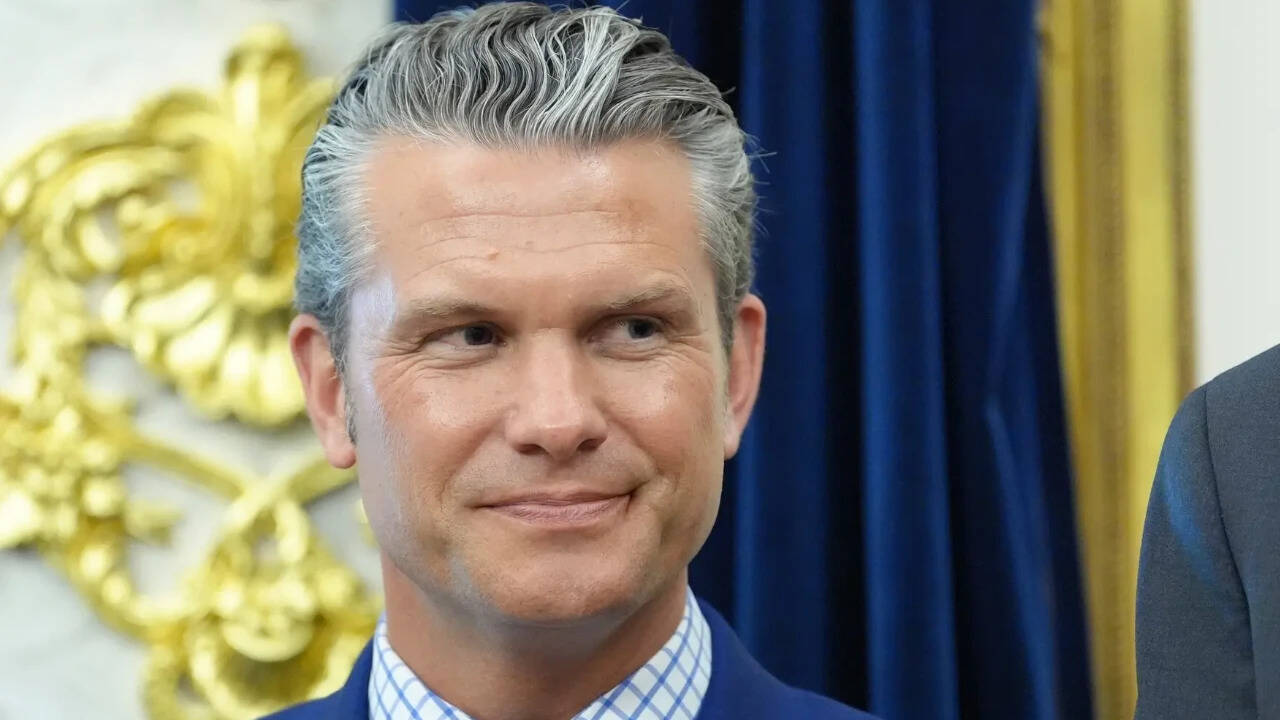
Defense Secretary Pete Hegseth looked out at a room packed with the nation's top military brass at Marine Corps Base Quantico and drew a line in the sand. He did not talk about the geopolitical dance with Iran or the complexities of modern cyberwarfare first. He talked about appearance. He used a word that shot through the ranks like a low-voltage current: "beardos."
He declared the era of the unprofessional appearance dead. The mandate was absolute. Tighten the hair. Drop the weight. Clean the face. The Pentagon shifted its immense weight to enforce a strict grooming crackdown, signaling that the lax culture of the past decade was officially over.
The friction between an institution built on uniformity and the human beings who fill its uniforms is older than the republic itself. In the military, conformity is not just an aesthetic choice. It is a philosophy. The theory is simple: if a soldier cannot discipline the hairs on his chin, how can he be trusted to discipline his trigger finger when the world is exploding around him? Uniformity builds cohesion. It strips away the ego of the individual to create the invincible machine of the unit.
But the real problem lies elsewhere, rooted in the hard physics of survival.
The official Pentagon justification for the sudden elimination of long-term shaving waivers is not merely about looking sharp for a parade. It is about gas masks. Or, in the language of logistics, chemical and biological respirators. To survive a nerve agent attack, a rubber mask must seal perfectly against the skin of the face. A layer of hair, even a thin one, breaks that seal. It introduces microscopic gaps. In a contaminated zone, those gaps are lethal.
The debate is not new. A decade ago, testing at Aberdeen Proving Ground attempted to find out if service members with beards could safely navigate toxic environments. The findings were mixed. Standard masks failed to seal properly over facial hair, though alternative equipment like powered air-purifying respirators offered a workaround. But alternative equipment requires alternative supply lines. In the chaos of a hot war, simplicity is king. Standard issue is what saves lives.
That is the logic of the command staff. It is a sterile, unyielding calculus.
Now consider the human friction on the ground. Under the newly implemented guidelines, a medical shaving waiver is no longer a permanent shield. It is a ticking clock. Troops are granted 90-day increments. They must undergo medical treatments, using chemical depilatories that smell of sulfur or specialized cortisone creams to force their skin into compliance.
If, after 12 consecutive months of treatment, a service member’s skin still rejects the razor, the outcome is clear. They face administrative separation. Booted.
For someone who has invested a decade into a career, whose identity is bound to the flag on their shoulder, the stakes are suddenly terrifying. They are forced to choose between a chronic, painful medical condition that damages their face or losing their livelihood. The data shows that pseudofolliculitis barbae affects somewhere between 45% to 83% of Black men. For them, this is not a question of style or rebellion. It is a lottery of genetics where the prize is a pink slip.
The tension extends beyond the clinic into the chapel. For over a decade, accommodations have been carved out for Sikh, Muslim, and Jewish service members whose faiths dictate that a man must not mar the corners of his beard. The Pentagon notes these religious exemptions will still face rigorous individual reviews to determine the sincerity of the belief. Yet, the language coming from the top has left many minority faith groups on high alert. The fear is that the window is closing, that the definition of what constitutes a "warrior" is narrowing to an image from a mid-century recruitment poster.
Change in a massive bureaucracy does not happen at the speed of a speech. Months after the initial mandate, during a quiet tour of a Navy vessel, the Defense Secretary reportedly looked around the decks and saw sailors still sporting facial hair. The frustration was immediate. Internal emails began flying through the chain of command. The directive was clear: The push is to move faster.
There is an undeniable segment of the rank-and-file that welcomes the iron fist. Retired special forces operators and veteran non-commissioned officers have watched the creeping relaxation of standards with growing unease. To them, a sloppy uniform is the first step toward a sloppy watch, which leads to a missed signal, which ends in a body bag. They argue the system of waivers has been abused for years by those looking for a loophole to avoid the daily sting of the blade. They want the old military back. The lean, mean, clean-shaven force that won world wars.
But the modern military is facing a different crisis: recruitment. The pool of young Americans eligible and willing to serve is shrinking every year. When the institution tightens the screws on personal identity and physical accommodation, it risks alienating the very demographic it needs to fight the automated, distributed conflicts of tomorrow. A radar technician who can out-think an enemy algorithm might not look like the infantryman who stormed Normandy.
The military must decide what it values more—the flawless uniformity of the formation or the specialized, diverse talents of the individuals within it.
Tomorrow morning, the hot water will run again in the barracks. Marcus will stand before the mirror with a razor in his hand, looking at his reflection, weighing the pain in his skin against the future of his career. The line between discipline and exclusion has never been thinner, scraped down to the bare, bleeding surface of the bone.