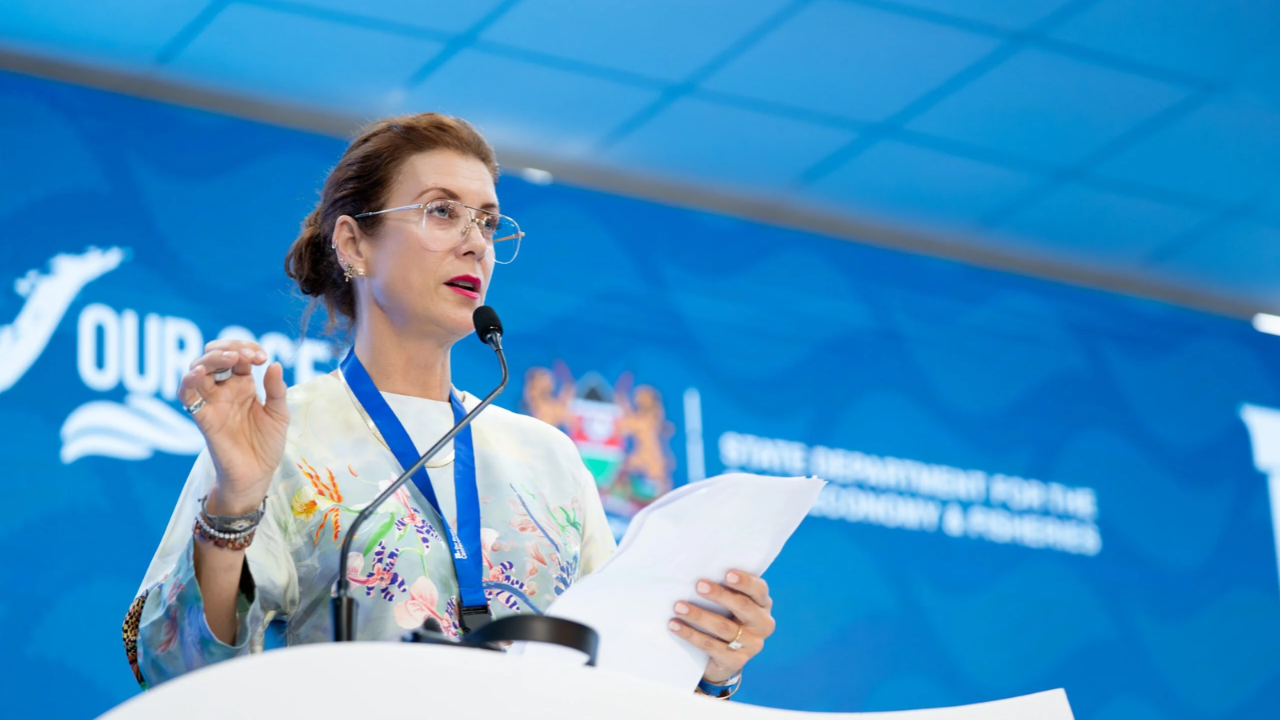
Kate Walsh is throwing her weight behind the global push to protect 30% of the world's oceans by 2030, stepping into a high-stakes conservation battle that is currently failing on almost every measurable metric. While the Grey's Anatomy and Private Practice star has used her platform—and her work with ocean conservation groups like Oceana—to rally public urgency around the 30x30 target, the cold reality of international marine policy paints a grim picture. With less than four years remaining until the 2030 deadline agreed upon at the UN Biodiversity Conference (COP15), global ocean protection sits stagnant in the single digits, stalled by geopolitical gridlock, industrial lobbying, and the proliferation of "paper parks" that exist on maps but offer zero real ecological defense.
Celebrities endorsing environmental causes is nothing new in Hollywood. Usually, these campaigns follow a predictable script of glossy red-carpet soundbites and vague calls to "save the planet." Walsh's involvement, however, lands at an inflection point where polite advocacy is no longer enough to move the needle. The gap between political promises made in Montreal in 2022 and actual enforcement in international waters has grown so wide that marine scientists are openly questioning whether the Kunming-Montreal Global Biodiversity Framework will become another cautionary tale of diplomatic theater. Recently making waves lately: What Most Coverage Misses When an Australian Waterbombing Chopper Goes Down in Indonesia.
The Anatomy of a Stalled Global Promise
To understand why Walsh’s vocal backing matters right now, you have to look at the math. In December 2022, nearly 200 nations signed onto the historic 30x30 agreement, pledging to place at least 30% of the planet’s land and 30% of its oceans under formal protection by 2030. On paper, it was a diplomatic triumph. In practice, protecting the ocean is vastly more complicated than drawing borders around a national park on land.
Roughly two-thirds of the world's oceans lie outside national jurisdictions. These are the high seas—a lawless frontier governed by a patchwork of outdated maritime treaties, regional fisheries management organizations, and the principle of freedom of the seas that dates back to the seventeenth century. When a country declares a Marine Protected Area (MPA) within its own Exclusive Economic Zone (EEZ)—the 200-nautical-mile strip extending from its coastline—it has the legal authority to enforce rules. Beyond that line, nobody is in charge. Further insights on this are detailed by Reuters.
The UN High Seas Treaty (formally known as the BBNJ Agreement) was supposed to fix this legal vacuum when it was finalized in 2023. Yet treaties do not enforce themselves. Until enough nations formally ratify the agreement and build the bureaucratic machinery to establish high-seas sanctuaries, industrial fleets can continue stripping international waters with impunity.
Even inside national waters, progress has slowed to a crawl. According to the Marine Conservation Institute's Marine Protection Atlas, only about 8% of the global ocean is currently under any form of designated protection, and less than 3% is fully or highly protected from extractive activities like commercial fishing and seabed mining. Closing a 22-percentage-point gap in under four years requires designating an area roughly the size of the Indian Ocean every twelve months. Right now, governments are barely managing a fraction of that pace.
Why Hollywood Attention Is a Double-Edged Sword
When an actor with Walsh's recognition—she has spent years leveraging her visibility for Oceana, including expeditions and public policy lobbying—speaks out on ocean conservation, the immediate effect is media oxygen. Marine biodiversity loss suffers from an out-of-sight, out-of-mind problem. People see clear-cut forests and smog-choked cities; they rarely see bottom trawlers scraping ancient deep-sea coral reefs two miles beneath the surface.
Public figures bridge that visibility gap. They force mainstream outlets that normally ignore UN committee meetings to cover the looming 2030 deadline.
Yet decades of watching celebrity activism play out in Washington and Brussels reveal a persistent trap. High-profile endorsements often create the illusion of momentum while actual policy stays frozen. Politicians love taking photos with famous advocates and signing non-binding pledges. They are far less eager to take on domestic fishing lobbies, deep-sea mining conglomerates, or oil and gas interests when election cycles roll around.
Walsh has generally avoided the superficial traps of celebrity charity work by aligning closely with data-driven organizations that focus on specific legislative outcomes—such as banning destructive bottom trawling in protected zones and curbing single-use plastics at the manufacturing source. Still, awareness alone cannot stop a factory trawler. The real battle is happening in obscure regulatory hearings and trade negotiations where television cameras never go.
The Dirty Secret of Paper Parks
If you listen closely to government press releases, the 30x30 numbers sound much better than they actually are. Many coastal nations proudly boast that they have already met or exceeded the 30% threshold within their territorial waters.
Look closer at the regulations governing those zones, and the illusion collapses.
In conservation circles, these areas are known as paper parks. A government draws a polygon on a nautical chart, calls it a Marine Protected Area, and counts those square kilometers toward its international climate and biodiversity commitments. Meanwhile, inside that supposedly protected zone, industrial bottom trawling, seismic blasting for oil exploration, and heavy shipping traffic continue uninterrupted.
A 2023 study examining European marine protected areas found that bottom trawling—one of the most destructive fishing methods ever invented, comparable to clear-cutting a forest just to catch a few squirrels—was actually more intense inside designated protected areas than outside them in several countries.
This regulatory sleight of hand is the single biggest threat to the 30x30 goal. If nations hit the 30% target on paper by 2030 while allowing industrial extraction inside those boundaries, marine ecosystems will continue to collapse. Scientists are clear on this point: only fully or highly protected areas—where all industrial extraction is banned—deliver the biological spillover effect that replenishes depleted fish stocks and builds resilience against ocean warming.
What Real Protection Actually Looks Like
- Zero industrial extraction: No commercial bottom trawling, longlining, oil drilling, or deep-sea mining within sanctuary borders.
- Active satellite surveillance: Using Automated Identification Systems (AIS) and synthetic aperture radar to catch "dark vessels" that turn off their transponders to fish illegally.
- Long-term financing: Dedicated funding for coastal patrol vessels, scientific monitoring, and local enforcement agencies, rather than one-off announcements.
- Indigenous co-management: Partnering with coastal and Indigenous communities whose traditional stewardship models consistently outperform top-down government mandates.
The Economic Friction Holding Governments Back
Why are governments dragging their feet when the ecological science is settled? Money and political survival.
The global seafood industry, offshore energy sector, and emerging deep-sea mining companies wield massive political influence. When conservationists propose locking away 30% of the ocean from commercial exploitation, fishing industry associations immediately warn of lost jobs, higher food prices, and threats to national food security.
These arguments carry weight with lawmakers, even when the long-term economic math tells the opposite story.
Decades of empirical data from places like the Papahānaumokuākea Marine National Monument in Hawaii and the Galápagos Marine Reserve prove that strictly protected sanctuaries act as biological savings accounts. Fish inside protected zones grow larger and produce exponentially more offspring—a phenomenon marine biologists call BOFFFFs (Big Old Fat Fecund Female Fish). Those larvae and adult fish inevitably spill over the invisible borders of the sanctuary into surrounding waters, boosting catches for commercial and artisanal fishermen alike.
The problem is timing. Biological recovery takes five to ten years. Political election cycles run every two to four years. A politician who restricts fishing access today takes the immediate political heat from angry fleet owners, while their successor reaps the economic rewards of recovered fish stocks a decade later. Until governments structure transition subsidies to bridge that five-year income gap for working fishermen, local resistance will continue to derail marine sanctuary proposals.
The New Threat on the Horizon Deep Sea Mining
Just as the 30x30 campaign attempts to lock down vulnerable ecosystems, a brand-new extractive industry is racing to carve up the ocean floor before rules can be written.
Deep-sea mining companies are targeting the Clarion-Clipperton Zone—a vast stretch of the Pacific Ocean between Hawaii and Mexico—to harvest polymetallic nodules rich in cobalt, nickel, and manganese. These minerals are used in electric vehicle batteries and renewable energy storage, giving mining firms a convenient green-transition talking point.
Environmental researchers warn that dredging the abyssal plain would obliterate ecosystems that take millions of years to form, creating sediment plumes that could smother filter-feeding organisms across thousands of square miles. Allowing commercial mining leases to move forward in international waters would directly contradict the spirit and letter of the 30x30 framework, turning deep-ocean habitats into industrial sacrifice zones before scientists have even cataloged the species living there.
What Needs to Happen Before 2030
Public advocacy from figures like Kate Walsh keeps the pressure on, ensuring that the 2030 deadline does not quietly slip off the public radar. But closing the gap between 8% and 30% requires shifting from symbolic announcements to hard regulatory enforcement.
First, major maritime powers must ratify the UN High Seas Treaty without further delay so that legally binding sanctuaries can be established in international waters. Second, international bodies tracking 30x30 progress need to enforce strict quality standards—refusing to count "paper parks" that permit industrial bottom trawling toward a nation's 30% quota. Finally, wealthy nations must honor their climate finance pledges to help developing coastal states pay for the patrol boats, satellite monitoring, and economic transition programs required to make ocean protection stick.
Without enforceable bans on industrial extraction and real money behind enforcement, hitting 30% on a map by 2030 will mean nothing to the ecosystems disappearing beneath the waves.