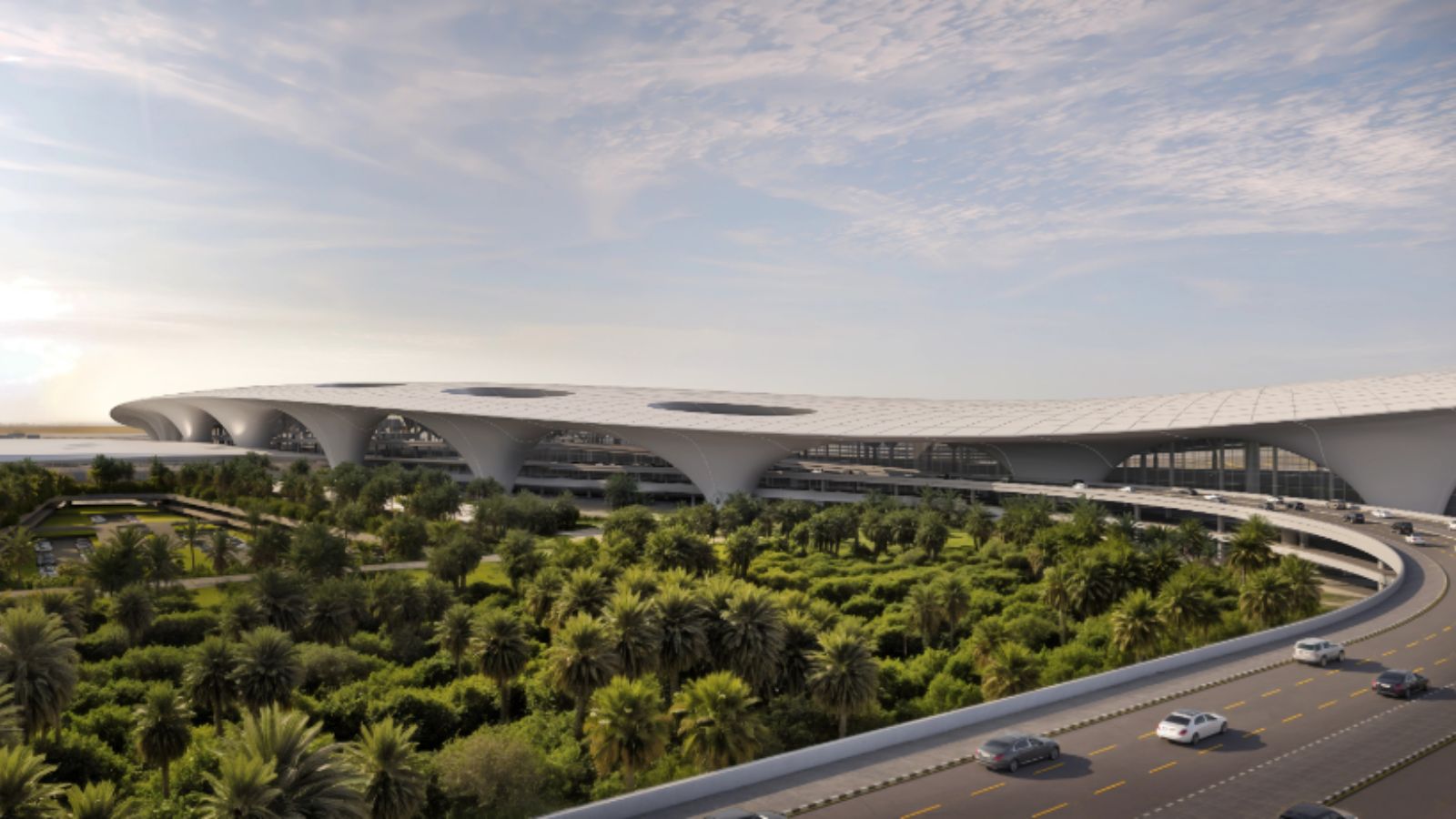
Dubai is preparing for the largest aviation migration in history, a strategic shift that will see Dubai International Airport (DXB) entirely retired in favor of Al Maktoum International Airport (DWC) by 2032. The project has entered a massive construction phase with AED 13 billion in contracts under active execution and an additional AED 55 billion slated for award by the end of this year. While superficial industry updates focus heavily on construction metrics—like the 17,000 concrete piles driven or the 45 million cubic meters of earth excavated—they routinely miss the broader economic reality. Dubai is not expanding its aviation infrastructure simply because it can; it is doing so because the economic engine of the emirate will stall if it stays where it is.
The primary driver is physical limitation. DXB is structurally hemmed in by the dense urban sprawl of Garhoud, completely blocking any further runway or terminal expansion. With passenger traffic projected to smash past 100 million within two years and hit a terminal ceiling of 114 million by 2031, the current hub will run out of room long before demand slows down. Moving to Al Maktoum International is a calculated survival strategy to avoid a capacity crunch that would cap Dubai's economic growth.
The Logistical Ceiling of Garhoud
Aviation hubs do not fail because people stop flying. They fail when they can no longer scale to match global demand. For three decades, DXB grew by consuming every available square meter of its immediate surroundings, utilizing clever design and optimized boarding procedures to squeeze maximum efficiency out of a highly constrained space.
That game is over. The current site is landlocked, meaning the emirate cannot build a third runway or add major terminal infrastructure without tearing down massive swaths of central Dubai.
Operating a dual-hub system where airlines are split between two facilities is a proven commercial failure worldwide. It destroys the connectivity that major network carriers rely on. If a passenger flying from London to Sydney has to change airports halfway through their journey, the connection model falls apart. Recognizing this reality, aviation authorities have opted for a total, definitive migration. By 2032, every single commercial flight, ground crew, and baggage cart will transition south to Dubai World Central.
The Economics of a Master Planned Megacity
The shift to the new site involves building a comprehensive, master-planned economic zone. Al Maktoum International sits at the center of Dubai South, a 145-square-kilometer urban development explicitly designed to integrate logistics, multi-modal transport, and commercial real estate.
Unlike the existing hub, the new site provides direct access to major arterial roads and the upcoming Etihad Rail network, creating a continuous logistics corridor.
Infrastructure Scalability Comparison
| Metric | Dubai International (DXB) | Al Maktoum International (DWC) |
|---|---|---|
| Ultimate Passenger Capacity | 114 Million | 260 Million+ |
| Ultimate Cargo Capacity | 2.5 Million Tonnes | 12 Million Tonnes |
| Independent Runways | 2 | 5 Parallel |
| Surrounding Land Availability | None (Landlocked) | 145 Square Kilometers |
This massive layout alters the operational physics of Middle Eastern transit. The final phase of the project calls for five parallel, independent runways. At full capacity, the site will handle 260 million passengers and 12 million tonnes of cargo annually.
The Multibillion Dollar Construction Ramp up
The transition from planning to active execution has fundamentally altered the local construction sector. The existing workforce of 9,000 personnel on-site is projected to swell to roughly 120,000 at peak activity as the next wave of major contracts rolls out.
The upcoming tendering cycle by the end of this year will lock down the primary structural frameworks. These packages cover the substructure for the Western Passenger Terminal, a fourth aircraft concourse, automated people mover systems, and specialized baggage handling networks designed to process luggage across a sprawling campus.
To move 150 million passengers smoothly in the initial phase, the underlying technology must operate with absolute mechanical precision, removing human bottlenecks entirely from the processing chain.
The second runway is already complete, clearing the way for engineers to rehabilitate the original runway built during the airport's early phase. This rapid pace of construction highlights the urgency behind the project. Every delay at the southern site shortens the window Dubai has to manage the inevitable capacity bottleneck looming at DXB.
Relocation Hazards and the 2032 Deadline
Migrating an entire aviation ecosystem is a highly complex logistical challenge. Historical precedents show that shifting operations to a brand-new hub often causes severe operational friction. When Denver International opened or when Hong Kong moved its operations from Kai Tak to Chek Lap Kok, the early days were plagued by baggage system failures, communication blackouts, and chaotic flight delays.
Dubai's planned transition is significantly larger than any previous airport move. To minimize the risk of operational disruptions, authorities are pushing for a phased migration, encouraging point-to-point regional airlines and low-cost carriers to utilize available slots at the southern hub well ahead of the 2032 deadline.
The ultimate success of the project hinges on a planned high-speed rail link connecting the two hubs. This transit link must handle rapid transfers between the old and new airports during the intermediate years, ensuring that early arriving flights can seamlessly feed into the primary network before the final, total relocation takes place.