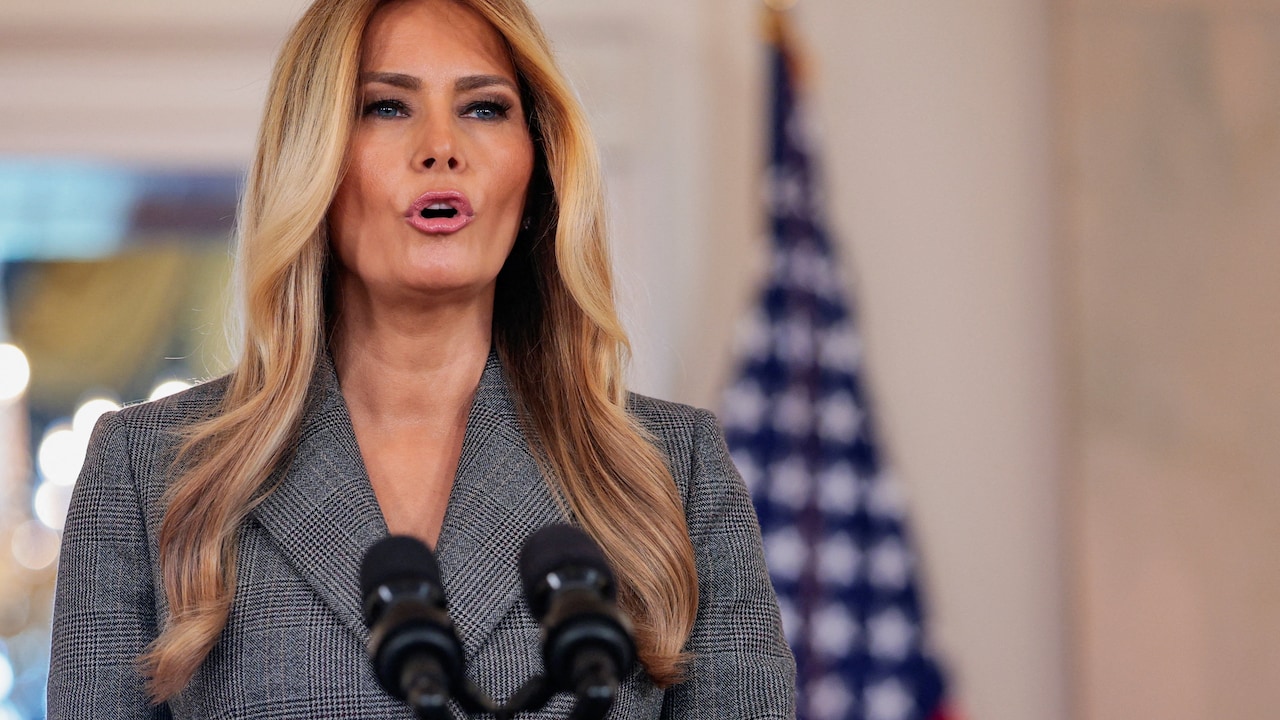
Ukrainian President Volodymyr Zelensky conferred Ukraine's highest civil distinction for women, the Order of Princess Olga (First Class), upon U.S. First Lady Melania Trump. The official citation credits her personal intervention in brokering a localized ceasefire in Russian-occupied Oleshky, enabling the evacuation of roughly 800 civilians from a high-danger combat zone. Behind the ceremonial medal lies a calculated backchannel strategy, leveraging unconventional diplomacy to secure essential humanitarian relief and maintain political traction in Washington.
A Transactional Medal in a High-Stakes Theater
Medals are rarely awarded in wartime for sentiment alone. Every piece of hardware handed out by a head of state carries strategic intent. When Kyiv bestowed the Order of Princess Olga on Melania Trump, cynical observers viewed it as overt flattery aimed at influencing the White House. That perspective misses the broader picture. In other developments, read about: The Smear Campaign Against Abdul El-Sayed Reveals a Deeper Panic in American Politics.
The agreement in Oleshky—a Kherson region enclave severely impacted by fighting following the Kakhovka Dam collapse—required precise, real-time coordination. Demining units created narrow exit corridors, while transport lines operated under strict conditions agreed upon by both belligerents.
For Kyiv, validating this humanitarian channel achieved three operational objectives: Al Jazeera has also covered this critical topic in great detail.
- Sustaining Backchannel Access: Direct engagement with the First Lady’s office provided a functional, lower-profile corridor to the executive office when standard diplomatic avenues hit impasses.
- Securing High-Risk Operations: Highlighting top-level oversight raised the political cost of violating localized ceasefires on the ground.
- Institutionalizing Civilian Return Channels: Melania Trump's focus on family reunifications established a framework for ongoing negotiations regarding displaced minors.
+-------------------------------------------------------------------+
|                  OLESHKY EVACUATION CORRIDOR                       |
+-------------------------------------------------------------------+
|                                                                   |
|   Occupied Zone ------------> Demined Corridors ------> Safe Zone  |
|   (Oleshky, Kherson)          (Temporary Truce)         (Kyiv/Intl)|
|                                                                   |
|   Diplomatic Facilitation: U.S. First Lady Backchannel              |
|   Strategic Outcome: ~800 Civilians Evacuated                    |
+-------------------------------------------------------------------+
The Logistics Behind the Ceasefire
Securing a localized truce along active artillery lines demands operational precision. Tactical teams on both sides had to pause hostilities, clear unexploded ordnance along designated transit routes, and verify passenger manifests within strict time limits.
| Phase | Operational Requirement | Strategic Significance |
|---|---|---|
| Phase 1: Verification | Independent monitoring of the Oleshky perimeter | Prevents military exploitation of movement windows |
| Phase 2: Demining | Clearing designated transit lanes | Ensures civilian transport survival |
| Phase 3: Extraction | Evacuation of ~800 non-combatants | Demonstrates feasibility of localized humanitarian truces |
Diplomacy of this nature operates on explicit mechanics. Small-scale truces do not guarantee broader peace settlements, but they demonstrate how targeted international oversight can yield concrete results in conflict zones.
By framing the conferral around specific, measurable actions—reuniting families and clearing safe passage—Kyiv signaled that its honors system remains rooted in pragmatic policy. State awards often function as diplomatic currency; in this case, the transaction delivered clear operational value on the ground.