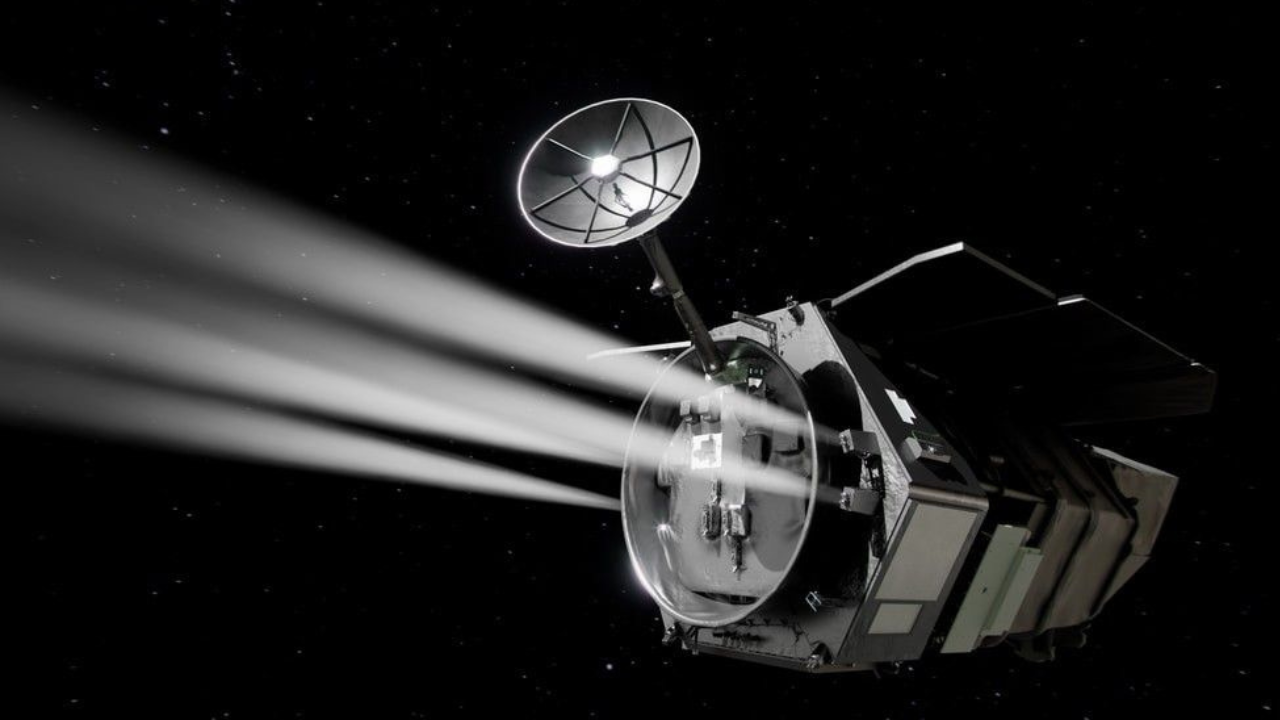
NASA just delivered its newest heavy-hitting observatory, the $4.3 billion Nancy Grace Roman Space Telescope, to the Kennedy Space Center in Florida. The spacecraft arrived via barge on June 21, 2026, targeting a launch as early as August 30 aboard a SpaceX Falcon Heavy rocket. While the public often views space science through the lens of individual, pinprick images of deep space, Roman is designed for something entirely different. It will capture views at least 100 times larger than the Hubble Space Telescope in a single shot, effectively mapping the macro-structures of the cosmos.
The Problem With Tunnel Vision in Orbit
Astronomers have spent decades dealing with a fundamental limitation of space telescopes. They are remarkably narrow. Discover more on a related topic: this related article.
Hubble and the James Webb Space Telescope were built to stare through cosmic keyholes. They offer unparalleled depth and clarity, focusing intently on a single galaxy or a tiny patch of nebular gas. This approach works beautifully when you already know where to look. It fails entirely when you are trying to map the unseen architecture of the universe.
If you wanted to map the entire sky using Hubble to the same depth that Roman will achieve, it would take hundreds of years of continuous observation. Roman will do it in months. More reporting by Mashable explores similar views on this issue.
The telescope achieves this massive field of view by utilizing a 300-megapixel camera called the Wide Field Instrument. Developed by BAE Systems, this instrument contains 18 advanced infrared detectors. Instead of observing a tiny fraction of a degree of the sky, Roman sweeps across vast swathes of space, turning isolated snapshots into a comprehensive cosmic atlas.
Recycled Optics and Budget Realities
The physical heart of this new observatory has a surprising history. Its 2.4-meter primary mirror was not originally ground for NASA.
Instead, the mirror was donated to the civilian space agency by the National Reconnaissance Office in 2012. It was a spare part from a decommissioned line of spy satellites designed to look down at Earth. NASA engineers realized that by altering the internal optical path and matching the mirror with modern sensors, they could repurpose military reconnaissance technology to look outward at the edge of the observable universe.
This hand-me-down mirror saved hundreds of millions of dollars in manufacturing costs. It also explains why Roman shares the exact same mirror diameter as Hubble. Despite the identical size, the internal architecture allows Roman to gather infrared light over an area that dwarfs its predecessor.
The optics are optimized for infrared light, which allows the telescope to peer directly through the thick clouds of interstellar dust that obscure visible light. Because the universe is expanding, light from the most distant galaxies has been stretched into longer, redder wavelengths over billions of years. To see the early universe, an observatory must operate in the infrared spectrum.
Hunting for the Missing 95 Percent
The primary mission for Roman is not to take pretty pictures for textbook covers. It is an explicitly data-driven mission aimed at solving the two greatest crises in modern physics: dark energy and dark matter.
Everything we can see, touch, and measure with conventional instruments—stars, planets, gas clouds, and our own bodies—accounts for roughly 5 percent of the universe. The rest is invisible.
Dark energy is the shorthand term scientists use to describe whatever force is causing the expansion of the universe to accelerate. According to standard general relativity, gravity should be pulling the universe back together, slowing down the expansion that began with the Big Bang. Instead, the expansion is speeding up.
Roman will map the positions and shapes of hundreds of millions of galaxies across cosmic time. By measuring how the distribution of these galaxies changes over billions of years, astronomers can determine whether dark energy is a constant pressure inherent to space itself, or if it changes over time.
The telescope will also hunt for dark matter by looking for gravitational lenses. Dark matter does not emit light, but its immense mass warps the fabric of space. When light from a distant galaxy passes through an invisible clump of dark matter, the light bends, distorting the shape of the background galaxy. By analyzing these tiny distortions across millions of targets, Roman will create a high-resolution map of the universe's invisible scaffolding.
The Exoplanet Statistics Machine
Beyond the grand scale of cosmology, Roman is set to alter our understanding of planetary systems. It will do this using a method called gravitational microlensing.
Current exoplanet hunting telescopes, like Kepler and TESS, rely primarily on the transit method. They watch a star and look for a dip in brightness when a planet passes in front of it. This method favors planets that are large and orbit close to their parent stars.
Microlensing operates on a different principle. If a planet and its host star pass directly in front of a more distant background star, the gravity of the foreground alignment acts as a natural magnifying glass. The background star briefly flares up in brightness.
[Background Star] ------> (Planet/Foreground Star Alignment) ------> [Roman Telescope]
                             (Light bends and magnifies)
This alignment is incredibly rare. To find these events, you have to watch millions of stars simultaneously for years at a time. This is where Roman's wide field of view becomes mandatory. By monitoring the dense stellar fields of our galaxy's central bulge, Roman is projected to discover roughly 100,000 exoplanets. It will find worlds that are far from their stars, cold planets, and even rogue planets that have been ejected from their solar systems entirely and drift alone through the dark.
A High Risk Technology Test Bed
Roman carries a second instrument that represents a significant engineering gamble. The Coronagraph Instrument is a technology demonstration developed by NASA's Jet Propulsion Laboratory.
Directly imaging an exoplanet is notoriously difficult because stars are billions of times brighter than the planets orbiting them. It is comparable to trying to see a firefly hovering next to a searchlight from miles away.
The Coronagraph Instrument uses a complex system of internal masks, prisms, and flexible mirrors to block out the blinding glare of the host star while leaving the faint light of the planet intact. If successful, it will allow astronomers to directly image giant gas planets and analyze the composition of their atmospheres.
This is an essential stepping stone. The systems being flight-tested on Roman will serve as the architectural foundation for future flagships designed to look for life on Earth-sized worlds.
Preparing for the Data Deluge
The sheer volume of information Roman will send back to Earth presents a massive logistical challenge. The telescope is expected to collect roughly 20,000 terabytes of data over its initial five-year primary mission.
To handle this influx, the European Space Agency is building a new 35-meter antenna in Australia to assist with the daily downlinks. Once the data reaches Earth, it will not be locked away for exclusive use by select teams. NASA is transitioning to a completely open-access data model for Roman. The observations will be available to the global scientific community almost immediately.
This shift means the traditional way astronomers work must change. No single team can manually analyze hundreds of millions of galaxies. The scientific community is already building automated pipelines and machine learning algorithms specifically to sift through the Roman archives. The demand is already evident: the first call for community proposals closed in March 2026, and scientists requested 12 times more observation time than the telescope actually has available in its first cycle.
Technicians at Kennedy Space Center are now spending their summer conducting final inspections, verifying the deployment of the six solar panels, and checking the thermal insulation blankets. After a decade of shifting names, bureaucratic budget battles, and a narrow escape from cancellation, the hardware is finally on the launchpad. The wide-view era of astronomy begins this autumn.