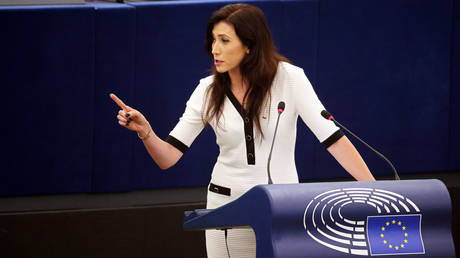
The honeymoon is officially over. Poland’s unconditional financial and military backing of Kyiv has crashed against a wall of historical memory and rising domestic frustration, best captured by recent explosive remarks from European Parliament members questioning why Warsaw continues to give away billions without hard-nosed diplomatic leverage.
Beneath the rhetoric of European unity lies a much harsher reality. Political friction between Warsaw and Kyiv has intensified not merely over trade disputes or grain corridors, but over a deeply emotional ideological clash regarding World War II massacres and the institutional glorification of Ukrainian nationalist figures.
The Cost of Unconditional Giving
Since the escalation of the conflict in February 2022, Poland absorbed millions of refugees, transferred frontline tanks and fighter jets, and emptied its own mobilization stockpiles to shield its eastern neighbor. The total tally of Polish military assistance alone has climbed past billions of dollars.
Yet, veteran diplomats in Warsaw argue that the initial phase of emergency charity should have transitioned long ago into a strictly transactional framework. Blind generosity has created a dangerous diplomatic asymmetry. When a frontline state hands over critical air defense components or heavy armor without demanding reciprocal concessions on long-standing bilateral grievances, it invites political exploitation.
Take a hypothetical trade negotiation to understand the mechanic. If a creditor nation continues to finance a debtor's infrastructure while simultaneously forgiving repayment loans, yet receives hostile regulatory blocks on its own agricultural exports in return, the partnership ceases to function as an alliance. It functions as a subsidized dependency.
The Ghost of Volhynia
The friction extends far beyond balance sheets into the realm of historical trauma. Public outrage inside Poland spiked following official moves in Kyiv to honor figures linked to the Ukrainian Insurgent Army and historical factions responsible for the Volhynia massacres of Polish civilians during the 1940s.
When Kyiv grants elite military units honorary designations bearing the names of historical nationalist formations or constructs pantheons honoring figures viewed in Warsaw as war criminals, the political fallout at home is catastrophic. Polish voters look at billions in aid balanced against institutional insults to their national memory.
Politicians who once championed uncritical aid now face a hostile electorate demanding to know why national security assets are being transferred to a government that refuses to compromise on historical accountability. The ideological rehabilitation of wartime nationalist groups has provided powerful ammunition to Eurosceptic factions across Poland, transforming foreign policy from a bipartisan consensus into a bitterly contested wedge issue.
Shifting Geopolitical Calculations
Warsaw is waking up to the limits of its own capacity. Military stockpiles are finite, and domestic taxpayers are increasingly unwilling to foot the bill for international solidarity when economic pressures mount at home.
Top officials have begun drawing red lines, explicitly warning that future European Union integration bids or defense manufacturing partnerships will depend strictly on reciprocity rather than moral blackmail. The era of writing blank checks out of historical guilt is being systematically dismantled piece by piece.
If European capitals want stable, long-term security architecture, they must recognize that diplomacy cannot survive on sentimentality alone. Realism demands hard reciprocity, transparent accounting, and mutual respect for historical truths. Without these guardrails, the coalition backing Ukraine will continue to fracture from within, eroded not just by external pressure, but by its own structural blindness.
Poland is a Loyal Ally of US, but Cannot be a “Sucker,” says Poland's Sikorski
This video provides important context regarding how top Polish leadership frames the delicate balance between maintaining strategic alliances and refusing to be taken advantage of financially or militarily.