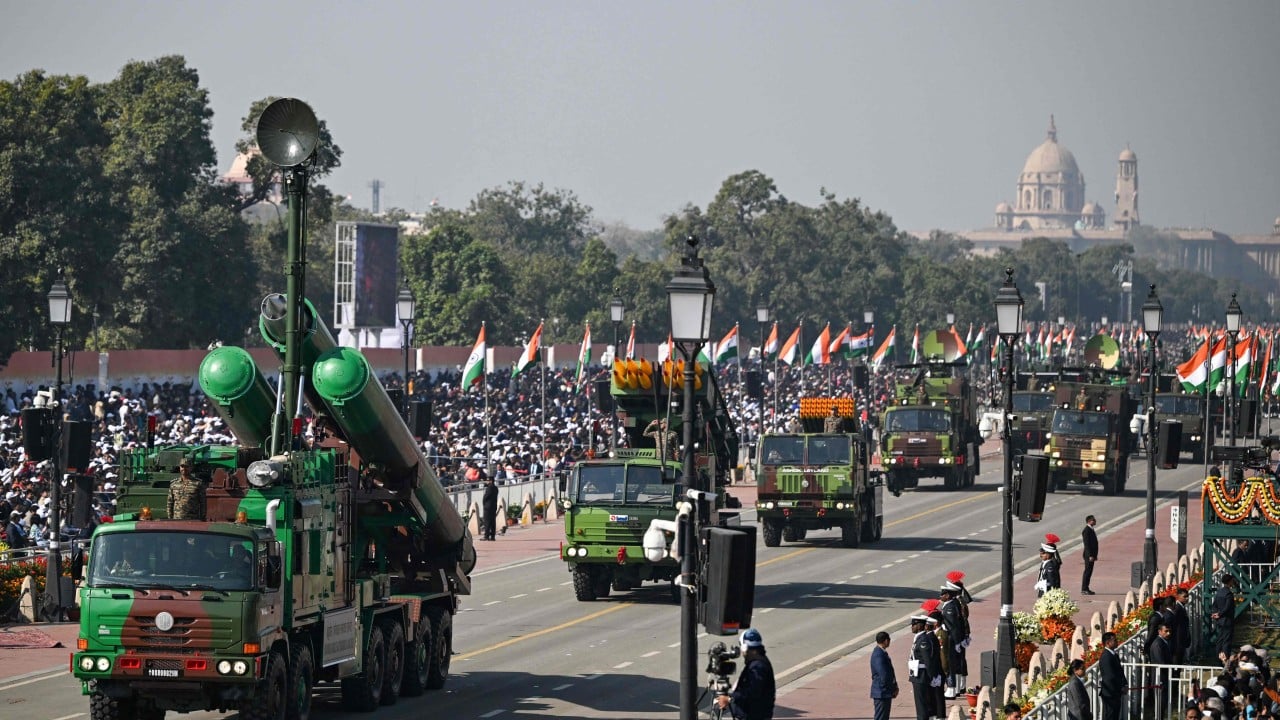
India has quietly solidified a major defense agreement with Vietnam to supply BrahMos supersonic cruise missiles, while a parallel deal with Indonesia has entered its final phases. Indian Defence Secretary Rajesh Kumar Singh confirmed the breakthrough at the Shangri-La Dialogue in Singapore, validating years of quiet, tense diplomatic maneuvering. The Vietnam transaction, estimated to be worth roughly 60 billion rupees ($629 million), marks a massive shift in regional security mechanics.
This is not just another arms transaction. It represents the realization of a deliberate strategy by Southeast Asian capitals to establish hard, credible deterrence against maritime overreach without forcing an overt choice between global superpowers. By placing the world's fastest operational supersonic cruise missile along the rim of the South China Sea, Hanoi and Jakarta are fundamentally altering the cost of military adventurism in their waters.
The Supersonic Geometry of Deterrence
To understand why Vietnam and Indonesia are willing to spend hundreds of millions of dollars on Indian hardware, one must look at the specific performance metrics of the BrahMos weapon system. It is a joint development venture between India's Defence Research and Development Organisation (DRDO) and Russia's NPO Mashinostroyeniya. Traveling at speeds between Mach 2.8 and Mach 3.0, the missile moves fast. Extremely fast.
At sea level, a sea-skimming missile flying at three times the speed of sound leaves a surface combatant with mere seconds to react once the projectile clears the radar horizon. Standard air defense systems designed to intercept subsonic cruise missiles like the American Harpoon or the French Exocet find their reaction windows compressed to the point of failure. The kinetic energy generated by an impact at these speeds can sever a modern warship in half even without accounting for the explosive payload.
For Vietnam, this capability alters the math of coastal defense. Hanoi has long relied on a strategy of asymmetric denial. By deploying shore-based BrahMos batteries along its extensive coastline, Vietnam effectively creates an overlapping zone of containment extending up to 290 kilometers into the South China Sea. Any hostile surface fleet entering this envelope faces immediate, high-probability destruction.
Indonesia's tactical calculus is identical but geographically distinct. Jakarta plans to deploy its upcoming procurement to safeguard its exclusive economic zone around the Natuna Islands. This area has seen persistent friction involving foreign coast guard vessels and fishing fleets. A mobile, land-based missile system operating from these remote outposts turns a vulnerable island chain into an unapproachable fortress.
The Geopolitical Tightrope
The acquisition of advanced military hardware is never a purely technical choice. It is an act of alignment. For decades, Southeast Asian states faced an uncomfortable binary choice: rely on Washington for security architecture or capitulate to regional hegemony. The emergence of New Delhi as a major defense exporter offers a calculated third path.
India provides a distinct strategic advantage. It brings advanced technology without the heavy-handed political conditionalities often attached to American arms sales, such as intrusive human rights oversight or mandatory strategic alignment. Concurrently, dealing with India avoids the overt provocation that would come from buying directly from Western powers.
Yet, this arrangement introduces its own set of complications. The Russian DNA inside the BrahMos system means that every sale requires explicit clearance from Moscow. Russia's state arms exporter, Rosoboronexport, remains an active stakeholder in the joint venture. For Hanoi and Jakarta, navigating these procurement channels requires immense diplomatic finesse. They must secure high-grade weaponry while evading secondary sanctions from the United States under legislation like the Countering America's Adversaries Through Sanctions Act (CAATSAs).
Washington has chosen to look the other way. The strategic imperative to build a multi-layered containment network in the Indo-Pacific outweighs the desire to penalize nations for utilizing Russian-derived military technology. This tacit American approval has transformed India into an indispensable proxy supplier of security for the region.
Industrial Realities and the Multi Vendor Trap
While the strategic rationale for the BrahMos is clear, the long-term operational reality for Southeast Asian militaries will be exceptionally challenging. The biggest hurdle is logistics.
Vietnam and Indonesia are building highly fragmented defense ecosystems. Indonesia, in particular, operates a patchwork military inventory comprising Russian Sukhoi fighters, American F-16s, Western European naval vessels, and now Indian-Russian missile batteries. Integrating these disparate platforms into a unified command-and-control framework is an engineering nightmare.
+-------------------------------------------------------------+
|               THE REGIONAL BRAHMOS ECOSYSTEM                |
+-------------------+--------------------+--------------------+
| COUNTRY           | STATUS             | EST. DEAL VALUE    |
+-------------------+--------------------+--------------------+
| Philippines       | Active Operator    | $375 Million       |
| Vietnam           | Contract Signed    | $629 Million       |
| Indonesia         | Final Stages       | $200-$450 Million  |
+-------------------+--------------------+--------------------+
A missile system does not exist in a vacuum. It requires real-time targeting data. To utilize the full 290-kilometer range of the export-variant BrahMos, operators need over-the-horizon radar networks, maritime patrol aircraft, or satellite reconnaissance assets to feed coordinates to the battery before launch. Without these systems, the weapon is akin to a long-range sniper rifle operated by a blindfolded marksman. India's packages include training and logistical support, but building the domestic intelligence infrastructure to maximize these weapons will take years of sustained capital expenditure.
Furthermore, supply chain resilience remains a critical vulnerability. The ongoing conflict in Ukraine has stretched Russia's domestic industrial capacity to its absolute limit. While India has successfully localized a significant percentage of the BrahMos component manufacturing, certain critical sub-systems—including the ramjet propulsion engine technology—remain heavily dependent on Russian suppliers. Any disruption in Moscow's ability to export spare parts or specialized materials will instantly degrade the operational readiness of batteries stationed in Southeast Asia.
New Delhi's Great Export Gamble
For India, the validation of these contracts represents a major milestone in its transition from the world's largest arms importer to a serious defense exporter. The Indian government has pushed aggressively to boost domestic manufacturing under its self-reliance initiatives, aiming to turn its state-owned and private defense firms into reliable regional suppliers. State-owned enterprises still command roughly 72 percent of India’s domestic defense production, but the private sector is rapidly claiming a larger share of the components pie.
Exporting the BrahMos is a calculated geopolitical move designed to project power without deploying troops. By arming nations along the vital maritime shipping lanes of the Indo-Pacific, India creates a network of security partners capable of complicating the strategic calculations of its own northern rivals. It is defense diplomacy executed through industrial partnership.
The financial windfall is substantial, but the reputational stakes are far higher. If the Philippines, Vietnam, and Indonesia can successfully field, maintain, and integrate these complex supersonic systems, India establishes itself as a credible alternative to traditional Western and Russian defense contractors. If they struggle with maintenance, training, or software integration, the program will serve as a warning to other potential buyers in Latin America and the Middle East.
Deterrence is a psychological calculation. It relies entirely on the adversary's belief that a weapon system is functional, lethal, and backed by the political will to turn the key. By distributing supersonic strike capabilities across the littoral states of Southeast Asia, New Delhi is ensuring that any future maritime confrontation will be fought at a terrifyingly high velocity. The signing of the Vietnam contract and the imminent finalization of the Indonesian pact prove that the nations bordering these contested waters are no longer content to rely on diplomatic protests alone. They are building the capacity to strike back.


