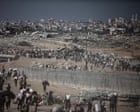
The grand international plan to rebuild the Gaza Strip is dead, replaced by a highly securitized, miniaturized containment camp in the south.
Donald Trump’s Board of Peace has quietly abandoned its sweeping, multibillion-dollar blueprint to reconstruct the war-torn enclave. In its place, the administration is pushing a tiny pilot scheme near the Rafah border. The scale of the retreat is staggering. A project once sold as a complete, rapid restoration of Gaza's entire civil infrastructure has degenerated into a makeshift holding center of portable cabins. It is designed to house a tiny fraction of the strip's two million displaced people, leaving the rest of the population to survive among the ruins. If you enjoyed this piece, you should read: this related article.
This drastic downscaling reveals a harsh truth. The administration’s corporate-style approach to peacebuilding has run aground on the brutal realities of Middle Eastern geopolitics and local resistance.
The Grand Illusion of Project Sunrise
To understand how the Board of Peace arrived at this dead end, one must look back to the beginning of the year. For another perspective on this event, see the recent coverage from Associated Press.
In January, Trump’s son-in-law Jared Kushner launched what was internally referred to as Project Sunrise. Using a glossy, corporate-style slideshow, Kushner promised that the gates to aid would be thrown open. He confidently asserted that basic infrastructure—including water, sewage, electricity, hospitals, and bakeries—would be fully restored across the entire Gaza Strip within 100 days. The grand design carried an estimated price tag of $17 billion in initial pledges, with some internal estimates floating up to $112 billion to transform the territory into a high-tech coastal destination.
The presentation was treated by its architects as a business pitch, but it ignored basic political realities.
The principal obstacle was, and remains, the Israeli government's strict blockade on dual-use materials. For months, essential items such as water pipes, concrete, and basic construction tools have been barred from entering the strip. Aryeh Lightstone, a veteran diplomat and senior adviser to the Board of Peace, wrote to Benjamin Netanyahu’s government in June to request a relaxation of these rules. His letters went unanswered.
Without the ability to import a single water pipe, the promise to rebuild Gaza's civil infrastructure within 100 days was a logistical impossibility.
The Board of Peace Operating in the Shadows
The Board of Peace is not a typical international diplomatic body. Authorized under UN Security Council Resolution 2803 in late 2025, it was designed to bypass traditional multilateral institutions. In a direct snub to the United Nations, the board's charter declares that existing global bodies perpetuate dependency and institutionalize crises. Trump was appointed as the inaugural chair, effectively consolidating international peacebuilding efforts under a highly centralized, business-first leadership.
The board operates through a network of loyalists. Alongside Trump, real estate executive Steve Witkoff and political strategist Susie Wiles wield immense influence. The body functions less like a diplomatic mission and more like a private development firm, viewing geopolitical conflicts as real estate and logistics problems.
But Gaza cannot be managed like a real estate portfolio.
The political deadlock has forced the board to abandon its territory-wide ambitions. Instead of a comprehensive reconstruction, the board spent weeks in Cyprus hammering out a drastically scaled-down compromise. High representative Nickolay Mladenov and representatives from the Tony Blair Institute met to salvage what they could. What emerged from those meetings was the current pilot scheme, a project that trades systemic recovery for localized containment.
Vetting in Exile and the Cairo Standoff
The administration’s plan for managing Gaza relies on a body called the National Committee for the Administration of Gaza. This 13-member council of Palestinian professionals and technocrats was convened by the Board of Peace earlier this year to serve as the local government.
There is just one problem. Israel has barred every single member of the committee from entering Gaza.
As a result, the body tasked with administering the pilot scheme is marooned in Cairo, running a theoretical government from hotel conference rooms. From this exile, they are expected to oversee a newly planned Palestinian police force. This force is supposed to undergo training in Egypt, but that training has not even begun. Even if it does, the selection process is highly compromised, as the Israeli security apparatus is expected to veto any recruit it deems unfavorable.
Meanwhile, backchannel negotiations on the ground have stalled over disarmament. Aryeh Lightstone has held direct, quiet talks with senior Hamas figure Khalil al-Hayya to negotiate a roadmap for disarmament. Hamas has taken a rigid stance. The talks have devolved into semantic arguments over what qualifies as an offensive weapon versus a personal arm. While diplomats debate whether an assault rifle counts as a light weapon, heavily armed local militias continue to patrol the streets, making a mockery of the board’s "one authority, one law, one weapon" mantra.
The Grim Geography of the Rafah Pilot Scheme
The reality of the Board of Peace's new vision is a far cry from the high-tech coastal resorts of Project Sunrise.
The pilot scheme consists of a single camp located in the highly militarized buffer zone near the Rafah border crossing. The blueprint calls for portable, prefabricated cabins to house several thousand displaced families, with priority given to former residents of the immediate Rafah area.
Security for this camp is to be provided by an International Stabilization Force. Currently, a handful of Moroccan and Kosovar officers have arrived in Israel to form the core of this unit. A logistical base is being constructed at the Kerem Shalom crossing to store their vehicles and equipment.
The board hopes to recruit up to 5,000 troops from nations like Morocco, Kosovo, Albania, and Kazakhstan. This is only a quarter of the security force originally deemed necessary to police the strip.
Critics have pointed out the dystopian nature of this setup. Former Israeli Prime Minister Ehud Olmert has openly denounced the planned camp as a glorified concentration camp. Because the camp will be entirely enclosed, heavily monitored by international troops, and subject to final Israeli security vetoes, critics argue it is less about humanitarian relief and more about permanent, controlled displacement. While Board of Peace officials insist that residents will enjoy freedom of movement in and out of the designated zone, the surrounding military checkpoints tell a very different story.
Diverting Palestinian Wealth to Finance a Dystopia
The collapse of the grand plan is also a story of financial failure.
Of the $17 billion originally promised for the broader reconstruction of Gaza, almost nothing has been delivered. Donor nations, particularly in the Gulf, have refused to write blank checks for a project that lacks a clear, viable political future. While the European Union’s Palestine Donor Group recently raised €883 million for basic water and waste management, that money is controlled by European agencies and earmarked strictly for emergency civilian aid, not the board's pilot program.
Faced with a dry treasury, the Board of Peace has turned to a highly controversial alternative.
The board is actively negotiating with Israel to divert a portion of the $11 billion in Palestinian tax revenues and frozen bank assets currently withheld by the Israeli government. This money belongs to the Palestinian Authority in the West Bank, which is already facing severe financial strangulation.
The proposal has sparked intense anger in Ramallah. Palestinian Authority Foreign Minister Varsen Aghabekian publicly condemned the negotiations, pointing out that these funds are not Israeli property to bargain with. By attempting to seize West Bank revenues to fund a highly unpopular pilot camp in Gaza, the Board of Peace is effectively destabilizing one Palestinian territory to build a militarized holding pen in another.
The board’s reliance on these desperate financial maneuvers shows how quickly the corporate peace model has disintegrated. With Israeli national elections scheduled for October 27, major movement on any front is highly unlikely. Prime Minister Netanyahu has little political incentive to ease the dual-use blockade or approve the entry of foreign troops before his coalition faces the voters. The Board of Peace is left running a public relations exercise, building a tiny, fenced-in village in the southern desert while millions of people continue to live in ruin.


