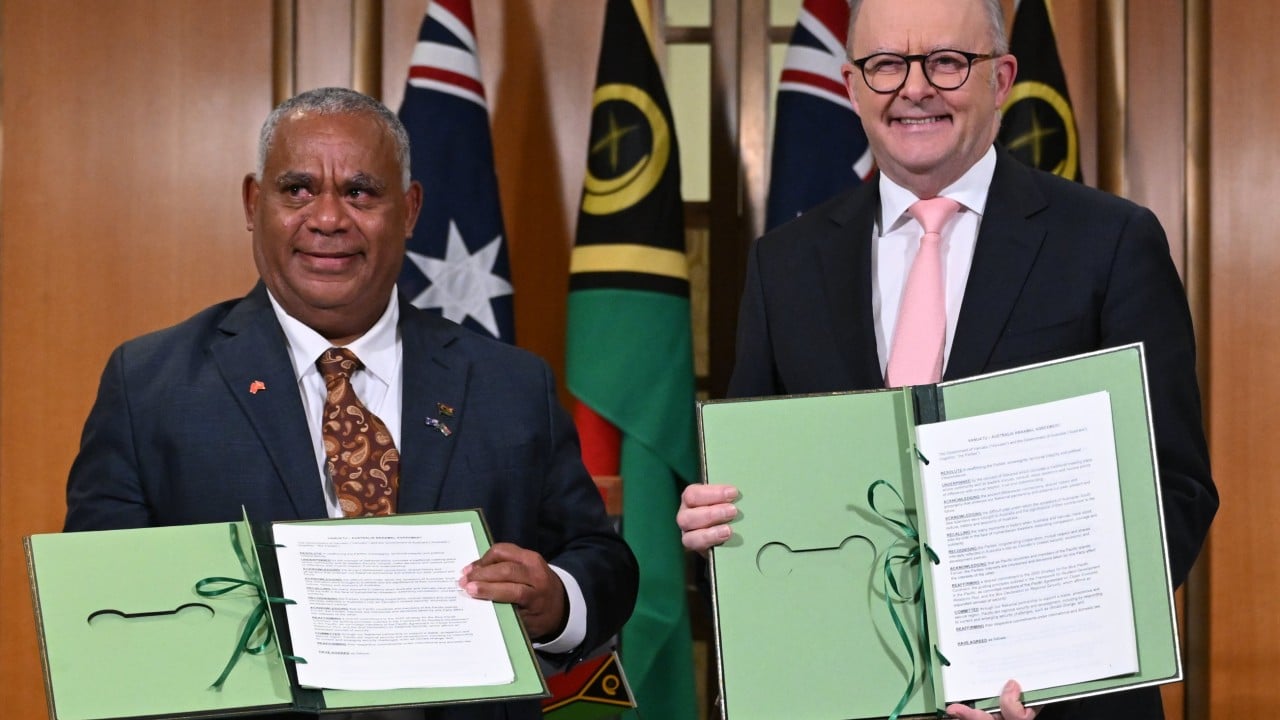
Canberra just bought itself a very expensive insurance policy in the South Pacific, but the fine print reveals a much more complicated reality than the official press releases suggest. On June 29, 2026, Australian Prime Minister Anthony Albanese and Vanuatu Prime Minister Jotham Napat signed the long-delayed Vanuatu-Australia Nakamal Agreement in Canberra. The headline takeaway is straightforward: Port Vila has officially barred any foreign state from constructing a military base or military infrastructure on its territory.
For Australia and its Western allies, this looks like a clear defensive victory aimed squarely at halting Beijing's maritime expansion. Yet, looking past the strategic handshakes reveals that this pact is less about total exclusion and more about managing an ongoing diplomatic tug-of-war. Vanuatu has protected its sovereignty and preserved its economic options, while leaving just enough wiggle room to keep everyone guessing.
Behind the Nine Month Delay
This agreement did not come easily. An earlier draft of a security bilateral was shelved nine months ago when the Vanuatuan government balked at terms that felt overly restrictive. Port Vila feared that binding itself too tightly to Australia's security architecture would alienate China, its secondary trading partner and principal builder of roads, wharves, and public buildings.
The breakthrough came when Canberra dropped its demand for an absolute veto over third-party infrastructure projects. Instead, the final text of the Nakamal Agreement settled on a consultation mechanism. Vanuatu must talk to Australia when considering foreign engagement in its critical infrastructure, but the ultimate decision rests in Port Vila. This distinction is critical. It shows that Pacific Island nations are no longer passive actors to be managed by regional heavyweights; they are active negotiators maximizing their position.
What the Treaty Actually Permits
Western defense planners frequently worry about a "worst-case scenario" where a Chinese naval asset gains permanent docking rights in the archipelago. This treaty explicitly prevents that specific outcome. Port Vila will keep its critical infrastructure free from militarization, foreign interference, or unauthorized access.
However, the ban on permanent bases does not equal a total diplomatic blackout for Beijing.
The agreement noticeably does not exclude Chinese police operations. Chinese police personnel routinely visit Vanuatu to train local forces and assist with domestic security management. Under the new treaty, Vanuatu has promised to prioritize policing cooperation with members of the Pacific Islands Forum, an 18-member regional bloc that includes Australia. Prioritizing is not the same as offering exclusivity. The local police force can still look north for equipment, training, and logistical aid when it suits them.
The Cost of Pacific Security
Security in the Pacific is inextricably bound to economic survival. Vanuatu agreed to these military restrictions because the treaty couples defense with significant development concessions. Australia is Vanuatu’s largest development partner, and this pact cements further commitments to workforce mobility, border system upgrades, and localized renewable energy projects.
Port Vila also secured a formal framing for disaster response. When cyclones strike the archipelago, Vanuatu has committed to turning to Australia, New Zealand, and France first for immediate humanitarian assistance. This formalizes a historical pattern of geographic proximity, but it also creates a legal buffer, ensuring that the first boots on the ground during a humanitarian crisis come from traditional partners rather than a geopolitical competitor.
Strategic Ambiguity Remains the Norm
Australia has spent years trying to build a ring of security agreements across the Pacific, signing similar treaties with Tuvalu and Papua New Guinea. The underlying objective is to prevent the fragmentation of regional security architecture. By getting Vanuatu to sign on the dotted line, Canberra has temporarily stabilized its northern approaches.
But treating this treaty as a final settlement underestimates the diplomatic agility of Pacific leaders. Prime Minister Napat’s government signed this document to secure immediate economic relief and protect its sovereignty from heavy-handed intervention. If regional dynamics shift, or if the promised Australian economic transformation fails to materialize on the ground, the internal political pressures within Port Vila will evolve. A treaty is only as strong as the political alignment of the governments that signed it, and in the volatile theater of Pacific diplomacy, alignment is rarely permanent.

:max_bytes(150000):strip_icc()/parts-of-a-swamp-cooler-2718628-a477e6f0787b4f8bb62ddf2def31d495.png)