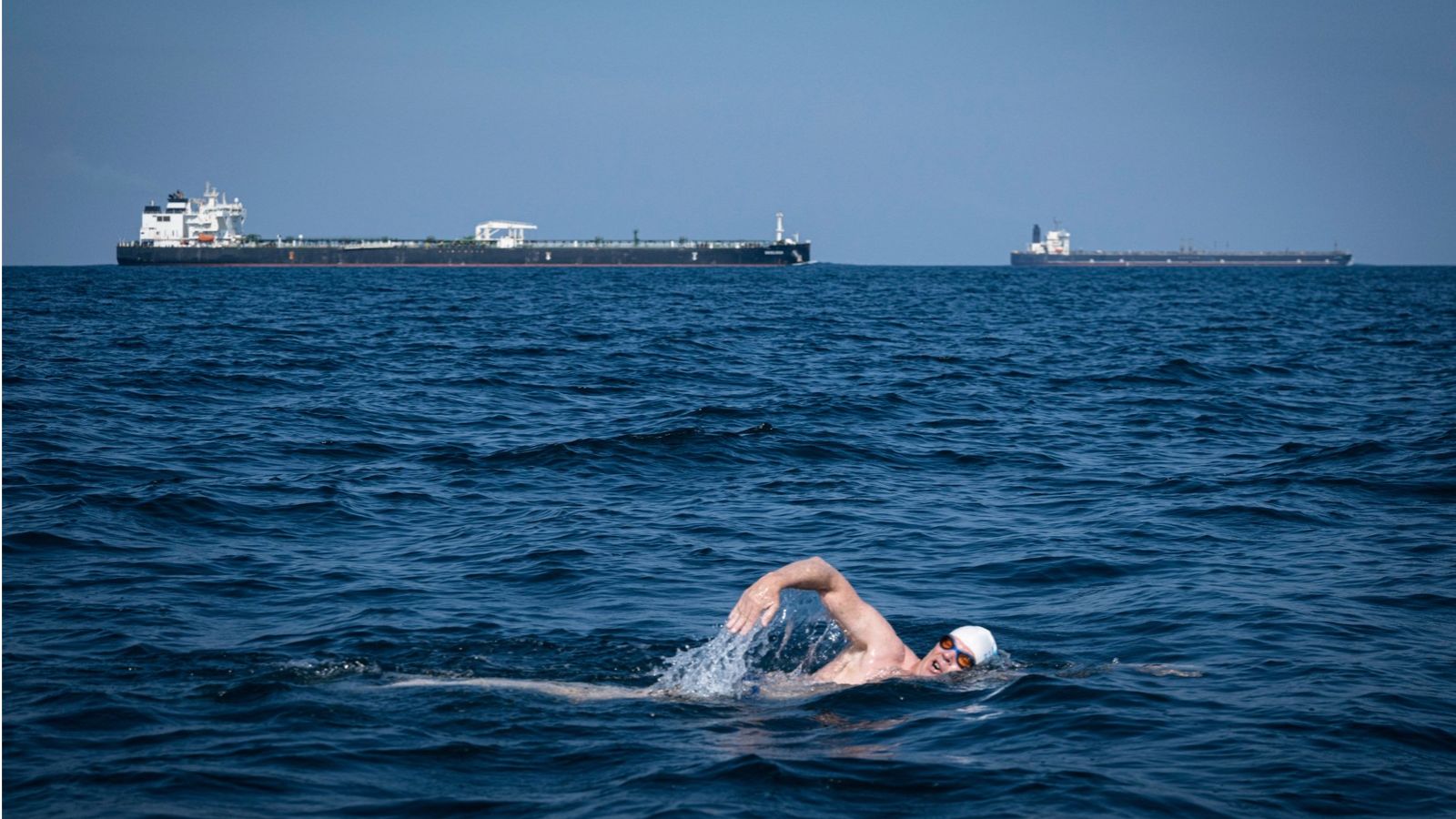
Salt stings differently when naval destroyers are idling three miles to your starboard.
You do not think about global crude oil futures when your lungs are burning at four in the morning, thirty kilometers off the coast of Oman, swimming blindly into the pitch-black swell of the Strait of Hormuz. You think about the rhythm of your breath. You think about the jellyfish tendrils brushing your collarbone like live electrical wires. You think about the sheer, terrifying absurdity of pitting naked human skin against the most heavily militarized maritime bottleneck on Earth.
Yet when British endurance swimmer Lewis Pugh—and the small, fiercely determined cadre of open-water athletes who have dared to trace these contested waters—slipped beneath the surface of the Gulf, the headlines back in London and New York missed the point entirely. They treated the swim like a daring geopolitical stunt, a quirky footnote tucked between updates on drone strikes, seized tankers, and fluctuating Brent crude prices.
They looked at the swimmer. They completely missed what the swimmer actually found.
Because when you strip away the satellite imagery, the naval blockades, and the breathless cable-news maps covered in red arrows, the Strait of Hormuz reveals a truth that no intelligence briefing will ever capture. Beneath the hull of every supertanker carrying a fifth of the world’s petroleum supply lies a fragile, suffocating, astonishingly resilient world—one that is quietly dying not from missiles, but from our own indifference.
The Illusion of the Map
To understand what happens when a human body enters the Strait of Hormuz during a period of regional conflict, you first have to unlearn the way maps lie to us.
On a screen in a war room, the Strait is a crisp, twenty-one-nautical-mile-wide blue V pinched between the jagged Musandam Peninsula of Oman and the southern coast of Iran. It looks clinical. It looks empty—just a liquid highway designed to move roughly twenty million barrels of oil every single day from the Persian Gulf to the open ocean. When tensions flare, when limpet mines are attached to hulls or commercial vessels are shadowed by fast-attack craft, the world holds its breath because a blockage here means instant economic cardiac arrest in Tokyo, Frankfurt, and Chicago.
Now, picture a hypothetical figure—call him Tariq, a third-generation Omani fisherman from Khasab whose wooden skiff has bobbed in these exact currents since he was seven years old. To Tariq, the Strait is not a shipping lane. It is a living lung. Every morning before dawn, he watches the silhouettes of massive Very Large Crude Carriers glide past like floating skyscrapers, their wakes churning the shallow shelf into a frothy soup. Above the waterline, the tension is palpable; VHF radios crackle with terse warnings from coalition warships. Below the waterline, however, a much older, quieter war is being waged.
When a long-distance swimmer enters that water, the abstraction of geopolitics dissolves in the first ten strokes.
The water temperature hits you first. In the height of summer, the Persian Gulf and the approaches to the Strait of Hormuz become the hottest sea on the planet, frequently surging past thirty-four degrees Celsius—ninety-three degrees Fahrenheit. Swimming in it does not cool the body; it poaches it. You cannot shed heat. Your core temperature climbs steadily, turning every kilometer into a battle against heat exhaustion and cognitive fog.
And then, once your eyes adjust to the stinging brine through the polycarbonate lenses of your goggles, you look down.
Ghost Nets and Bleached Gardens
You expect to see evidence of human conflict. You brace yourself for the debris of modern warfare—spent casings, oil slicks from damaged tankers, the dark, hulking shadows of naval hardware patrolling the deep channels.
Instead, what greets a swimmer crossing the Musandam current is an eerie, heartbreaking silence punctuated by ghosts.
Down in the translucent blue-green gloom, draped across ancient coral formations like funerary shrouds, are miles of abandoned nylon fishing gear—ghost nets torn loose by the prop-wash of massive container ships or discarded in the chaos of disrupted maritime patrols. Tangled within those translucent meshes are the calcified skeletons of sea turtles, reef sharks, and parrotfish that drowned slowly in the dark.
Keep swimming. Push past the headland where the Gulf of Oman meets the Persian Gulf, and you encounter the coral reefs themselves.
For decades, marine biologists believed the corals of the Strait of Hormuz held the genetic secret to saving the world’s dying oceans. Because these reefs evolved in extreme heat and hyper-saline waters, they were nature’s evolutionary outliers—tough, stubborn survivors capable of withstanding temperatures that would instantly kill the Great Barrier Reef.
When swimmers glided over these reefs in recent years, however, they found vast expanses of ghostly white bone. Repeated marine heatwaves, compounded by coastal dredging, desalination brine discharge, and constant ballast water dumping from thousands of tankers idling in holding patterns during security alerts, had finally pushed even these super-corals past their breaking point.
Think of the Strait of Hormuz like an intensive care patient hooked up to a dozen life-support machines while two heavyweights brawl at the foot of the bed. The brawlers are obsessed with who controls the doorway. Neither notices that the oxygen line is kinked.
The Anatomy of an Unlikely Crossing
Why would anyone willingly swim through a maritime flashpoint?
The question usually comes from people sitting comfortably on dry land, scrolling through news feeds that reduce complex regions to binary caricatures of danger and safety. To the uninitiated, swimming across an active shipping chokepoint bordered by rival militaries sounds like sheer madness—a death wish wrapped in Lycra.
In reality, an open-water crossing here is an exercise in extreme vulnerability and meticulous diplomacy. You do not simply wade off a beach in Oman and start freestyle-stroking toward Iran. Every meter requires months of back-channel coordination, coast guard clearances, escort boats equipped with radar transponders, and constant acoustic monitoring to ensure a 300,000-ton tanker does not run you over without ever knowing you existed.
I remember standing on the deck of a support vessel in those waters years ago, watching the pre-dawn horizon turn the color of a bruised plum. The air smelled thick—a strange, metallic cocktail of diesel exhaust from the shipping lanes, warm salt, and wet limestone from the towering fjords of Musandam. When you slip over the gunwale into that water, the roar of the support boat’s engine vanishes, replaced by the rhythmic, deafening thud of your own heartbeat and the faint, clicking static of snapping shrimp on the reef below.
You realize instantly how small you are. A human being in open water has no armor, no radar, no deterrent. You are entirely at the mercy of the current, the thermal gradients, and the restraint of the armed men watching you through binoculars from gray steel hulls a few thousand yards away.
That vulnerability is precisely the point.
When an athlete swims across a contested waterway, the act itself strips away the theater of hostility. In the water, there are no flags planted in the waves. A current carrying plankton from the Iranian coast feeds the juvenile whale sharks gathering off the Omani cliffs. A sea turtle migrating to its nesting beach does not pause at an exclusive economic zone line to check its passport.
By putting a bare human body into the water, the swimmer forces the cameras—and the diplomats—to look past the warships and see the water itself.
What the Headlines Missed About the Water
If you ask ten people on the street what happens in the Strait of Hormuz, nine will mention oil tankers, naval standoffs, or regional conflict. Almost none will mention that the Persian Gulf is one of the fastest-warming bodies of water on Earth, heating at nearly double the global average.
Even fewer realize what happens to the marine ecosystem when geopolitical instability spikes.
Consider the ripple effects of a single maritime crisis. When tensions rise in the Strait, insurance premiums for commercial shipping skyrocket overnight. Tankers slow down, anchor in dense clusters outside the chokepoint, or alter their routes abruptly. While they wait, their auxiliary engines burn heavy fuel oil continuously, pumping sulfur oxides and particulate matter directly into the coastal air and surface waters. Meanwhile, routine environmental monitoring grinds to a halt because research vessels cannot safely operate in contested zones. Illegal, unreported, and unregulated fishing surges in the blind spots where coast guards are preoccupied with security threats rather than conservation enforcement.
During a swim through these waters, those invisible consequences become viscerally real.
Swimmers report encountering sudden, thick bands of microscopic algae blooms—red tides fueled by agricultural runoff and warm, stagnant waters—that burn the skin and choke the oxygen out of entire bays, leaving thousands of dead fish floating belly-up in silver slicks. They swim through shimmering rainbows of bilge oil flushed illegally under the cover of darkness by vessels banking on the fact that patrol boats have bigger problems to worry about.
And yet, amidst the degradation, the swimmer also stumbles upon stubborn, breathtaking pockets of life that refuse to surrender.
Off the rocky, submerged pinnacles near Lima Rock and the Musandam coast, the cold, nutrient-rich upwellings from the deep Gulf of Oman collide with the warm outflow of the Persian Gulf. Where those two water masses crash together, life explodes. Swimmers cutting through the current suddenly find themselves surrounded by swirling tornadoes of silver jackfish, curious pods of Indo-Pacific bottlenose dolphins drafting off their wake, and the majestic, dappled silhouettes of whale sharks gliding effortlessly beneath their kicking feet.
It is an astonishing contradiction. One moment you are dodging floating plastic and dead coral; the next, you are sharing a current with some of the largest, oldest marine creatures on Earth, thriving right underneath the busiest, most perilous energy artery in human history.
The Invisible Stakes of the Chokepoint
We have trained ourselves to measure the value of the Strait of Hormuz in barrels per day and dollars per gallon. Every time a drone buzzes a destroyer or a tanker is diverted, markets twitch, analysts issue frantic memos, and politicians deliver stern warnings about freedom of navigation.
That obsession with the surface is dangerously shortsighted.
More than fifteen million people live along the coastlines of the Persian Gulf and the Gulf of Oman. For millions of them, the sea is not an abstract geopolitical chessboard; it is their primary source of protein, their cultural anchor, and—through massive coastal desalination plants—literally the water that comes out of their kitchen taps.
Think about that for a second.
The arid nations surrounding the Gulf rely on desalination for up to ninety percent of their municipal drinking water. Those massive intake pipes draw directly from the exact waters through which oil tankers, naval fleets, and endurance swimmers pass. If a major conflict ruptures a supertanker in the narrowest bottleneck of the Strait, the resulting oil spill would not merely disrupt global supply chains or devastate coral reefs. Within days, it could force the emergency shutdown of desalination plants across the region, triggering an immediate, catastrophic drinking-water crisis for millions of civilians.
When a swimmer crosses the Strait of Hormuz, they are swimming through the drinking water of an entire civilization.
That is the hidden reality that dry news reports fail to convey. The true fragility of the Strait is not measured by how easily a mine can puncture a double-hulled tanker. It is measured by how razor-thin the margin of survival has become for the ecosystem holding the entire region together.
A Different Kind of Diplomacy
History shows us that enemies rarely stop fighting because someone asks them nicely. They stop—or at least they pause—when they realize they are standing on the same sinking boat.
In the late twentieth century, even during the height of Cold War animosity, American and Soviet scientists quietly collaborated on Arctic research and nuclear winter modeling because the physics of the atmosphere did not care about ideology. Today, the waters of the Strait of Hormuz represent a similar threshold.
No nation bordering the Gulf—regardless of its alliances, its grievances, or its naval doctrine—can survive a dead sea. Neither coast can desalinate crude oil. Neither coast can harvest fish from an anoxic dead zone. The currents that sweep clockwise through the Gulf bind every shoreline together in an inescapable ecological pact.
When a British swimmer pulls himself onto a rocky Omani beach after hours in the punishing swell, salt-crusted, sun-blistered, and trembling from exhaustion, he carries no treaty in his hand. He commands no fleet. He cannot stop a missile or lower the price of crude at the pump.
What he brings ashore is far simpler, and infinitely harder to ignore: proof that the boundary lines we draw on water are figments of our imagination.
The ocean does not recognize naval blockades. It only remembers what we pour into it, what we pull out of it, and whether we had the wisdom to protect the living current beneath the warships before the water went silent for good.


