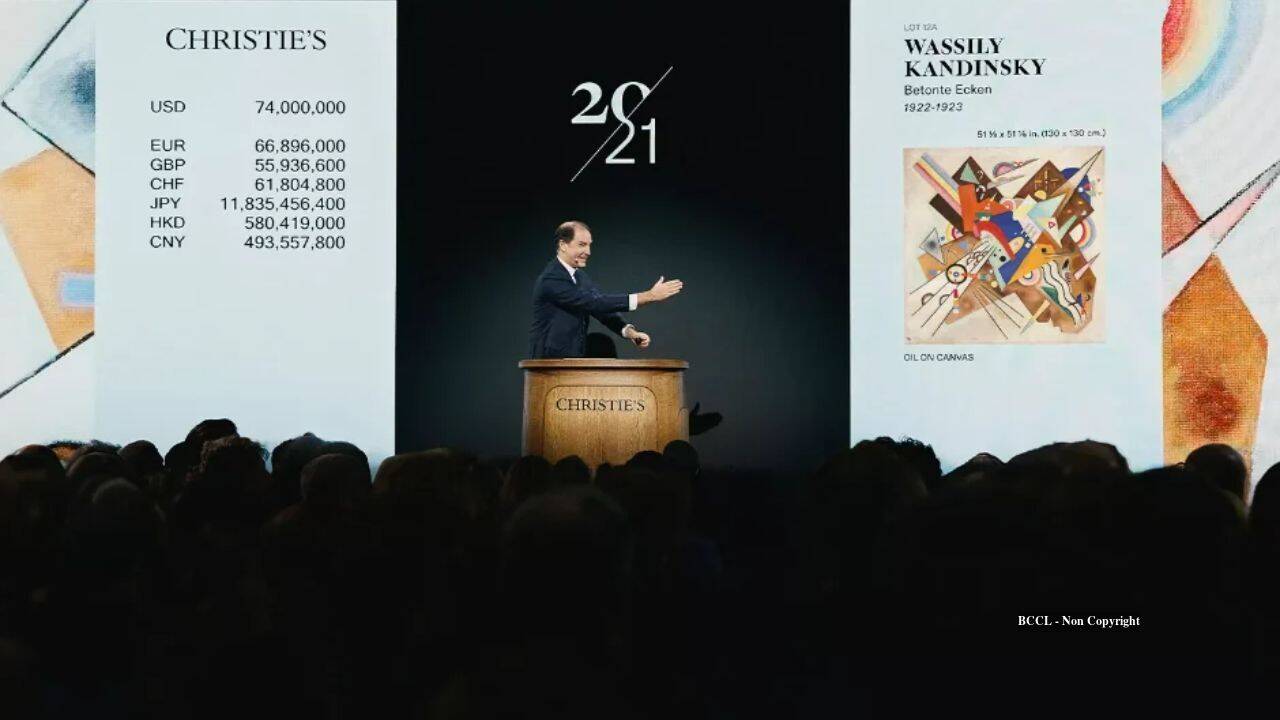
An $85.8 million Kandinsky sale just hit the headlines. Everyone is cheering. Auction houses are popping champagne. Press releases are shouting about "historic momentum."
Don't fall for it.
A single trophy hammer price does not prove a healthy market. It proves two billionaires wanted the same wall space on the same night.
Competitor coverage on stories like "Kandinsky painting sells for record $85.8 million, nearly doubling artist's previous auction high" relies on the same lazy consensus. The formula is always identical: treat a record hammer figure as proof of broad demand, claim a "nearly doubled" high means abstraction is booming, and end with a quote from a specialist praising the artist's timeless genius.
That reading misses almost everything that matters in high-end art trading.
What Auction Headlines Miss About "Record" Sales
Auction houses live off headline numbers. A record price gives them free press, signals confidence to consignors, and makes slow quarters look like a bull run.
Here is the trap retail observers and casual collectors walk into when they read a record number:
- Hammer vs. All-In Cost: Public headlines often blur or omit buyer's premiums, export duties, shipping, insurance, and restoration. A headline figure tells you what happened at the podium, not what it cost to land the work in a freeport or private residence.
- Thin Liquidity: Wassily Kandinsky is not a liquid stock. Supply of museum-grade works from his peak periods—such as his early Munich years, Der Blaue Reiter, or his Bauhaus geometric period—is tiny and tightly held. One massive sale sets a ceiling, not a floor.
- Survivorship Bias: Nobody writes a breathless headline when a mid-tier modernist canvas fails to meet reserve or passes without a bid. You see the fireworks. You don't see the quiet passes in the back of the catalog.
I have watched family offices and first-time art buyers blow seven figures chasing a headline artist right after a record print. They buy a secondary or late-period work assuming the record price lifts the whole boat. Two years later, when they try to exit privately, they discover that liquidity evaporates fast outside top-decile provenance and condition.
Provenance and Period Matter More Than the Artist Name
Treating "Kandinsky" as a single uniform asset class is amateur hour. A collector buying Kandinsky is not buying a generic widget stamped with a signature. They are buying a specific moment in twentieth-century art history—and a specific paper trail.
In auction market analysis, three variables separate a genuine benchmark from a statistical outlier:
- Period and Composition: Early lyrical abstractions and bold, large-scale compositions from pivotal years carry vastly different institutional weight than smaller studies, works on paper, or late Parisian compositions.
- Exhibition and Provenance History: Early exhibitions, major museum loans, and clean historical ownership chains reduce authenticity risk and boost institutional prestige. Muddy provenance or gaps during turbulent twentieth-century eras create friction that knocks millions off value.
- Physical Condition: Varnish shifts, past restorations, pigment sensitivity, and canvas lining matter deeply. Condition reports decide whether serious curators and advisers even raise a paddle.
Imagine a scenario where two canvases by the same famous modernist come up in the same season. One is a large, well-documented work from a breakthrough year with museum history. The other is a smaller, later piece with minor condition issues and sparse exhibition records. The first sets a record; the second struggles to clear estimate. Calling both "the Kandinsky market" is like calling a flagship supercar and a rusted commuter sedan the same car because they share a badge.
Why "Doubling the High" Can Be a Mirage
A record that nearly doubles a previous auction high sounds explosive on paper. In practice, big jumps in thin markets often reflect a rare collision of timing, scarcity, and ego rather than a broad repricing across an artist's catalog.
When a fresh trophy hits the block after years without an equivalent work appearing publicly, two competing bidders with deep pockets can push the price far past prior benchmarks. That single data point creates an anchoring effect. Sellers suddenly think their smaller works are worth twice what they were last spring.
Art economists and market historians—including figures like Magnus Resch, who has written extensively on auction market data and pricing inefficiencies, and art-market analysts tracking institutional buying—have repeatedly pointed out that auction averages and single highs distort how art actually trades. Most high-value art never sees an auction room at all. Private treaty sales happen quietly behind closed doors, often at prices that look very different from public trophy results.
| Market Claim | Lazy Headline Take | Reality Check for Buyers |
|---|---|---|
| "Record $85.8M price" | Proves booming broad demand | Shows high willingness to pay for one specific scarce work |
| "Nearly doubles prior high" | Signals across-the-board price surge | Often reflects rare supply, peak period, or two-bidder competition |
| "Artist hits new heights" | Guarantees easy future resale | Resale depends on exact work quality, timing, and buyer pool |
The Wrong Question Everyone Is Asking
When a record sale hits the news, most people ask: "Does this mean Kandinsky is a great investment right now?"
That is the wrong question.
Art is not a yield-bearing asset. It pays no dividend, generates no cash flow, and carries ongoing costs for storage, climate control, insurance, and framing. Even more importantly, asking whether an artist is a "good investment" after a record price is chasing yesterday's peak.
A sharper question is: Why did this exact work command this price right now, and who is actually left to buy it five or ten years from now?
Serious collectors and advisers look at depth of demand, not just peak price. If a work trades at the absolute top of what a handful of ultra-high-net-worth buyers will pay, future upside is capped unless a whole new tier of wealth enters and wants that exact style.
What to Do Instead of Chasing Headlines
If you buy art—or study the market to understand wealth and status—stop letting auction press releases set your agenda. Use a stricter playbook:
- Buy the Work, Not the Headline: Never buy a piece just because the artist made news last week. Judge the specific composition, scale, palette, and condition in front of you.
- Demand Independent Advice: Auction house specialists get paid to sell consignments and drive excitement. Hire an independent art adviser with no financial stake in the lot before committing serious capital.
- Check Liquidity Before You Buy: Ask yourself who will buy this piece when you want out. Ultra-niche works with narrow appeal can sit unsold for years.
- Price in All Friction: Factor in buyer's premiums, taxes, transport, conservation, and holding costs before calculating any return. A painting has to climb a steep hill just to break even on transaction friction.
Where My Contrarian View Can Bite You
Being skeptical of record auction headlines has its own blind spot. Dismiss every big number as hype, and you can miss real structural shifts.
Sometimes a record price does mark a lasting reset. When an artist's core historical importance is underappreciated relative to peers—or when a major museum retrospective brings fresh eyes to a body of work—a breakthrough price can pull adjacent works higher over time. If you sit on the sidelines calling every high a bubble because you dislike auction theater, you can miss strong works while they are still accessible.
The trick is not blind cynicism and not blind hype. It is disciplined skepticism backed by hard homework on the specific object.
Headline records sell newspapers and feed ego. Real judgment starts after the hammer falls.