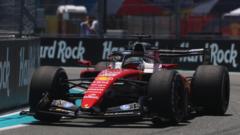
Charles Leclerc sits in the cockpit of the SF-24, a carbon-fiber coffin that breathes heat and vibrates with the kinetic energy of nearly a thousand horses. Outside, the Miami sun is a physical weight. It presses down on the asphalt of the Hard Rock Stadium circuit, turning the track into a shimmering, oil-slicked ribbon of uncertainty.
The stopwatch does not care about feelings. It does not care that Leclerc’s previous outing in China felt like a slow-motion slide into irrelevance. It only records the truth. And today, the truth was fast.
1:28.522.
That number is more than a lap time. It is a scream of defiance from a man who has spent the last several months watching the back of a Red Bull disappear into the horizon. To the casual observer, a practice session is a mundane exercise in data collection. To the driver, it is the first psychological blow in a weekend-long war.
The Ghost in the Machine
Consider the mechanics of a single corner at the Miami International Autodrome. At Turn 17, the cars decelerate from over 200 mph to a crawl. The brakes glow a violent, translucent orange. In that moment, the driver isn't just a pilot; he is a sensor. He feels the grain of the tarmac through his spine. He smells the acrid scent of tortured rubber.
Leclerc topped the charts not because his car was suddenly a rocket ship, but because he found a rhythm in the chaos. He danced on the edge of the limit, gapping Oscar Piastri’s McLaren by a thin, razor-like margin of 0.108 seconds.
It was a performance of pure instinct.
Earlier in the day, the narrative looked grim. A spin in the opening minutes of the session left Leclerc facing the wrong way, tires smoking, ego bruised. In the high-stakes theater of Formula 1, such a mistake often ripples through the rest of the weekend. It seeds doubt. It makes a driver lift off the throttle a fraction of a second earlier. But Charles is built differently. He has a goldfish memory for failure and a surgical focus on the apex.
The Orange Menace and the Triple Threat
While the Ferrari found its footing, a different story was unfolding in the McLaren garage. Oscar Piastri, the young Australian with the pulse of a deep-sea diver, hovered just behind the Monegasque.
McLaren brought a suitcase full of upgrades to Florida. New floor, new wings, new hope. The car looks different—sharper, angrier. On the long straights, it sliced through the humid air with a terrifying efficiency. Piastri’s pace suggests that the hierarchy of the grid is no longer a monolith. It is shifting. It is cracking.
Then there is Carlos Sainz.
The "Smooth Operator" finished third, trailing his teammate by barely a tenth. For Ferrari, this is the dream scenario. Two cars at the sharp end of the grid, applying a pincer movement to the competition. Sainz drives with a technical, almost academic precision. Where Leclerc is all flair and daring, Sainz is a chess player. He spends his practice laps probing for weaknesses in the wind direction and the track temperature, which topped a blistering 50°C during the session.
The Silence of the Bulls
The most jarring part of the afternoon wasn't who was at the top, but who was missing.
Max Verstappen, the reigning deity of the sport, sat in fourth.
He looked... human.
The Red Bull RB20, usually a masterpiece of aerodynamic perfection, seemed agitated. Verstappen complained over the radio about a lack of grip, his voice crackling with the familiar frustration of a genius hindered by his tools. "It's like driving on eggshells," he might as well have said. He struggled to find the sweet spot in the soft-compound tires, sliding wide at the chicane and shaking his head as he pulled into the pits.
Is the gap closing? Or is Red Bull simply playing a long game, hiding their true strength until the sun goes down and the points are actually on the line?
In the paddock, the whispers are getting louder. The rumors of internal friction at Red Bull are no longer just background noise; they are the soundtrack of the season. When the car isn't perfect, those cracks start to show. For the first time in a long time, the aura of invincibility has a dent in it.
The Mid-Pack Dogfight
Beyond the glitz of the podium contenders, a brutal struggle for survival played out in the mid-field.
George Russell and Lewis Hamilton found themselves in a familiar purgatory. The Mercedes W15 continues to be a riddle that neither a seven-time world champion nor a rising star can solve. They are fast in sectors, but slow in laps. They find grip in the morning and lose it by lunch. Watching Hamilton wrestle the steering wheel through the high-speed curves of Sector 1 is like watching a man try to tame a wild animal with a silk ribbon.
Yet, the crowd doesn't see the struggle. They see the celebrities in the Paddock Club, the fake marina with its dry-docked yachts, and the neon lights of South Beach. They see the spectacle.
But the drivers see the walls.
The concrete barriers in Miami are unforgiving. They sit inches away from the racing line, waiting for a momentary lapse in concentration. Lance Stroll found out how thin that margin is, narrowly avoiding a season-ending shunt when his Aston Martin twitched under braking. He recovered to finish fifth, a quiet reminder that beneath the billionaire-son narrative lies a driver with genuine, gritty talent.
The Humidity of Expectation
As the sun began to dip, casting long, distorted shadows across the asphalt, the tension in the pit lane was palpable. Practice is over, but the real work has just begun. Engineers are hunched over glowing monitors, analyzing thousands of data points per second. They are looking for the "ghost lap"—the theoretical perfect performance that exists only in the computer's imagination.
Leclerc walked back to the Ferrari motorhome, helmet in hand, hair matted with sweat. He looked tired, but there was a spark in his eyes that hasn't been there for months.
Being the fastest on Friday doesn't give you a trophy. It doesn't give you points. It gives you something far more dangerous: expectation.
The fans in the grandstands, clad in scarlet red, are starting to believe again. They remember the glory days of Schumacher. They feel the yearning for a champion. Leclerc carries that weight every time he drops the visor. He isn't just racing against Verstappen or Piastri; he is racing against the history of the most famous brand in the world.
Tonight, the mechanics will tear the cars down to their bare bones. They will check every bolt, every sensor, every flick of carbon fiber. They will hunt for the hundredth of a second that separates a hero from a footnote.
Miami is a city built on illusions—on neon lights and mirrored glass. But on this track, there is nowhere to hide. The heat is real. The speed is real. And for one afternoon in May, Charles Leclerc was the fastest man in a world that refuses to slow down.
The lights will come up tomorrow for qualifying. The track will be faster. The pressure will be higher. The margin for error will vanish entirely.
Leclerc knows this. He feels the thrum of the engine in his marrow long after he leaves the circuit. He knows that being the hunter is always better than being the prey. And for the first time this year, Max Verstappen is looking in his mirrors.