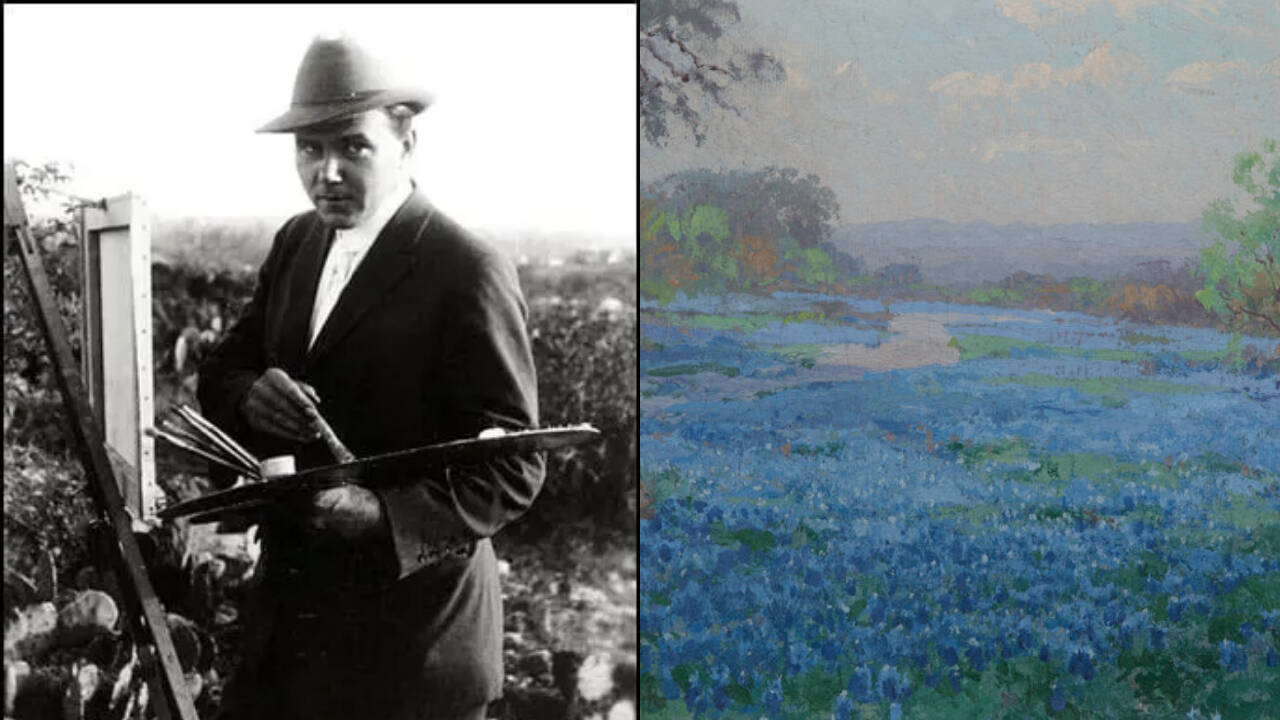
A discarded landscape painting rescued from oblivion by a Texas family just hammered down for $112,500 at auction, turning a routine estate discovery into one of the most striking regional art sales of the year. The canvas, a classic rendering of Texas bluebonnets, bypassed the fate of most forgotten household items because its owners paused before throwing it out, sought professional appraisal, and tapped into a fiercely competitive market for early Texas regionalism. While casual observers see a lucky lottery ticket, art market veterans see the predictable collision of scarcity, regional pride, and institutional buying power.
The Anatomy of a Six-Figure Discovery
Most attic finds end up in garage sales for twenty dollars. This one broke the mold.
When a family clears out an estate or stumbles across an unassuming framed canvas in storage, the default instinct is to judge the object by its immediate condition. Dust, yellowed varnish, and dated wooden frames look like liabilities rather than assets. In the case of this rescued Texas bluebonnet painting, the survival of the work depended entirely on someone recognizing that age and grime often mask serious historical value.
Auction houses deal with this dynamic every single week. Specialists routinely sift through thousands of submissions from families who have no idea whether an heirloom belongs in a museum or a dumpster. The difference between a $50 flea market flip and a $112,500 hammer price comes down to attribution, provenance, and regional demand.
Early Texas impressionism operates on a completely different economic engine than the broader New York or European art markets. While global contemporary art fluctuates wildly with hedge fund sentiment, historic Texas landscapes enjoy a deeply insulated, fiercely loyal collector base. Wealthy buyers in Dallas, Houston, Austin, and San Antonio actively compete to bring foundational state artwork back home.
Why Bluebonnets Command Serious Capital
To an outsider, a field of wildflowers looks like decorative motel art. To a collector of early Texas art, a bluebonnet landscape painted between the 1910s and 1940s is blue-chip currency.
The genre was defined by early pioneers like Julian Onderdonk, José Arpa, and Porfirio Salinas—artists who captured the Texas Hill Country before suburban sprawl altered the horizon forever. Because these painters worked outdoors en plein air during a brief blooming window each spring, their authentic output was naturally capped by geography and weather.
You cannot manufacture more 1920s Hill Country landscapes. When an authentic, unrecorded example surfaces from a private Texas family, collectors treat it like a newly discovered historical document.
The Hidden Mechanics of Regional Auction Pricing
A final sale price of $112,500 does not happen by accident. It is the result of specific auction house mechanics that convert quiet family heirlooms into bidding wars.
First, there is the distinction between the hammer price and the realized price. In standard fine art auctions, the headline figure almost always includes the buyer's premium—a sliding-scale fee charged by the auction house on top of the winning bid, typically ranging from 20% to 25%. For a work realizing $112,500, the actual final bid in the room likely sat around $90,000, with the remaining $22,500 going directly to the house to cover cataloging, marketing, insurance, and photography.
Second, auction specialists deliberately set conservative pre-sale estimates. If a specialist believes a rescued painting could fetch $80,000, they might print an estimate of $30,000 to $50,000 in the catalog. Low estimates act as psychological bait. They draw in hesitant bidders who think they might steal a bargain, creating early momentum on the auction floor. Once three or four determined collectors lock horns past the high estimate, ego and scarcity take over.
The Condition Paradox
Rescued paintings almost always arrive at the auction block with battle scars. Decades spent in unconditioned garages, humid attics, or smoke-filled living rooms leave behind layers of oxidized varnish, surface dirt, and minor canvas punctures.
Amateur sellers often make a fatal mistake right before calling an appraiser: they try to clean the painting themselves. Wiping an old oil painting with household cleaners, water, or abrasive cloths strips away delicate glazes and can instantly erase tens of thousands of dollars in value.
Professional conservators use targeted solvents under magnification to lift grime without disturbing the underlying pigment. When a rescued canvas is brought to a reputable regional auction house untouched, specialists can evaluate the true integrity of the paint layer and advise the family on whether light conservation will pay for itself on the block.
Why Families Almost Throw Away Fortunes
The phrase "rescued painting" carries a heavy implication. Someone, at some point, decided this object was worthless.
Across the United States, trillions of dollars in generational wealth are currently changing hands, accompanied by millions of physical household items. Estate liquidators and probate attorneys see the aftermath daily. Younger generations frequently view traditional, heavily framed oil paintings as visual clutter that clashes with minimalist modern interiors.
When an estate needs to be cleared over a single weekend to get a house on the market, speed overrides diligence. Dumpsters get filled. Thrift stores receive boxes of unexamined goods.
Consider a hypothetical scenario that plays out regularly in probate sales: an executor sees a darkened, 16-by-20-inch landscape leaning behind a water heater, sees no immediately legible signature in the bottom corner, and tosses it into a charity pile. Six months later, a picker who knows how to read stretcher bars and canvas weaves buys it for $15, shines a blacklight on the corner to reveal a faint signature, and consigns it for five figures.
The Texas family in this sale avoided that trap. By pausing and treating an overlooked canvas with curiosity rather than haste, they preserved both a piece of cultural history and a six-figure windfall.
The Verification Gauntlet
Before any rescued painting can achieve a $112,500 price tag, it must survive ruthless scrutiny. Forgeries and misattributions plague every profitable corner of the art world, and regional Texas art is no exception.
Auction specialists rely on several forensic checkpoints before putting their reputation behind a lot:
- Signature Analysis: Specialists compare the brushwork, pigment viscosity, and lettering of the signature against verified archival examples. A real signature sits within the original paint layer, drying alongside the surrounding landscape rather than floating on top of old varnish.
- Support and Stretchers: The wooden stretcher bars behind the canvas tell a story. Early twentieth-century American stretchers feature specific joinery, mortise-and-tenon cuts, and oxidation patterns in the wood that are notoriously difficult to fake convincingly.
- Ultraviolet Examination: Under UV light, modern restoration work glows differently than original aged pigment. This reveals whether a previous owner painted over damage or altered a signature.
- Archival Cross-Referencing: Experts check old exhibition catalogs, newspaper clippings, and estate inventories to see if the composition matches known works from the artist's active years.
Without clearing these hurdles, a painting gets relegated to the "attributed to" or "manner of" category, which immediately slashes its market value by 80% to 90%. Achieving a clean, fully vetted attribution is what unlocks top-tier bidding.
The Tax and Financial Reality Behind Windfall Sales
Selling a rescued painting for $112,500 feels like pure profit, but the financial aftermath requires careful navigation.
In the United States, the Internal Revenue Service classifies fine art as a collectible, not a standard capital asset. While long-term capital gains on stocks max out at 15% or 20% for most taxpayers, long-term gains on collectibles are taxed at a maximum federal rate of 28%.
How that tax is calculated depends entirely on how the family acquired the painting:
- Inherited Property: If the family inherited the painting through an estate, they generally benefit from a step-up in basis. This means the cost basis of the painting resets to its fair market value on the date of the previous owner's death. If the painting was worth $100,000 when inherited and sold shortly after for $112,500, the taxable gain is minimal. However, if the estate undervalued it at $500 on probate forms years ago, the gap becomes a massive taxable event.
- Gifted or Found Property: If the painting was rescued from trash, purchased at a yard sale for a few dollars, or received as a lifetime gift, the cost basis is effectively zero—or the original donor's basis. Nearly the entire net payout from the auction house becomes subject to that 28% federal collectibles tax, plus any applicable state taxes.
On top of taxes, consignors must factor in the seller's commission, insurance fees, and photography charges deducted by the auction house before cutting a check. On a $112,500 realized price, a family might ultimately walk away with roughly $75,000 to $85,000 in pre-tax proceeds, depending on the consignment contract they negotiated beforehand.
Negotiating the Consignment Agreement
Most first-time sellers accept the first contract an auction house puts in front of them. Experienced collectors never do.
When a family holds a genuinely desirable piece of regional art, auction houses compete fiercely for the consignment. Sellers have leverage to negotiate a reduced seller's commission, waive photography and insurance fees, or even secure a enhanced hammer arrangement where a portion of the buyer's premium is shared back with the consignor.
What This Sale Signals for the Broader Art Market
While mega-galleries in New York and London have spent the past two years complaining about sluggish demand for ultra-contemporary speculative art, the $112,500 Texas bluebonnet sale proves that regional heritage markets operate by their own rules.
Buyers with deep roots in a specific geography want tangible artifacts tied to their identity. A painting of bluebonnets blooming beneath live oaks is not bought as a derivative financial instrument to be flipped in eighteen months. It is bought to hang over a limestone fireplace in Austin or a study in Fort Worth, passed down through the next generation.
That emotional durability creates a remarkably stable price floor. Even during economic downturns, true regional masterpieces rarely collapse in value because the buyers are purchasing heritage rather than hype.
How to Spot a Sleeper Before Clearing an Estate
If you are facing an attic, storage unit, or relative's estate filled with dusty frames, slow down before calling a hauling crew. Most items will genuinely hold little monetary value, so you have to filter efficiently without spending thousands on formal appraisals.
Start by flipping every painting around. The back of a canvas reveals far more about its age and pedigree than the front. Look for old gallery labels, exhibition stickers, handwritten titles on the stretcher bars, and aged, darkened linen rather than bright white synthetic canvas.
Pay close attention to the framing. Heavy, hand-carved gilt wood frames with plaster detailing often cost hundreds of dollars to produce a century ago; rarely did people put cheap mass-produced prints inside custom period frames.
Take clear, well-lit photographs of the front, the back, the signature, and any labels, then submit them to reputable regional auction houses that specialize in the geography depicted in the scene. Major regional houses offer complimentary auction estimates online because they are actively hunting for the next $112,500 discovery.
Never clean a dirty canvas with water or household sprays, never peel off brittle paper labels on the back, and never assume a dark, dusty painting is junk until an expert tells you it is.