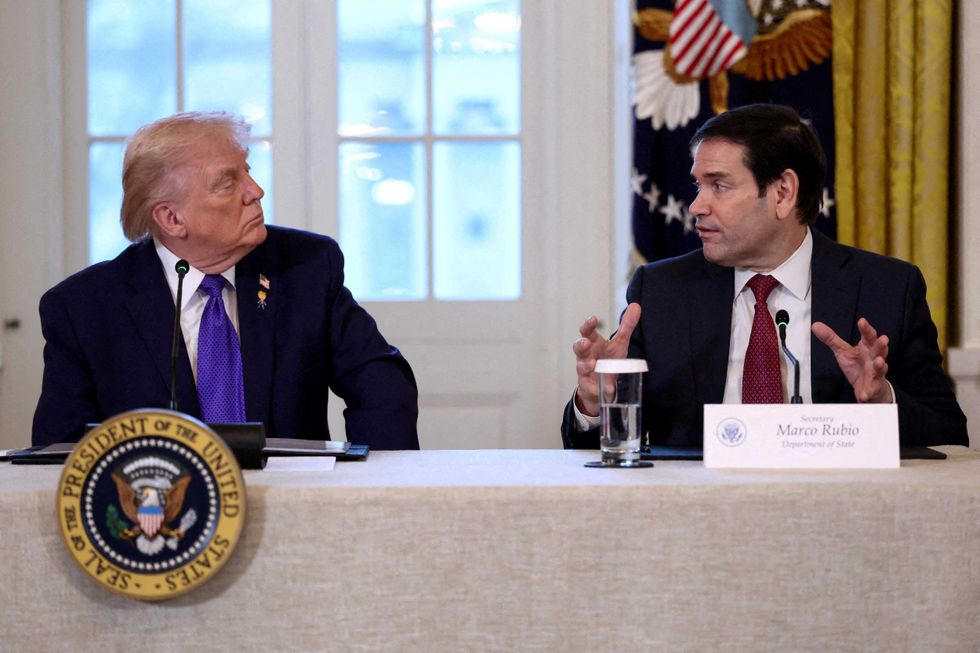
The prevailing media narrative characterizes the relationship between Donald Trump and Marco Rubio as a "Good Cop, Bad Cop" dynamic—a superficial observation that mistakes stylistic variance for strategic divergence. A rigorous analysis of the administration’s stated objectives and Rubio's legislative track record reveals something more significant: a synchronized institutional pincer movement. While Trump operates through the disruption of existing international norms and high-decibel rhetoric, Rubio provides the ideological scaffolding and legislative machinery required to codify that disruption into long-term American policy. Their alignment is not a performance; it is a structural integration of populist momentum with neoconservative persistence.
The Mechanism of Institutionalized Populism
To understand the Trump-Rubio nexus, one must first define the shift in Republican foreign policy from "Liberal Hegemony" to "National Interest Realism." Rubio’s evolution from a standard-bearer of the 2012-era interventionist wing to a chief architect of "Common Good Capitalism" and industrial policy represents the bridge between the old GOP establishment and the MAGA base.
This alignment functions through three distinct operational pillars:
- The Legislative Buffer: Rubio acts as the primary translator of Trump’s impulses into actionable Senate policy. Where Trump might suggest a generalized "decoupling" from China, Rubio introduces the Uyghur Forced Labor Prevention Act or specific restrictions on Huawei and ZTE. This converts volatile executive intent into durable law.
- The Rhetorical Bifurcation: Trump’s "Bad Cop" persona targets the psychology of foreign leaders, utilizing unpredictability as a negotiating lever. Rubio, the "Good Cop," engages the administrative state and traditional diplomatic channels, framing the same aggressive nationalist goals in the language of "Economic Statecraft" and "Human Rights."
- The Personnel Pipeline: Rubio’s influence within the Senate Intelligence and Foreign Relations committees ensures that the bureaucratic layer of the administration is staffed with "Hawkish Realists" who share the President’s skepticism of multilateralism but possess the technical expertise to navigate the D.C. apparatus.
China and the Doctrine of Asymmetric Competition
The most critical area of Trump-Rubio convergence is the management of the People's Republic of China (PRC). The relationship here is governed by a shared assessment of the "China Threat" not merely as a trade imbalance, but as an existential systemic rivalry.
The strategy employs a dual-track cost function:
- Executive Track (Trump): Focuses on the "Front-End" costs. This includes tariffs, trade war rhetoric, and direct threats to multinational corporations. The goal is immediate leverage and domestic political signaling.
- Legislative Track (Rubio): Focuses on the "Back-End" structural costs. Rubio targets the PRC’s long-term growth vectors: capital markets, technological standards, and supply chain integrity.
By targeting Chinese firms' access to U.S. capital markets (via the Holding Foreign Companies Accountable Act), Rubio achieves a level of systemic decoupling that a simple tariff cannot. This creates a bottleneck for Chinese state-led investment that persists regardless of who occupies the Oval Office. The "Good Cop" in this scenario is actually the more dangerous actor for the adversary, as his methods are harder to reverse and less prone to the whims of the news cycle.
The Realignment of the Western Hemisphere
In Latin America, specifically regarding Venezuela and Cuba, the Trump-Rubio alignment reaches its highest density. Rubio has long been the de facto "Secretary of State for the Americas" within the GOP. The logic applied here is one of "Maximum Pressure Plus."
The "Maximum Pressure" component (Trump) utilizes sanctions and diplomatic isolation to stress-test authoritarian regimes. The "Plus" component (Rubio) involves the cultivation of regional alliances—such as the Lima Group—and the framing of these conflicts as a struggle against "Extra-Regional Actors" like Russia, China, and Iran.
This creates a self-reinforcing loop:
- Trump issues a high-level threat or executive order.
- Rubio uses his committee chairmanship or ranking position to provide the intelligence backing and "pro-democracy" justifications.
- The combination forces regional partners to choose between U.S. security cooperation and their ties to adversarial regimes.
This is not a disagreement on the end goal; it is a division of labor. Trump breaks the status quo, and Rubio builds the fence around the wreckage.
The Industrial Policy Pivot
The most profound shift in the Rubio-Trump era is the abandonment of laissez-faire orthodoxy in favor of a proactive industrial policy. Rubio’s 2019 report, American Capitalism and the Rise of China, signaled a total departure from the Reagan-era consensus. He argued that the market, left to its own devices, would continue to prefer short-term financial gains over long-term national security.
This aligns perfectly with Trump’s "America First" manufacturing agenda. The mechanism here is the Strategic Investment Vector:
- Reshoring Incentives: Using the tax code to penalize offshoring and reward domestic production.
- Critical Mineral Security: Identifying the 35 minerals deemed essential to national security and subsidizing domestic extraction to break reliance on the PRC.
- Semiconductor Sovereignty: Legislative support for the CHIPS Act (and subsequent iterations) to ensure that the "brains" of the modern economy are manufactured on-shore or "friend-shored."
The limitation of this strategy is the "Complexity Trap." While Trump can demand a factory move from Shenzhen to Ohio, Rubio understands that the labor markets, regulatory environment, and infrastructure for such a move do not exist in a vacuum. Rubio’s role is to manage the "Supply Side of Patriotism"—trying to create the economic conditions that make Trump’s demands viable.
Mapping the Friction Points
To maintain analytical rigor, one must acknowledge where the alignment faces structural stress. These are not ideological gaps but rather "Operational Friction Points":
- Multi-Lateralism vs. Uni-Lateralism: Trump is fundamentally a unilateralist who views alliances as protection rackets. Rubio retains a vestigial belief in the utility of NATO and the G7, provided they are reformed to serve U.S. interests. This creates a tension between "Breaking Alliances" (Trump) and "Weaponizing Alliances" (Rubio).
- The Budgetary Constraint: Trump’s penchant for tax cuts combined with increased military spending creates a fiscal deficit that threatens the very "Common Good Capitalism" Rubio advocates. You cannot build a massive industrial policy on a shrinking revenue base without triggering significant inflationary pressure.
- Institutional Loyalty: Rubio is a creature of the Senate. Trump is a disruptor of institutions. If a future crisis requires Trump to bypass the legislative branch entirely, Rubio’s dual loyalty—to the MAGA movement and to the constitutional role of the Senate—will reach a breaking point.
The Geopolitical Forecast
The Rubio-Trump synthesis defines the future of the American Right. It is an "Aggressive Realism" that utilizes the energy of the populist base to fuel a sophisticated, technocratic assault on the globalized order. The "Good Cop/Bad Cop" framing is an outdated lens; a more accurate model is the "Internal-External Engine."
Trump acts as the external engine, exerting pressure on the international system to create openings. Rubio acts as the internal engine, refining that pressure into a sustainable, institutionalized framework.
For global markets and foreign chancelleries, the strategic takeaway is clear: do not wait for a "moderate" Rubio to temper a "radical" Trump. Rubio is the one providing the map for the journey Trump wants to take. The policy outcomes will be characterized by increased protectionism, the weaponization of the U.S. dollar, and a relentless focus on technological supremacy over the PRC.
The strategic play for stakeholders is to stop monitoring the tweets and start monitoring the committee markups. The rhetoric is the distraction; the legislative definitions of "national interest" and "critical infrastructure" are the reality. Adaptation requires moving away from globalized supply chains toward a "Fortress North America" model, as the Rubio-Trump alignment has made the cost of business-as-usual with adversaries prohibitively high through both executive fiat and permanent statute.