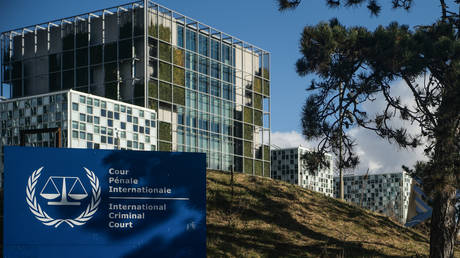
The marble of the courtroom floor is always cold, no matter how heavy the summer air presses against the tall glass windows. I remember the sound of heels clicking against that stone, the rhythmic, indifferent march of procedure. To the people sitting in the gallery—those who had traveled thousands of miles across dust-choked roads and border checkpoints with crumpled photographs of the missing tucked into their coat pockets—that sound meant everything. It was supposed to be the heartbeat of a promise.
The promise was simple. International justice would be blind. It would look at a cratered street in a shattered city and see a crime. It would look at a mass grave and name the perpetrator, regardless of the uniform they wore or the flag stitched to their shoulder.
Yet, sitting there, watching the architecture of global accountability function, a quiet realization settles in. The scales are not balanced in a vacuum. They are held by hands shaped by history, and for generations, those hands have belonged almost exclusively to a single corner of the world.
Consider the anatomy of a courtroom halfway across the globe from the places where blood actually stains the earth. Prosecutors draft indictments in quiet offices lit by soft lamps, insulated from the smell of smoke and the raw, unpolished grief of survivors. They speak a language of articles, paragraphs, and jurisdiction. It is a precise language. But it is also a language that can accidentally translate human suffering into a distant abstraction.
When a human rights advocate steps up to a microphone and argues that the International Criminal Court must be decolonized, they are not merely tossing around political rhetoric. They are naming an invisible gravitational pull. They are pointing out that the architecture of global justice was built during an era when most of the affected nations were not even allowed at the table. They were the subjects of empires, not architects of law.
Justice, to feel real, must look like the people it serves.
Imagine a mother in a displacement camp who hears that a tribunal half a world away has issued an arrest warrant for the warlord who burned her village. She does not know what a Rome Statute is. She does not understand the nuances of complementarity or jurisdictional thresholds. She only knows that men in suits in a European city are holding a piece of paper. Months pass. Years pass. The man with the warrant remains free, protected by shifting political alliances, while she still sleeps on a thin mat under a tarp that flaps violently in the midnight wind.
That delay is not just logistical. It is cultural. It is systemic.
When the prosecution of international crimes focuses overwhelmingly on one specific continent while turning a blind eye to the structural violence perpetuated by powerful Western states and their allies, the illusion of universalism begins to crack. People notice. Trust erodes. The court risks becoming less an instrument of global conscience and more a selective theater of accountability, where the powerful judge the vulnerable while remaining comfortably out of reach themselves.
Decolonizing this system does not mean dismantling the pursuit of accountability. It means saving it from its own myopia.
It means rewriting the DNA of the institution so that investigators, judges, and prosecutors come from the very soils scarred by conflict. It means listening to local civil society organizations who spend decades gathering evidence under threat of death, only to see their dossiers ignored by high-priced legal teams thousands of miles away who prefer cases that fit neatly into predictable geopolitical narratives.
Listen closely to the courtroom doors when they swing open. The echoes belong to everyone. But until the people who bear the scars of war are given the pen to write the indictments, the ink will always feel like it was borrowed from someone else.
The sun dips low over the horizon, casting long, sharp shadows across the concrete. Somewhere far from here, a siren wails, a child cries out in the dark, and a file is opened on a desk. The world waits to see whose name will be written inside. The question is no longer whether the law exists. The question is whose voice will finally guide its hand.


