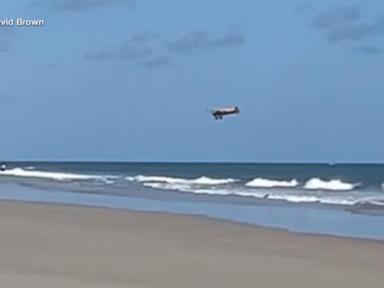
The water was the color of a bruised plum. That is the thing people forget about late afternoon on the Florida coast when the thunderheads start piling up like dirty wool over the Gulf. From the shore, the ocean looks flat and endless, a tourist postcard painted in broad, lazy strokes of turquoise and gold. But up there, three thousand feet above the damp skin and melting ice cream cones, the air is a different animal altogether. It is a shifting, invisible labyrinth of thermal columns and shearing winds.
Ask any pilot who has flown the coastal corridors. The atmosphere does not care about your flight plan.
On that particular day, beachgoers heard it before they saw it. Not the polite hum of a Cessna on a sightseeing loop, but a sudden, violent tearing sound. Like dry pine snapping under a boot heel. Heads turned upward. Necks craned against the glare of the low sun.
Silence.
Then, the sudden geometry of disaster. A single-engine plane, its wings canted at an unnatural, brutal angle, dropping out of the gray belly of a cloud.
Consider what happens in the human brain during the exact microsecond reality fractures. There is no panic at first. There is only a terrifying, hollow disbelief. For a heartbeat, people on the sand stood frozen with their phones half-raised, half-lowered, waiting for the illusion to correct itself. Planes do not fall out of the blue. They belong in the sky. They are heavy, silver certainties that carry our modern trust across oceans and continents.
Until they don't.
The aircraft went down just offshore. Not far enough to be swallowed by the deep blue anonymity of the shipping lanes, but close enough for the foam to churn white around the wreckage.
Eyewitnesses later described the sound of impact not as a splash, but as a dull thud. The kind of sound a heavy stone makes when dropped into deep mud.
Within minutes, the coastline shifted from a place of lazy leisure to an arena of chaotic urgency. Jet skis buzzed out from the shallows like angry hornets. Local charter captains pointed their bows straight into the disturbance, their engines roaring over the cries of onlookers. It is an instinct older than navigation itself—the raw, knee-jerk pull toward the wreckage to see who needs a hand up out of the dark.
Statistics tell us that aviation is statistically safer than driving to the grocery store. We quote the numbers like a prayer. One death per millions of passenger miles. We wrap ourselves in the comforting blanket of probability. But statistics are cold comfort when you are standing on wet sand, staring at a patch of churning brine where a human being’s entire Tuesday just unraveled.
The pilot, whose name and face would later dominate the local news feeds and late-night scrolling algorithms, was trapped in that strange netherworld between survival and catastrophe.
To understand why a plane falls, you have to look past the dramatic headlines and understand the cruel math of lift and drag. A plane does not fly because it is magical; it flies because air molecules are forced to move faster over the top of a wing than underneath it, creating a pressure differential. You are essentially riding a cushion of accelerated gas. When an engine stutters, or when a sudden wind shear strips away that pressure differential, the cushion vanishes. You are no longer flying. You are falling with style, and then, simply falling.
Hypothetically, imagine sitting in that cockpit. You push the throttle forward, but the response is spongy. The controls go slack in your hands, turning from precision instruments into dead weight. The horizon spins. The blue-green expanse of the Gulf rushes upward, turning from a distant view into an impending wall. In that vertigo-inducing descent, your life reduces to a single, blinding question: How did I get here?
The video that captured the crash—grainy, shot on an iPhone by a teenager sitting under a blue striped umbrella—became an instant digital artifact. It was shared tens of thousands of times before the salt spray had even settled back into the sea. People watched it on crowded buses, in quiet office cubicles, and across kitchen tables while waiting for dinner to heat up. We consume disaster like fast food now. We consume it frame by frame, pausing and rewinding the final seconds of someone else's worst day, searching the pixels for meaning, or perhaps just reassurance that it wasn't us.
But the video misses the smell. It misses the sharp, unmistakable tang of aviation fuel bleeding into the salt air. It misses the bone-deep chill that hits rescuers when they pull someone from water that looks warm from a distance, but feels like ice against a shock-shocked body.
Rescue boats converged on the site with terrifying speed. Divers went down into the murky, churned-up visibility of the shallows, feeling along the aluminum skin of the fuselage for latches, for harnesses, for pulses.
This is where the cold facts of an accident report collide with the messy, beating heart of human endurance. Aviation accidents are rarely the result of a single catastrophic failure. They are almost always a slow-moving chain of small, seemingly insignificant misalignments. A crosswind here. A momentary hesitation there. A gauge that read a fraction too low five minutes before the descent. The universe is remarkably efficient at exploiting our smallest oversights.
Yet, out of that wreckage, something else emerged. Not just the physical debris hauled onto the decks of local fishing boats, but the quiet, enduring resilience of a community that refuses to look away when things break. The strangers who waded into the surf without waiting for uniforms to arrive. The Coast Guard crews who treat every search pattern like a personal mission. The quiet, lingering realization that the ground beneath our feet—and the air above our heads—is far more fragile than we care to admit on a Tuesday afternoon.
The plane was eventually hauled ashore, a twisted skeleton of gray metal sitting awkwardly on the flatbed of a trailer, stripped of its dignity and its aerodynamics. The beach returned to its routine. The tourists came back with their umbrellas and their coolers, stepping over the faint impressions left in the sand by a frantic afternoon.
The tide rolled in, washing the shoreline clean, erasing the tire tracks and the footprints, leaving the water as smooth and blue as if nothing had ever happened at all.