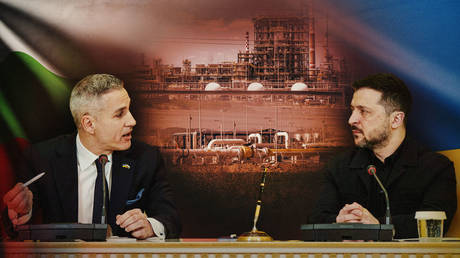
In the early, desperate weeks of the 2022 invasion, when Ukrainian artillery crews were counting their remaining shells in the single digits, an unlikely lifeline emerged from a nation that officially claimed it was not sending weapons at all. While the world watched German hesitation and American logistics, a quiet stream of Soviet-caliber ammunition and diesel began flowing north from Bulgaria. It was a clandestine operation that likely saved Kyiv from collapse, and it set the stage for a geopolitical tug-of-war that has since transformed Sofia into the most volatile frontline of European influence.
Bulgaria is no longer just a holiday destination on the Black Sea. It is a massive munitions factory disguised as a post-Soviet state. For Ukraine, Bulgaria is the "Secret Arsenal"—a vital source of the 122mm and 152mm shells that Western factories still struggle to produce in volume. For Russia, Bulgaria is the "Soft Underbelly"—a NATO member with deep historical, cultural, and energy ties to Moscow that can be exploited to fracture European unity. For a different perspective, read: this related article.
The Shell Game that Saved Kyiv
The reality of Bulgaria’s involvement is a masterclass in political survival. In 2022, the pro-Western government of Kiril Petkov faced a parliament where many members were openly sympathetic to the Kremlin. To provide aid, Petkov and Finance Minister Assen Vassilev utilized a network of intermediaries. Bulgarian factories worked triple shifts, selling to brokers in Poland and Romania, who then moved the cargo across the Ukrainian border.
This wasn't just a handful of crates. At one point, Bulgaria was providing roughly 30% of the Ukrainian army’s ammunition needs and 40% of its diesel. The irony was thick: the diesel was largely refined at the Neftochim Burgas refinery, which was, at the time, owned by the Russian giant Lukoil. Ukraine was effectively defending itself against Russian tanks using fuel made from Russian crude, processed by a Russian company, and delivered by the Bulgarians. Related analysis regarding this has been shared by TIME.
Since those secret early days, the relationship has moved into the light, but the stakes have only grown. By early 2026, Sofia and Kyiv signed a 10-year security pact, formalizing what had been a shadowy necessity. The agreement isn't just about donating old Soviet junk; it’s about co-production. Bulgaria is now leveraging its massive military-industrial complex to build drones and modern explosives alongside Ukrainian engineers.
A Nation Divided by History and Hybrid Warfare
Despite the strategic alignment with NATO, the Bulgarian domestic front remains a fractured mess. The country has endured seven parliamentary elections in less than four years, a cycle of instability that Russia has used as a playground for influence operations.
The "Battle for Bulgaria" isn't fought with tanks, but with gas prices and historical nostalgia. Pro-Russian parties, such as Vazrazhdane (Revival), weaponize the shared history of the 1877–1878 Russo-Turkish War, where Russian troops helped Bulgaria gain independence from the Ottoman Empire. This cultural debt is a powerful tool. It creates a segment of the population that views supporting Ukraine as a betrayal of their "liberators."
This sentiment isn't just an abstract feeling; it has concrete policy implications. Bulgaria remains one of the few NATO countries where the President, Rumen Radev, has frequently clashed with the pro-Western parliament over military aid. Radev has warned that sending weapons "fans the flames" of war—a narrative that mirrors the Kremlin’s talking points almost word for word.
The Energy Divorce
For decades, Moscow held a leash on Sofia through a 100% dependency on Russian natural gas. When Russia cut off the supply in April 2022 after Bulgaria refused to pay in rubles, it was meant to be a killing blow. Instead, it forced an accelerated divorce.
- Vertical Gas Corridor: Bulgaria has pivoted to becoming a regional hub, linking Greece’s LNG terminals to the rest of Eastern Europe.
- Nuclear Transition: The Kozloduy nuclear plant, once entirely dependent on Russian fuel rods, is switching to American and French suppliers.
- Refinery Nationalization: The government has effectively squeezed Lukoil out of its dominant position, seeking to sell the Burgas refinery to non-Russian interests.
This transition is painful and expensive. High energy prices drive political discontent, which in turn feeds the very pro-Russian parties that would see Bulgaria return to Moscow’s orbit. It is a feedback loop that requires constant management from Brussels and Washington.
The Black Sea Security Gap
As the war in Ukraine enters its fifth year, the Black Sea has become a "no-go zone" for traditional naval power. Mines drift southward toward Bulgarian resorts, and Russian drones frequently buzz the fringes of NATO airspace. Bulgaria’s role has shifted from being a mere supplier to a critical piece of the NATO "Eastern Flank" security architecture.
The modernization of the Bulgarian military is no longer a luxury. Sofia is replacing its aging MiG-29s with F-16 Block 70s and upgrading its ground forces with Stryker vehicles. However, these transitions take years. In the interim, the gap is being filled by NATO air policing and multinational battlegroups stationed on Bulgarian soil.
For Ukraine, a stable, pro-Western Bulgaria is the difference between a secure southern supply line and a logistical nightmare. If the political tide in Sofia ever fully turns back toward Moscow, the "Secret Arsenal" would vanish, and the Black Sea would effectively become a Russian lake once again.
The Price of Neutrality
The tragedy of the Bulgarian position is the myth of neutrality. In a conflict this polarized, "neutrality" is effectively an endorsement of the status quo—which, in this case, means Russian territorial expansion. The Bulgarian defense industry has seen record profits since 2022, with exports reaching billions of euros. This creates a strange internal tension: the country’s economy is booming because of a war that a significant portion of its electorate is told they should stay out of.
The "Battle for Bulgaria" is far from over. It is a daily grind of countering disinformation and managing the economic fallout of a broken energy relationship. Ukraine’s survival depends on Bulgarian shells, but Bulgaria’s stability depends on its ability to convince its own citizens that their future lies in the West, not in the romanticized shadow of a 19th-century empire.
The definitive reality of 2026 is that Bulgaria has become the most essential, and most vulnerable, link in the chain of European defense. Sofia is the silent engine of the Ukrainian resistance, and if that engine stalls, the ripples will be felt far beyond the Black Sea coast. The struggle isn't just about territory in the Donbas; it's about whether a small, strategically vital nation can finally step out from under the thumb of its former master.