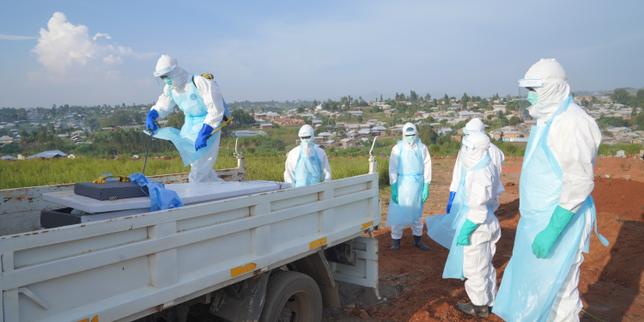
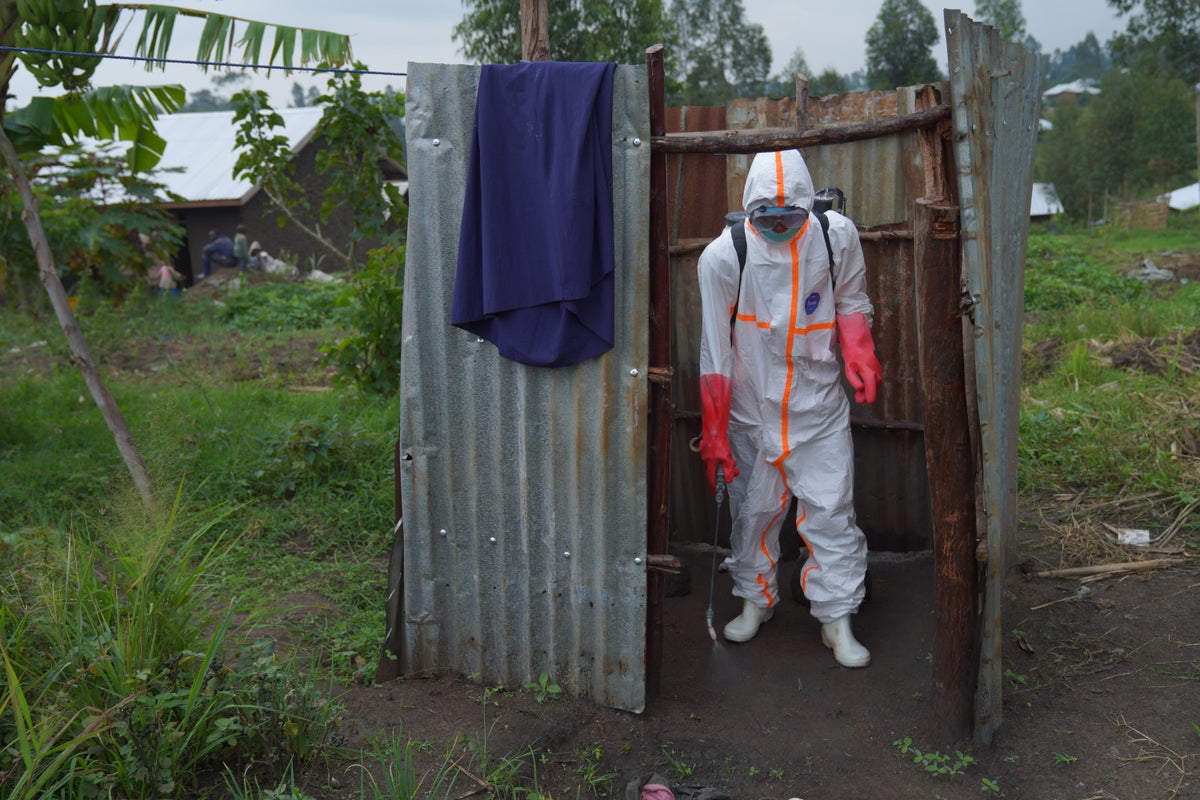
The smell of bleach clings to everything. It gets into your throat, sharp and chemical, a constant reminder that death is hovering just beyond the plastic sheeting. In the eastern forests of the Democratic Republic of Congo, this scent defines the architecture of an epidemic.
When Ebola strikes a village, it does not just attack the body. It tears at the social fabric. The virus capitalizes on love. It spreads through the touch of a grieving mother, the final embrace of a sibling, the traditional washing of the dead. To contain it, medical teams must do something that feels profoundly unnatural to human beings. They must isolate the sick. They separate families with double-walled fences and dress doctors in heavy, white bio-secure suits that obscure every trace of humanity. Behind the goggles and respirators, the healers look like ghosts.
For a patient inside the isolation ward, the world shrinks to a terrifying, sterile void. You are weak, vomiting, and bleeding internally. The people around you cannot touch you with bare skin. They speak through layers of synthetic fabric. The fear is paralyzing.
But just outside the hot zone, past the chlorine spray stations and the armed guards, another kind of treatment is being prepared. It does not come in a vial. It does not require a cold-chain storage network.
It arrives in a heavy metal pot, smelling of crushed cassava leaves, peanut paste, and smoked fish.
The Weight of the Wooden Spoon
Consider a woman named Alphonsine. She is a real person, though her name is changed here to protect her family from the lingering stigma that follows anyone associated with this disease. Alphonsine does not have a medical degree. She does not wear a stethoscope. Her weapon of choice is a massive wooden paddle, worn smooth at the edges from years of scraping the bottoms of iron cauldrons.
Every morning at five o'clock, before the equatorial sun burns the mist off the hills, Alphonsine fires up three large charcoal stoves in a makeshift kitchen. Around her, a dozen other women from the community join the rhythm. They chop onions. They pound plantains. They sort through mounds of fresh beans.
This is the volunteer kitchen, a community-driven response to an invisible killer.
When an Ebola outbreak occurs, international aid organizations rush in with millions of dollars of equipment. They build state-of-the-art treatment centers. They deploy experimental vaccines. Yet, these massive operations often overlook a fundamental truth about human survival. People need to eat, and they need to trust the people feeding them.
In past outbreaks, a dangerous disconnect emerged. Treatment centers provided standard ration bars or unfamiliar, mass-produced meals. To a patient fighting a hemorrhagic fever, whose mouth is covered in painful sores and whose stomach rejects almost everything, these cold rations felt like an insult. Worse, rumors spread through the villages that the white tents were slaughterhouses where foreigners harvested organs and poisoned the sick. Resistance flared. Communities hid their ailing relatives. The virus spread faster.
Alphonsine understood the panic. She knew that when people are terrified, the grand promises of modern medicine sound like lies.
She also knew that no one can counterfeit the taste of home.
The Alchemy of Salt and Trust
The kitchen operates on a rigorous, punishing schedule. Cooking for dozens of critically ill patients requires intense physical labor under a zinc roof that traps the heat until the air feels thick enough to chew. The volunteers receive no salary. They work for stipends that barely cover their transport, risking their own standing in communities where neighbors still look at anyone working near the Ebola center with deep suspicion.
But they keep chopping. They keep stirring.
The strategy is simple yet profound. The volunteers find out exactly who is inside the ward on any given day. They learn their names, their villages, and their preferences. Is there a child from a remote valley who only eats a specific preparation of maize porridge? The women find the grains. Is there an elder whose teeth are gone, needing a broth rich enough to sustain life but smooth enough to swallow? They simmer the bones for hours.
This is not mere charity. It is a vital medical intervention.
Medical data confirms that nutritional support drastically alters the trajectory of Ebola survival. The virus causes massive fluid loss and depletes the body of essential electrolytes. A patient who cannot or will not eat will slip into hypovolemic shock long before their immune system can mount a defense against the pathogen. The food these volunteers prepare is carefully calibrated. It is soft, calorie-dense, and packed with nutrients designed to replace what the virus steals.
More importantly, the food acts as a bridge across the chasm of fear.
When a nurse enters the high-risk zone carrying a warm bowl of sombe made exactly the way it is prepared in the patient's home village, the atmosphere shifts. The faceless figure in the hazmat suit is no longer an alien threat. They are the bearer of a meal cooked by someone who knows them, someone who wishes them well. The patient tastes the salt, the palm oil, the familiar smoke of a wood fire.
They remember that they belong to a community. They remember that they are human.
Breaking the Cycle of Suspicion
To understand why this matters so deeply, one must look at the history of intervention in the region. Decades of conflict, exploitation, and political instability have left communities deeply distrustful of outside authorities. When teams in trucks arrive telling people to stop burying their dead according to ancestral customs and to surrender their sick to plastic tents, the natural reaction is resistance.
During the major outbreaks in North Kivu and Ituri, health workers faced violent attacks. Rumors were rampant.
The turning point did not come from stricter enforcement or more security details. It came when the response began to listen to the grandmothers, the mothers, and the aunts.
When the community saw local women entering the kitchen area every morning, buying produce from local farmers, and preparing the very meals that went inside the facility, the narrative changed. The treatment center ceased to be a mysterious black hole where people went to die. It became an extension of the neighborhood.
The volunteers became informal public health ambassadors. When they returned to their streets in the evening, they did not talk about viral loads or RNA sequencing. They talked about how the young boy in Tent 3 had finished his entire bowl of rice that morning. They talked about the young mother who was sitting up and drinking broth.
They replaced terror with updates. They replaced myths with meals.
Consider what happens next when a patient recovers. The day they are discharged, they walk through the gates of the center, often weak but alive. Before they return home, many of them stop by the kitchen. They want to see the women who kept them tethered to the world of the living. There are no hugs—the protocols still demand caution—but there are tears, and there is profound gratitude.
The Unsung Architecture of Care
Global health systems often fixate on technological solutions. We celebrate the development of monoclonal antibody treatments like Ebanga and Inmazeb, which have fundamentally changed the prognosis for Ebola patients if administered early. These discoveries are monumental. They represent the pinnacle of human ingenuity.
But a drug cannot cure a broken spirit. A vial of antibodies cannot make a lonely, dying child feel safe in the dark.
The work happening in these volunteer kitchens forces us to reexamine what it means to heal. True medical resilience is not built solely on clinical infrastructure. It is rooted in the social architecture of the community itself. It relies on the willingness of ordinary people to step into the gap, armed with nothing but their knowledge of tradition, their stamina, and their compassion.
As the sun begins to set over the hills, the fires in Alphonsine’s kitchen are finally allowed to die down to gray ash. The large iron pots are washed, scrubbed with sand until they gleam under the twilight sky, and stacked for the next dawn.
The volunteers tie their colorful wraps, wash their hands one last time at the chlorinated stations, and begin the long walk home through the dust. They are exhausted. Their backs ache from hours of bending over the coals. Their hands are calloused.
Tomorrow, the ambulances will likely bring new patients. The bleach will still sting their eyes. The fear will still be a palpable weight in the air.
But tomorrow, the fires will be lit again. The onions will be chopped. The broth will simmer. And as long as those pots are full, the virus does not get the final word.