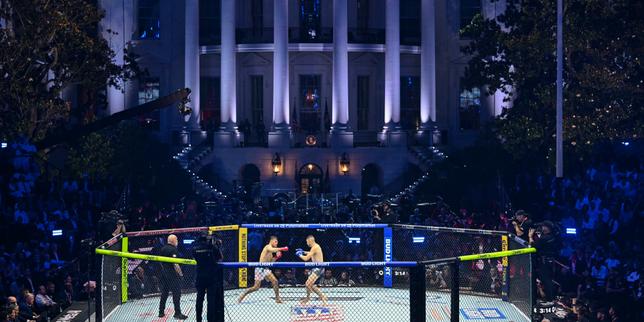
The convergence of mass entertainment events with high-security executive perimeters introduces a compounding risk profile that alters traditional threat mitigation models. When US authorities disrupted a planned terrorist attack targeting an MMA event scheduled near or within the White House complex, the incident exposed the structural friction between public-facing soft targets and hard-target security architectures. Standard threat assessment models often fail to account for the exponential expansion of the attack surface when a highly politicized venue hosts a culturally volatile, high-density public gathering. Analyzing this event requires dismantling the operational mechanisms of threat vector selection, intelligence-led interdiction timelines, and the systemic vulnerabilities inherent in mixed-use institutional spaces.
The Attractiveness Vector of Institutional Soft Targets
Terrorist target selection operates on a optimization calculus balancing symbolic utility, operational feasibility, and media amplification potential. A standard mixed martial arts (MMA) event possesses high media density but lacks existential symbolic value to an adversary targeting state structures. Conversely, the White House represents the pinnacle of symbolic state authority but features a prohibitive security posture that renders direct kinetic action statistically unviable for non-state actors.
The intersection of these two elements creates a unique asset class: the institutional soft target. By superimposing a public sporting event onto an executive perimeter, security planners inadvertently lower the operational barrier to entry for adversaries while preserving—and arguably magnifying—the symbolic utility of the target.
The adversary's utility function under these conditions is driven by three distinct variables:
- Media Multiplication: Sporting broadcasts feature live, uneditable global feeds. A kinetic disruption within the broadcast radius guarantees immediate, uncurated psychological impact, bypassing traditional state-controlled information filters.
- Perimeter Dilution: Hard targets maintain absolute access control. The logistical requirements of an MMA event—including external production crews, athletes, support staff, and ticketed spectators—force security personnel to transition from an absolute exclusion model to a high-throughput screening model. This transition creates operational bottlenecks and increases the probability of screening anomalies.
- Symbolic Juxtaposition: Executing an attack during a cultural event at a seat of geopolitical power yields a dual narrative: the penetration of state defenses and the disruption of western societal normalcy.
The foiled plot demonstrates that adversaries recognized this temporal vulnerability window. The threat actor did not target the White House in its baseline state; instead, they targeted the operational anomalies introduced by the event infrastructure itself.
The Operational Friction of Executive Perimeter Multi-Use
To understand how the plot developed and was subsequently neutralized, the physical and logistical infrastructure of the venue must be deconstructed. The White House complex is engineered around nested defensive rings designed to mitigate specific kinetic threats, ranging from vehicular improvised explosive devices (VBIEDs) to airborne incursions.
The introduction of an MMA event disrupts these nested rings by introducing foreign supply chains and atypical personnel flows.
[Ring 1: Outer Public Perimeter] -> [Event Infrastructure / Production Ingress] -> [Ring 2: Hardened Exclusion Zone] -> [Ring 3: Executive Core]
The primary vulnerability introduces itself at the intersection of the Outer Public Perimeter and the Event Infrastructure. Managing this friction requires balancing two opposing operational mandates: maximum throughput for event execution and zero-tolerance verification for executive protection.
The first structural vulnerability is Supply Chain Infiltration. Constructing a sporting arena requires tons of scaffolding, broadcast equipment, seating, and specialized staging. This material must be couriered onto the grounds via commercial vehicles that deviate from standard White House procurement lines. Adversaries exploit this by attempting to insert components of an explosive or kinetic apparatus into the logistical tail weeks before the event occurs.
The second vulnerability centers on Credential Multiplicity. The Secret Service and partner agencies must issue temporary, tiered access passes to individuals outside the verified federal database. The sheer volume of vendors introduces a reliance on third-party background checks, which inherently lack the depth of federal security clearances. This creates a data asymmetry that sophisticated threat actors can exploit via identity fraud or insider radicalization.
The third vulnerability involves Atmospheric Signal Distortion. Standard counter-surveillance relies on identifying anomalies in human behavior around a perimeter. A public sporting event normalizes erratic behavior, high noise levels, loitering, and the deployment of large electronic devices (cameras, cellular boosters, microwave links). The baseline noise floor rises dramatically, masking the preparatory indicators of an active attack.
Intelligence Interdiction Dynamics and Threat Mitigation Timelines
The disruption of the plot prior to execution underscores the mechanics of modern intelligence-led policing, which relies on a multi-layered signal interception framework rather than terminal physical interventions. Federal authorities utilize a predictive timeline model to identify and neutralize threats before they reach the kinetic phase.
The lifecycle of an asymmetric attack contains distinct, measurable phases: ideation, reconnaissance, logistics acquisition, dry-runs, and execution. Interdiction at the execution phase represents a systemic failure of intelligence, forcing a reliance on physical barriers and tactical response teams. The neutralization of the MMA plot indicates an intervention during the reconnaissance or logistics acquisition phase.
The interdiction mechanism relies on the triangulation of three distinct data streams:
- Signals Intelligence (SIGINT): Monitoring encrypted communication channels for shifts in operational tempo, specific geographic targeting keywords, or financial transactions tied to known procurement networks.
- Human Intelligence (HUMINT): Utilizing informants or embedded assets within extremist nodes to confirm intent and identify the specific operational timeline assigned to the cell.
- Open-Source Intelligence (OSINT) and Cyber Monitoring: Tracking anomalous queries regarding the physical layout of the event space, ticketing architectures, and local law enforcement deployment schedules on illicit forums or dark web nodes.
The primary operational challenge during this phase is the signal-to-noise ratio. The announcement of a high-profile event at the White House generates an immediate spike in online chatter, threat mimicry, and low-capability aspirational plots. Intelligence analysts must deploy filtering matrices to separate low-probability rhetorical threats from high-capability operational cells.
The successful disruption of this specific plot implies that the actors transitioned from aspirational rhetoric to verifiable procurement or physical reconnaissance, triggering automated indicator thresholds within federal tracking systems.
Strategic Frameworks for Future Event Security
The occurrence of this plot invalidates the assumption that high-security institutional venues are inherently self-defending when hosting public spectacles. To mitigate the systemic risks identified in this analysis, institutional venue management must pivot toward a zero-trust architecture during multi-use scenarios.
The first strategic mandate is the implementation of Biometric Ledger Verification for all non-governmental personnel. Relying on physical badges or standard state identification creates an unacceptable vector for spoofing. Future operations must require multi-factor biometric authentication at every transit node between the outer perimeter and the event core, cross-referenced in real-time against unified global watchlists.
The second mandate requires Logistical Isolation Protocols. Event infrastructure must not be screened on-site. Planners must establish off-site staging yards kilometers away from the target perimeter. All equipment must be assembled, scanned via high-energy radiography, and sealed in sanitized containers before transport to the final venue. This removes the screening bottleneck from the immediate vicinity of the executive core, neutralizing the threat of a secondary attack targeting the screening line itself.
The third mandate is the deployment of Automated Behavioral Anomaly Detection. Given the elevated noise floor of a sporting event, human observers cannot reliably spot counter-surveillance or pre-computation indicators. Security frameworks must integrate algorithmic video analytics capable of tracking micro-behaviors, prolonged dwell times in high-value zones, and non-linear movement patterns across the entire event perimeter.
Systemic Limitations of Modern Interdiction
While the disruption of the MMA event plot demonstrates the efficacy of current federal intelligence networks, the framework possesses inherent limitations that prevent it from being a definitive solution.
The strategy relies heavily on the adversary making detectable signature errors during the preparatory phase. If a threat actor utilizes localized, non-networked operational security—such as offline planning, cash-based local procurement, and zero digital communication—the efficacy of SIGINT drops to zero. Under those parameters, the defense model collapses back onto the physical screening layers, which are already strained by the logistical demands of the public event.
Furthermore, the integration of consumer-grade drone technology introduces an asymmetric aerial vector that bypasses traditional ground-level perimeter rings. Even with advanced counter-UAS (Unmanned Aircraft Systems) jamming suites, the proximity of civilian spectators creates a risk of collateral damage from falling debris or signal interference with civilian broadcasting equipment.
The structural reality remains absolute: hosting public entertainment within an active executive perimeter introduces a net-negative security posture. The operational friction generated by processing civilian populations through a counter-terrorism apparatus creates structural bottlenecks that can be delayed, but never entirely eliminated. Security directors must accept that every public ticket sold to an event within an institutional perimeter is a calculated compromise of absolute defense in favor of public relations value. Future planning must treat these events not as standard security assignments, but as active anomalies that require the temporary suspension of normal perimeter logic.