Stop Panicking Over Fiery Railroad Visuals
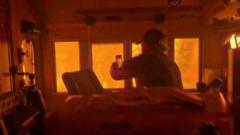
The media has a formulaic obsession with Canadian wildfire season. Every summer, like clockwork, your news feed fills with apocalyptic imagery. The latest clickbait darling? A train apparently "encased in flames" as smoke drifts toward the United States.
It makes for a great disaster-movie thumbnail. It drives clicks. It also misdirects public attention away from how heavy logistics actually function, substituting cheap panic for basic physical and economic literacy. Learn more on a connected subject: this related article.
The lazy consensus screams that a train passing through active wildfire zones is an unprecedented safety failure, a sign of impending supply chain collapse, and proof that our infrastructure is instantly melting.
The reality? You are being sold a narrative designed to trigger anxiety rather than explain engineering. Freight trains running through active or recently burned zones is not a sign of systemic failure. It is a calculated, highly engineered reality of transcontinental logistics. More journalism by NBC News highlights similar views on the subject.
The Physics of Steel vs. Fuel Load
Let us dismantle the "encased in flames" sensationalism with basic physics.
A standard modern freight locomotive is a massive block of reinforced steel, copper, and heavy-duty machinery weighing upwards of 200 tons. It is not a highly flammable, lightweight commuter vehicle.
[Forest Fire Heat Source] ---> (Radiant Heat) ---> [Heavy Steel Locomotive Frame]
                                                        |
                                            (High Thermal Capacity)
                                                        |
                                           Absorbs/Deflects Temporary Exposure
When a train passes through an area with active trackside burning, it is typically subjected to radiant heat, not direct, sustained thermal destruction.
- Thermal Capacity: The sheer mass of a steel train acts as a massive heat sink. For a passing train moving at a steady operational speed, the duration of exposure to localized flames is measured in seconds, not hours.
- Engine Intake Design: Modern diesel-electric locomotives pull air for combustion through heavily filtered systems designed to handle high particulate loads. While thick smoke can choke out oxygen and occasionally cause an engine to stall, it does not instantly turn the train into a rolling fireball.
- The Right-of-Way Buffer: Railroad rights-of-way are actively managed corridors. Track ballast (the crushed stone under the ties) and the cleared zone on either side of the rails act as a natural fuel break. The fire might look like it is "on" the train from a compressed telephoto camera lens, but the actual ignition sources are almost always kept at a distance by the gravel bed.
When you see a video of a train pushing through a smoky, glowing corridor, you are not watching a disaster. You are watching heavy machinery operating exactly within its structural tolerance thresholds.
The Illusion of Risk Mitigation
The public reflexively asks: Why not just stop the trains?
This question exposes a massive blind spot in how people view modern supply chains. The assumption is that shutting down a transcontinental rail corridor is a zero-risk safety measure.
It is actually the exact opposite.
I have seen operations managers forced to make these calls during peak fire seasons. Halting a major rail artery like those run by Canadian National (CN) or Canadian Pacific Kansas City (CPKC) does not erase risk; it merely redistributes it—often with far more dangerous consequences.
The Real Cost of a Shutdown
- Hazardous Materials Bottlenecks: When you halt rail traffic, you do not magically freeze the goods in transit. You force highly volatile chemicals, pressurized gases, and industrial fuels to sit idle in rail yards. A moving train is a controlled variable. A stationary line of tank cars sitting in a congested yard near regional fire zones is a massive, concentrated hazard.
- The Trucking Alternative Danger: If rail lines shut down for extended periods, shippers immediately pivot to long-haul trucking to fulfill contracts. Moving freight from rail to highways increases carbon emissions, spikes highway congestion, and exponentially raises the statistical probability of fatal traffic accidents.
- Economic Whiplash: A three-day complete shutdown of a major Canadian rail corridor can take up to three weeks to untangle. The resulting port congestion on the West Coast cascade-effects the global supply chain, driving up the cost of basic consumer goods.
Shutting down rail lines because of "scary smoke" is a luxury of the uninformed. Rail operators manage this through calculated, incremental risk assessments—not emotional reactions to dramatic social media videos.
The True Infrastructure Vulnerability is Not Fire
If you want to worry about rail infrastructure, stop looking at the flames. Look at the ground beneath the tracks.
The real threat that wildfire season poses to rail networks is not the spectacular visual of a train passing through smoke. It is the invisible, post-fire degradation of the terrain.
| Threat Level | Hazard Type | Mechanism of Damage | Detection Method |
|---|---|---|---|
| Low | Active Flame | Radiant heat to steel chassis; air intake particulate clogging. | Visual monitoring, thermal imaging. |
| Medium | Tie Ignition | Wooden ties catching embers (largely mitigated by fire-retardant treatments). | Track geometry cars, ground patrols. |
| Critical | Slope Instability | Destruction of root systems leading to mudslides and washouts during subsequent rains. | Geotechnical sensors, drone mapping. |
When a wildfire sweeps through a mountainous region like British Columbia, it incinerates the vegetation holding the mountainsides together. When the autumn rains arrive, the scorched earth can no longer absorb water.
The result? Massive debris torrents and landslides that can wash out entire sections of track instantly. This is what actually derails trains and severs trade corridors for weeks at a time.
By focusing on the dramatic "fire train" videos, the media completely ignores the actual engineering battlefront: geotechnical monitoring, slope stabilization, and post-fire watershed management.
Stop Demanding Perfect Safety
The modern obsession with eliminating all operational risk is a fantasy.
Logistics is the management of friction. It is the art of moving heavy, volatile, and essential goods through an unpredictable biosphere. If we suspended operations every time a natural event looked threatening on a smartphone screen, society would grind to a halt within forty-eight hours.
The crews operating these trains are not reckless cowboys. They are highly trained professionals guided by real-time telemetry, track-sensing technology, and strict operational protocols. When they move a train through a smoky pass, they do so because the data indicates the rails are aligned, the ties are structurally sound, and the atmospheric oxygen levels are sufficient for the propulsion systems.
The next time you see a video of a train framed by wildfire smoke, do not panic. Do not post a melodramatic tweet about the end of days. Recognize it for what it actually is: a testament to industrial resilience and the uncompromising necessity of keeping the world moving.