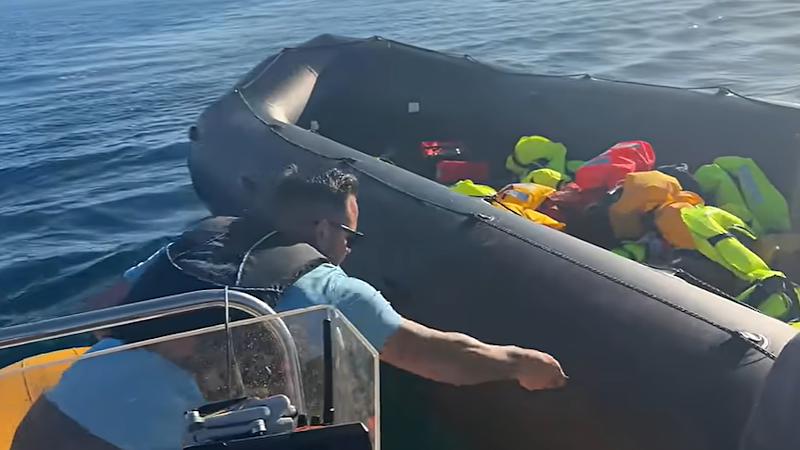
Salt spray clings to the iron railings of the Dover pier. The sky is the color of wet slate. In rooms across Whitehall, spreadsheets blink to life, glowing with a dry, sterile tally: 781. Seven hundred and eighty-one human beings crossing the English Channel in a single twenty-four-hour window. To a bureaucrat, it is a line item, a statistical spike, a difficult metric to file under border control management. To the men, women, and children bundled in oversized, salt-crusted life jackets, it is the end of a nightmare or the terrifying beginning of a new one.
The water is merciless. It is sixteen degrees Celsius in the middle of November. It smells of diesel, old rubber, and absolute exhaustion. When the rigid inflatable boats scrape against the shingle, the silence breaks. Shouts ring out. Sirens wail. The machinery of the state grinds into gear—border force vessels, immigration officers, yellow-jacketed handlers, and, just beyond the perimeter fence, the rising roar of a public split down the middle by fear and ideology.
By midday, the anger arrived. It didn't start with violence; it started with noise. Megaphones crackled. Banners snapped against the stiff coastal gale, bearing slogans that spoke of overwhelmed public services, broken promises, and national identity under siege. On the other side of the police line, counter-protesters held their own signs, speaking of sanctuary, international law, and human dignity. The air grew thick with tension. Words turned into shoves. Shoves turned into scuffles. By nightfall, the local constabulary confirmed multiple arrests. Handcuffs clicked shut against the backdrop of wailing sirens. The television cameras captured the friction, broadcasting the flashpoints across living rooms from Cornwall to Scotland.
Yet, television misses the grey spaces. It misses the exhaustion in the eyes of a father whose fingers are blue from hypothermia, and it misses the genuine, gnawing anxiety of a local shopkeeper who wonders how a strained healthcare clinic can absorb another hundred families.
Why 781? Why now?
Weather windows dictate the rhythm of human desperation. Autumn brings a deceptive calm—a brief window of flat seas before winter locks the water in freezing fury. Smugglers know this window. They cram forty, fifty, sometimes sixty people into flimsy rubber tubes designed for a fraction of that load. They take the money, thousands of pounds wrung from generational savings, and point a compass north toward the white cliffs. When the weather holds, the arrivals cluster. A quiet week of low numbers creates a false sense of security, followed by a surge like this one.
Seven hundred and eighty-one arrivals in one day is not an anomaly. It is the inevitable product of hydraulic pressure. Push down on the plunger in a war-torn province or an economically shattered nation, and the fluid shoots out wherever a crack appears in the perimeter.
Consider a hypothetical scenario, one mirrored a hundred times over across this exact stretch of coastline. Imagine a man named Amir, formerly a high school history teacher in a city whose name has been flattened by artillery fire. Amir didn't want to leave his homeland. He spent eighteen months believing the war would burn itself out, watching his students scatter like leaves before the wind until his own classroom became a pile of reinforced concrete and plaster dust. When he finally made the choice to flee, it wasn't an adventure. It was a slow, agonizing descent into the underworld of human smuggling networks. He spent weeks sleeping in transit vans, hiding in the cargo holds of lorries, and dodging border patrols across three different continents.
By the time he stepped onto the rubber floor of that inflatable boat, his shoes had rotted off his feet. When the British Border Force cutter pulled alongside his sinking craft, Amir didn't feel relief immediately. He felt numbness. His joints were locked by cold. His tongue felt like sandpaper. When officers pulled him onto the deck, he fell to his knees not in jubilation, but because his legs simply forgot how to carry his weight.
This is the reality behind the headline. It is not an invasion force wearing boots; it is a procession of broken bodies seeking a baseline of safety.
Dismissing the public anxiety as mere bigotry, however, is a profound mistake. The protests outside the Dover port are fueled by a legitimate, aching fear of scarcity. Citizens who have spent years watching their local National Health Service waiting lists stretch into infinity, their housing markets soar beyond reach, and their municipal budgets slashed to the bone look at an influx of new arrivals and feel a cold terror. They look at the numbers—781 today, thousands this year—and they ask a blunt, practical question: Where do they go? Who pays for them? How do we maintain social cohesion when the seams are already fraying?
These questions do not come from a place of malice; they come from a society that feels neglected by its own institutions. When governments fail to invest in the infrastructure required to handle migration humanely and efficiently, they create a vacuum. Into that vacuum rush demagogues, fear, and violence. The police officers standing between shouting protestors and processing centers are bearing the cost of a systemic failure that stretches far beyond any single town or port authority.
Migration is as old as human history. It is the original human instinct. When the environment becomes hostile—whether through the literal fire of war or the economic winter of extreme poverty—organisms move. To expect people to sit quietly in a burning house because the front door is locked is to misunderstand the fundamental wiring of survival.
Throughout history, empires and nation-states have grappled with the same dilemma: how to balance the ethical imperative of sanctuary with the administrative reality of borders. The Roman limes, the Hadrianic wall, the modern maritime patrols of the English Channel—they are all variations of the same human anxiety. We draw lines in the sand or the water and hope they hold against the tide. But water always finds a seam.
The sun dips below the horizon, painting the chalk cliffs in bruised shades of purple and grey. The television crews pack up their equipment. The protestors disperse into the chill evening, their voices hoarse, their placards rolled up and tucked away until the next surge.
Inside the processing center, fluorescent lights hum. Forms are filled out. Fingerprints are scanned. Cups of weak, warm tea are handed out to shivering hands. Tomorrow, the numbers will change. Perhaps they will drop to zero as a gale sweeps across the channel, or perhaps another wave will crest the horizon, pushing the tally even higher.
The debate will rage on in Parliament, on social media, and across kitchen tables. Voices will rise, tempers will flare, and the ideological trenches will dig a little deeper. But out on the dark water, beneath the indifferent stars, the tide continues its ancient, rhythmic push against the shore, indifferent to the laws of men, the anger of crowds, or the cold tally of a spreadsheet. It leaves behind only wet sand, footprints that fade with the next wave, and the enduring, heavy truth of a world in motion.