Borders are rarely just lines drawn on old parchment. They are physical scars on the earth, hardened by suspicion, quieted by distance, and watched over by millions of anxious eyes.
Imagine standing on the freezing ridge of the Himalayas, where the air itself feels thin enough to break your lungs. Down below, two vast civilizations stretch out toward opposite horizons. Together, they house a staggering chunk of humanity. When they speak, the global economy shifts. When they turn their backs, the geopolitical temperature drops instantly.
For seven long years, the highest corridors of power between Beijing and New Delhi have functioned like a frozen highway. Traffic stopped. Words grew clipped and formal. Diplomats traded pointed glances across sterile United Nations conference tables, while soldiers on high-altitude frontiers stared at one another through binoculars, weighed down by heavy winter gear and heavier historical grudges. Seven years of silence is a long time in the modern world. Entire generations of tech startups rose, fell, and reshaped commerce. Supply chains fractured and re-stitched themselves. Yet the diplomatic frost persisted, stubbornly refusing to thaw.
Until now.
The Anatomy of a Cold Distance
Let us trace the path back to understand what seven years of diplomatic hibernation actually looks like.
In the capital of a booming democracy, a bureaucrat sits in an air-conditioned office, shuffling paperwork that dictates whether a cargo ship laden with electronic components can clear customs. Two thousand miles away, a diplomat in a tailored suit looks out over the gray concrete courtyards of a sprawling ministerial compound, drafting an official statement that must satisfy hardliners at home without completely burning bridges abroad.
Distance does not merely measure miles. It measures misinterpretation.
When leaders do not sit across a wooden table from one another, sharing a pot of tea or exchanging polite diplomatic pleasantries before the real bargaining begins, imagination fills the vacuum. Every military patrol spotted too close to a disputed line becomes an aggressive provocation. Every trade restriction implemented to protect domestic industries looks like economic warfare. Without direct engagement, fear feeds upon itself.
The physical separation between Beijing and New Delhi has been palpable. Leaders met briefly at crowded multilateral summits, of course. A handshake here. A hurried photo-op there. But these fleeting moments are theater, not diplomacy. They lack the depth of a state visit, the heavy gravity of an arrival ceremony with a full honor guard, and the quiet, closed-door marathon sessions where real deals are hammered out over midnight black coffee.
The Weight of a Delegation
When a leader of a superpower travels, they do not pack light. They travel with an army of pragmatism.
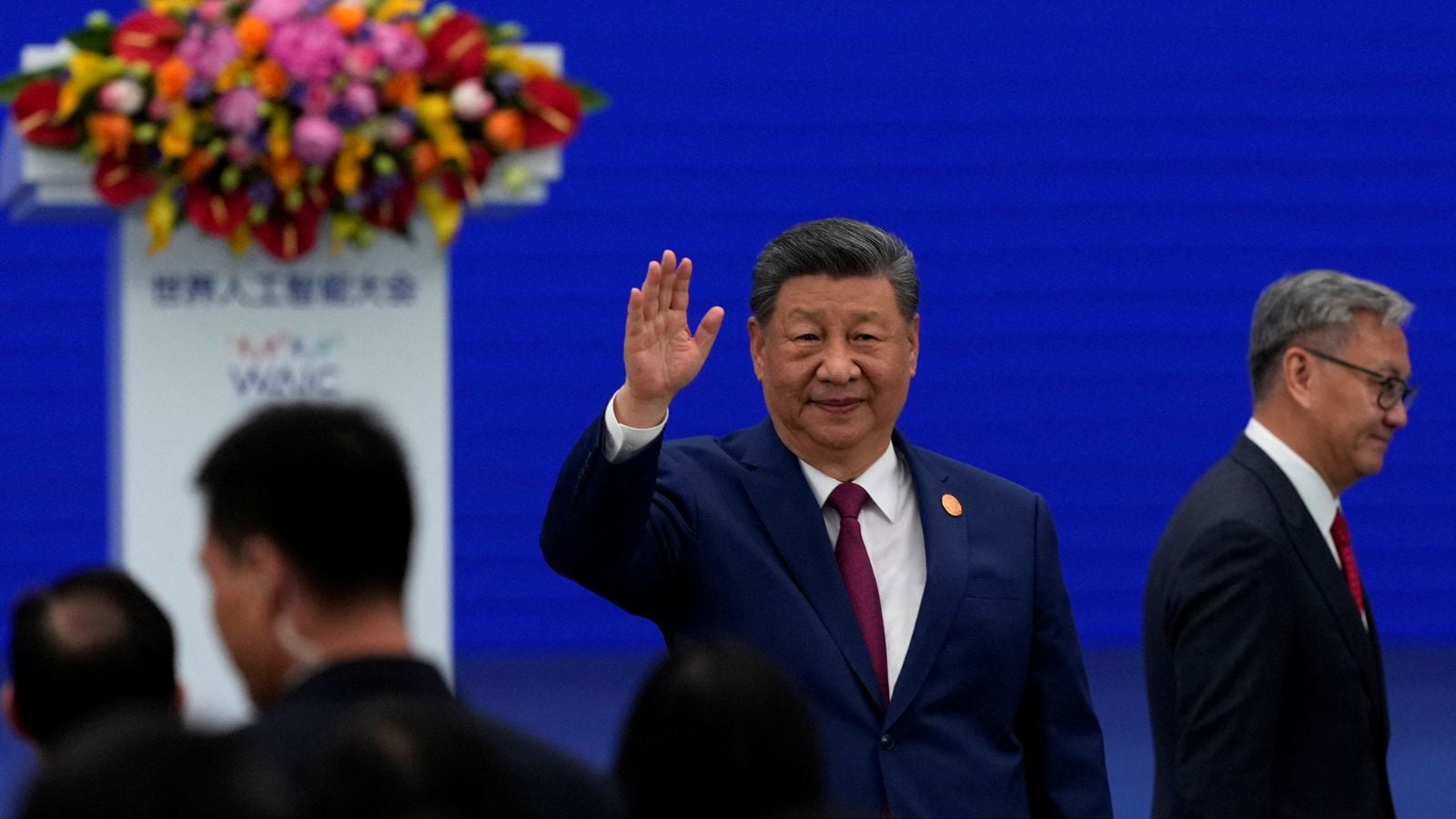
Picture the tarmac at the airport in New Delhi. A sleek aircraft touches down, its engines whining as they reverse thrust against the tarmac. The door opens. Out steps Xi Jinping, descending the stairs into the warm, humid air of the subcontinent. Behind him comes a massive delegation. Dozens of ministers, trade envoys, corporate titans representing manufacturing giants, and energy executives carrying dossiers thick with billion-dollar proposals.
This is not merely a social call. This is a massive, calculated recalibration of national self-interest.
Why now? Why break a seven-year freeze?
The answer lies in the harsh mathematics of global survival. No nation can afford perpetual friction while the rest of the economic order undergoes seismic transformations. Supply chains are fragile. Inflation bites into household budgets from Shanghai to Mumbai. Technology standards are splitting the world into competing camps. In this volatile environment, maintaining an active, frozen hostility with your most populous neighbor is an expensive luxury neither side can sustain indefinitely.
Consider what happens next when these delegations lock themselves away in executive boardrooms. They will talk about buffers. They will talk about trade deficits that tilt heavily in one direction. They will discuss how to manage the disputed border lines without triggering a kinetic flare-up that could destabilize entire markets.
The Human Toll of Geopolitics
It is easy to get lost in the grand theater of statecraft. We talk about gross domestic product, bilateral trade volumes, and strategic autonomy as if they were abstract pieces on a cosmic chessboard.
They are not. They are deeply human.
Think of the small-scale manufacturer in an industrial suburb of Gujarat, waiting for specialized machinery parts stuck in regulatory limbo due to tightened cross-border clearances. Think of the student in Chengdu who dreams of studying ancient Sanskrit literature but finds visa processing locked behind an impenetrable wall of bureaucratic red tape. Think of the families separated by oceans of political will, watching their ancestral ties wither under the harsh glare of nationalist posturing.
Geopolitics is simply the sum total of millions of individual anxieties magnified a million times over. When leaders refuse to talk, those anxieties fester. Small businesses close because they cannot secure critical raw materials. Young professionals miss opportunities to collaborate across borders that should, by all rights of geography and history, be porous to human ingenuity.
The impending visit represents a crack in that wall. It suggests a pragmatic realization that geography is destiny. You cannot pick up a subcontinent and move it across the Pacific. You cannot relocate an economic powerhouse to a different hemisphere. Beijing and New Delhi are bound together by the roots of the Himalayas and the flow of mighty rivers. They must figure out a way to live on the same continent without stepping on each other's throats.
The Fragile Architecture of Trust
Trust is like glass. Once shattered, putting the pieces back together leaves jagged seams that never quite disappear.
Diplomats understand this better than anyone. That is why a visit of this magnitude is planned down to the second, analyzed by intelligence agencies, and parsed by financial markets with religious fervor. Every word spoken at the joint press conference will be weighed for hidden meanings. Every smile will be scrutinized for sincerity.
Will this single visit erase seven years of accumulated distrust? Of course not. History does not reset with a single handshake, no matter how warmly the cameras capture it. Deep-seated strategic rivalries do not vanish simply because two leaders share a formal banquet.
Yet, diplomacy is the art of creating space. It is about building small guardrails so that competition does not inevitably spiral into catastrophe. By returning to bilateral state visits after a seven-year hiatus, both nations are signaling a willingness to manage their immense differences through dialogue rather than defiance.
The world watches with bated breath. In financial trading pits in New York and London, analysts adjust their risk models. In regional capitals across Asia, foreign ministries scramble to update their strategic assessments. And on the high mountain passes, young soldiers continue their lonely patrols, waiting to see whether the frost on the peaks is finally beginning to melt.
The road ahead is long, steep, and fraught with missteps. But the first step has always been the hardest part of the journey. The silence is finally breaking, and in that silence, a new chapter of global history is quietly being written.