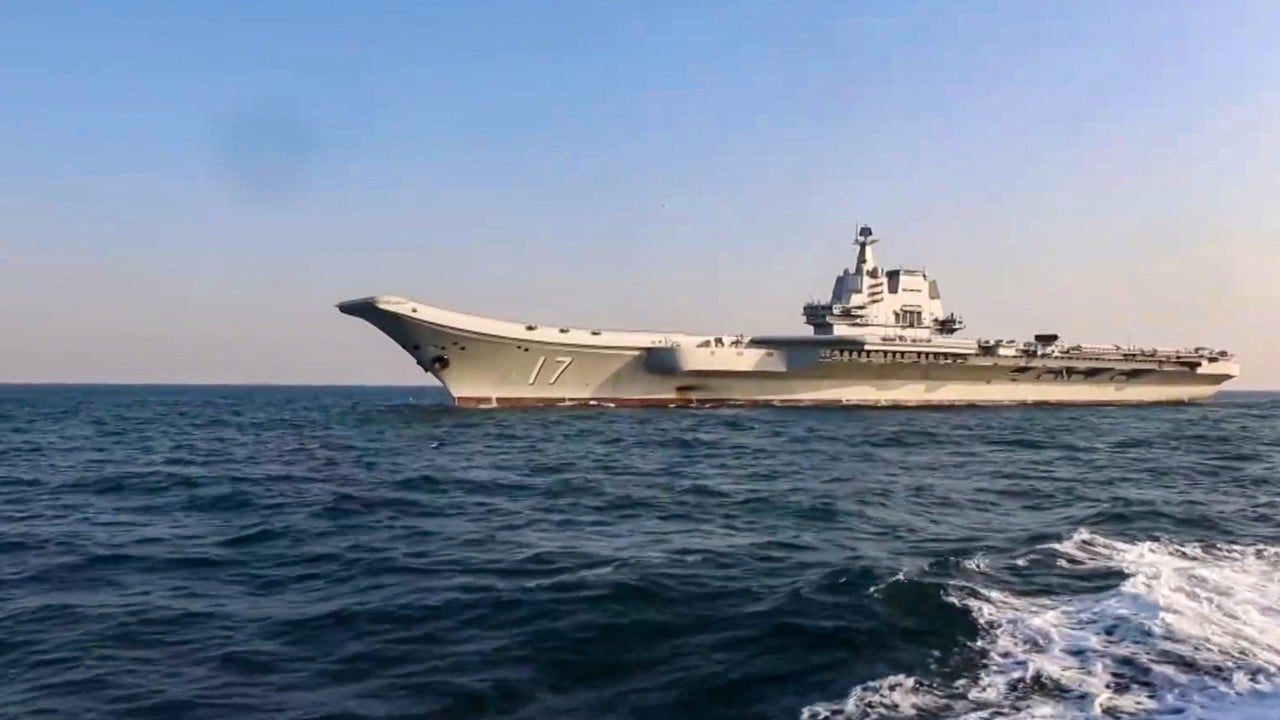
Salt crusts on the bridge wing of a grey hull, burning white under a vertical sun. Look out across the Philippine Sea, and you see an empty horizon. To the casual eye, it is just water—millions of square miles of deep blue isolation stretching between the Philippines, Guam, and the Japanese Ryukyu chain. But emptiness is an illusion. Beneath that surface and high above it in the ionosphere, electrons chatter, sonar arrays ping against thermal layers, and steel titans carry the geopolitical weight of the twenty-first century.
Consider a hypothetical watchstander aboard a modern destroyer, squinting into a radar scope. He is staring at a ghost. That ghost is a carrier strike group, a floating city of twenty thousand souls moving in absolute electronic silence. Discover more on a related subject: this related article.
The core question hanging over this vast maritime expanse is not a matter of abstract strategy. It is about geography, physics, and the terrifying math of modern naval combat. Will the Philippine Sea become the primary chessboard for People's Liberation Army aircraft carriers in a conflict over Taiwan?
To understand why military planners lose sleep over this specific basin, you have to look past the immediate shores of the Taiwan Strait. Additional journalism by Reuters explores similar perspectives on this issue.
The Trap of the Narrow Waters
The Taiwan Strait is narrow. Only about one hundred miles separate the coast of mainland China from the island of Taiwan. For centuries, narrow straits have spelled doom for navies that lack absolute control of both shores. In a modern war, that cramped corridor becomes a shooting gallery. It is choked with anti-ship cruise missiles, coastal batteries, submarine ambushes, and thousands of sea mines.
A modern aircraft carrier is many things. It is a projection of national will, a floating airfield, and an engineering marvel. It is also an extraordinarily large, expensive target.
Placing a multi-billion-dollar flattop inside the confined waters of the Taiwan Strait is tactical malpractice. The reaction time drops to seconds. Maneuver room vanishes. If you trap a heavy surface fleet in a bathtub, someone eventually drops a toaster in it.
This simple reality forces naval doctrine to look elsewhere. It points straight east, past the island spine of Taiwan, out into the deep, unforgiving blue of the Philippine Sea.
The Bastion Strategy
Military analysts often talk about anti-access and area-denial systems, or A2AD. Think of it as an invisible force field built from land-based missiles, long-range radars, and submarines. China has spent decades constructing this defensive perimeter along its eastern seaboard, stretching from the Qingdao naval bases down to the South China Sea.
Within this bubble, the People's Liberation Army Navy holds a distinct home-court advantage. But a defensive bubble has a wall.
When Beijing’s growing fleet of aircraft carriers—ships like the Liaoning, the Shandong, and newer electromagnetic-catapult giants—steams out to fight, they cannot simply hide near their own coastlines if their mission is to project power, sever enemy supply lines, or isolate a theater of operations. They have to break out.
They have to step through the island chain.
The Philippine Sea offers the deep water necessary for high-speed carrier operations. It provides the sea room required to launch and recover heavy wings of fighter jets under rolling swells. More importantly, it acts as a staging ground. By positioning a carrier battle group east of Taiwan, a naval force can threaten the island from an unexpected vector, intercept incoming foreign reinforcements, and shield mainland logistical lines from carrier-based air strikes.
The Walls Have Eyes
Yet, stepping into the Philippine Sea does not mean stepping into safety. It means stepping into a different kind of danger.
Imagine standing on the deck of a logistics ship caught in a heavy swell thousands of miles from home. You feel small. Now imagine that feeling, amplified by the knowledge that satellites are passing overhead every ninety minutes, painting your exact GPS coordinates onto glowing screens in command bunkers thousands of miles away.
The Philippine Sea is wide, but modern reconnaissance makes it narrow again.
Long-range maritime patrol aircraft, high-altitude surveillance drones, and space-based synthetic aperture radar ensure that hiding a floating city of steel is nearly impossible for long. When a carrier group moves into the Philippine Sea to operate outside the immediate protection of land-based surface-to-air missiles, it must rely on its own embarked air wing and escort cruisers for defense.
And that introduces a brutal trade-off.
To fight effectively in the Philippine Sea, a carrier group must venture beyond the umbrella of land-based air cover from the mainland. It trades the safety of proximity for the strategic freedom of depth. In doing so, it enters waters where adversary submarines—notoriously quiet, nuclear-powered hunters—lie in wait along known geographic bottlenecks like the Bashi Channel and the Miyako Strait.
The Human Element Beneath the Steel
Strip away the acronyms, the tonnage statistics, and the orbital mechanics, and you find people.
Nineteen-year-old sailors working the flight deck in screaming red and yellow jerseys, hand signals cutting through jet blast. Young officers clutching clipboards in darkened combat information centers, smelling stale coffee and ozone. Submariners breathing recycled air for months at a time, listening to the ocean through headphones, waiting for a signature that could change history.
They are the ones who bear the weight of these vast operational concepts. For them, the Philippine Sea is not a geographic polygon on a tactical map. It is a graveyard of weather, distance, and tension.
If a conflict ever erupts over Taiwan, the struggle for this oceanic basin will not be decided by a single cinematic clash of titans. It will be a grinding test of endurance, logistics, and electronic stealth. It will test whether a rising blue-water navy can successfully project power far from home against a deeply entrenched adversary network.
The water remains calm. The sun sets, turning the swells to liquid copper. But beneath the surface, the silent geometry of deterrence shifts every single day, waiting to see which side blinks first in the deep blue expanse.