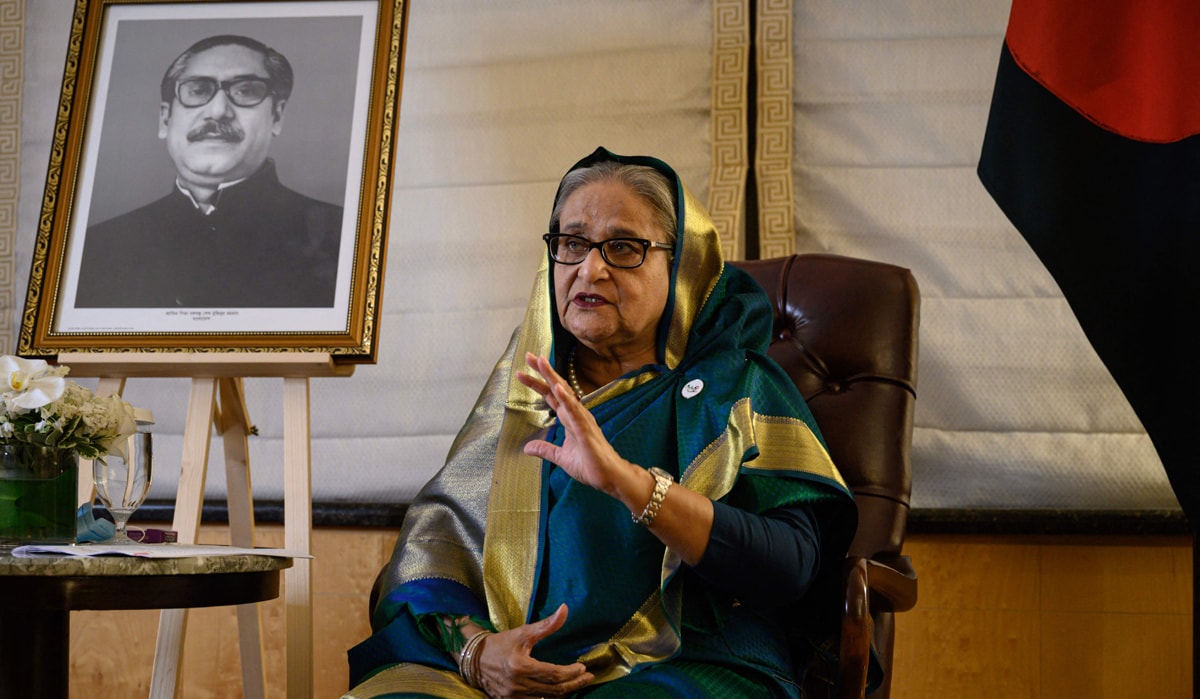
Foreign policy commentators love a tidy tragedy. When Sheikh Hasina boarded a military helicopter and fled Dhaka in August 2024, the international press corps immediately drafted the same predictable obituary. They looked at the burning Awami League offices, the International Crimes Tribunal arrest warrants, the student-led interim government under Muhammad Yunus, and reached a lazy consensus. Their verdict was simple. Hasina is finished. There is no easy road home for the former Prime Minister of Bangladesh.
That analysis misses the entire board. It assumes Sheikh Hasina wants to walk back into Ganabhaban tomorrow morning and resume day-to-day governance of a fractured, inflation-choked economy.
She doesn't.
Analysts obsessing over extradition treaties and airport security protocols are asking the wrong question entirely. They are measuring her political survival by her physical proximity to Dhaka. In South Asian dynastic politics, physical absence is rarely a death sentence. Often, it is an incubator. While the interim administration in Dhaka bleeds political capital trying to fix structural economic rot, manage Islamist street pressure, and appease impatient student coordinators, Hasina sits across the border in India—insulated from blame, preserved in amber, and weaponizing the exact chaos she left behind.
The Myth of the "Finished" South Asian Strongman
Western observers suffer from chronic historical amnesia regarding the subcontinent. They view the August 2024 uprising as a clean, irreversible rupture, much like the fall of the Berlin Wall. History in Dhaka, Islamabad, and Colombo tells a much messier story.
I have spent fifteen years tracking political risk across South Asia, watching Western diplomats and corporate consultants lose millions betting on "permanent" regime changes. Every single time a strongman or dynastic patriarch is chased out of a capital city, the prevailing wisdom declares their political machine dead. And every single time, the commentators forget that patronage networks do not evaporate when one person gets on a plane. They go underground. They wait.
Consider the mechanics of dynastic resurrection in the region.
- Benazir Bhutto spent years in self-imposed exile in Dubai and London facing corruption charges before returning to Pakistan to command massive crowds.
- Nawaz Sharif was ousted, jailed, exiled to London on medical grounds, and written off by every major newspaper—only for his party to return to the center of power in Islamabad.
- Mahinda Rajapaksa and his clan were chased out of Colombo by furious protesters storming the presidential palace in 2022, yet the political machinery they built remains deeply embedded in Sri Lankan state institutions.
The mistake analysts make is confusing a tactical retreat with strategic extinction. The Awami League is not a startup that collapses when the founder leaves the building. It is a 75-year-old bureaucratic and ideological apparatus woven into the Bangladeshi civil service, the judiciary, the business elite, and the rural patronage networks. You cannot dismantle seven decades of institutional entrenchment with a few months of student protests and a handful of tribunal warrants.
Why Dhaka’s Pain Is Hasina’s Oxygen
To understand why Hasina has zero incentive to rush home, look at the poisoned chalice she handed to Muhammad Yunus.
For fifteen years, Hasina’s government masked deep structural vulnerabilities behind headline GDP growth numbers. By mid-2024, the bill had come due. Foreign exchange reserves were depleted. Inflation was crushing the working class. The banking sector was hollowed out by politically connected defaulters. Youth unemployment had reached a boiling point.
Had Hasina stayed in power, she would have spent the next three years presiding over austerity, International Monetary Fund (IMF) conditionalities, currency devaluation, and inevitable public fury. By fleeing, she outsourced the economic hangover to her enemies.
Now, every time the price of rice ticks upward in Dhaka, every time a garment factory closes due to labor unrest or power shortages, and every time law enforcement fails to curb street crime, the interim government owns the failure. Public memory in politics is brutally short. Nostalgia is a potent drug. When daily life gets harder under a revolutionary administration, voters stop blaming the deposed autocrat and start remembering when the trains ran on time.
Imagine a scenario where Hasina actually returned to Dhaka in late 2024 or 2025 to face trial. She would instantly become a lightning rod for public anger, forced to defend her human rights record in a hostile courtroom while taking daily blows from the press. By staying in India, she denies the interim government its ultimate trophy. She forces Yunus and his advisors to govern against a ghost.
Dismantling the Extradition Illusion
The mainstream narrative relies heavily on the legal noose tightening around Hasina’s neck. Commentators point to the International Crimes Tribunal (ICT) issuing arrest warrants for crimes against humanity and the Bangladeshi foreign ministry formally requesting her extradition from New Delhi. They treat India’s reluctance to hand her over as a diplomatic headache that will eventually force New Delhi to cave.
This fundamentally misunderstands Indian grand strategy.
New Delhi does not view Bangladesh through the lens of international human rights law or democratic norms. India views Bangladesh through one prism: national security. Specifically, securing its vulnerable northeastern states—the Seven Sisters—from cross-border insurgency, and preventing China or Pakistan from establishing a strategic foothold on its eastern flank.
For fifteen years, Hasina delivered everything New Delhi wanted. She crushed anti-India militant groups operating out of Bangladeshi soil, granted India transit rights to its northeast, and kept Beijing’s military ambitions at bay.
If Prime Minister Narendra Modi’s government were to hand Hasina over to face a hostile tribunal in Dhaka, it would send a catastrophic message to every pro-India leader across the neighborhood—from Malé to Kathmandu to Colombo. It would tell them that India abandons its friends the moment the political weather turns ugly. New Delhi will never pay that strategic price.
Even the legal mechanism works in Hasina’s favor. Under the 2013 India-Bangladesh Extradition Treaty, Article 6 explicitly allows a requested state to refuse extradition if the offense is of a "political character." Article 8 allows refusal if the request is not made in good faith or in the interests of justice. India has an airtight legal off-ramp to stall any extradition request indefinitely.
Hasina isn't trapped in a gilded cage. She is sitting behind the thickest geopolitical shield in South Asia.
What Everyone Gets Wrong About the Awami League’s Collapse
When journalists look at Bangladesh today, they see the Awami League leadership scattered, jailed, or in hiding. They assume the party is dead because it cannot hold a rally in downtown Dhaka without being attacked.
This is a failure to distinguish between street visibility and organizational survival.
Political parties in South Asia operate like subterranean river systems. When the surface dries up, the water doesn't disappear; it moves underground.
| Conventional Wisdom | Ground Reality in Bangladesh |
|---|---|
| The Awami League is permanently destroyed as a political force. | Its core vote bank (historically 30% to 35% of the electorate) remains intact, silent, and waiting for a ballot box. |
| Student leaders control the political future of the country. | Student movements are inherently fractured; transitioning from street protest to administrative governance splits coalitions. |
| The Bangladeshi military is permanently aligned with the interim government. | The army is a pragmatic institution focused on UN peacekeeping revenue and domestic stability; its loyalties shift with public sentiment. |
| India will eventually bow to Dhaka’s diplomatic pressure. | New Delhi holds massive leverage over Bangladesh’s trade, power grid, and water supply, and will not sacrifice its core security assets. |
The biggest vulnerability facing the post-Hasina order is fragmentation. The coalition that toppled Hasina had only one unifying goal: removing her. It brought together secular leftists, liberal academics, conservative nationalists from the Bangladesh Nationalist Party (BNP), and hardline Islamist groups like Jamaat-e-Islami.
Now that the common enemy is gone, the fault lines are widening. The BNP wants elections immediately because its electoral machinery is ready to sweep the polls. The student leaders and civil society technocrats in the interim government want to delay elections to rewrite the constitution and purge state institutions—knowing full well that an early election hands power back to traditional dynastic politics. Meanwhile, Islamist factions are pushing for social and legal concessions that alienate the secular middle class and alarm Western donors.
Hasina doesn't need to lift a finger to break this coalition. Time and governance will do it for her.
The Unspoken Reality of the "Return"
People constantly ask: When will Sheikh Hasina go back to Bangladesh?
They are looking at the calendar when they should be looking at the demographics of the Awami League. Sheikh Hasina was born in 1947. By late 2026, she is nearly eighty years old. Her personal return to the Prime Minister’s office is irrelevant to the actual endgame.
In dynastic politics, the patriarch or matriarch does not need to sit on the throne to win. They only need to preserve the legitimacy of the bloodline until the pendulum swings back. Hasina’s current mission is not personal rehabilitation; it is brand preservation.
Every leaked phone call, every statement issued from exile warning of "unconstitutional" chaos, and every reminder of the economic stability during her tenure is aimed at one target: keeping the Awami League’s core base from defecting to the BNP or splintering into rival factions. As long as she remains the undisputed leader in exile, no ambitious lieutenant in Dhaka can hijack the party and cut a separate peace with the interim government. She holds the party together through sheer gravitational pull from across the border.
The Blind Spot in This Contrarian Thesis
I am not claiming Hasina’s playbook is guaranteed to succeed. Betting on the resurrection of a deposed leader carries massive, structural risks that even the sharpest political operator cannot fully control.
First, the generational rupture is real. Roughly two-thirds of Bangladesh’s population is under the age of 35. For Gen Z voters who watched security forces shoot unarmed protesters in July and August 2024, the Awami League is not the party that liberated Bangladesh in 1971. It is a blood-stained authoritarian cartel. No amount of economic nostalgia easily erases fresh trauma from a generation that came of age under her rule.
Second, the financial lifeline is severed. Dynastic parties run on cash. With the interim government freezing bank accounts, dismantling the business conglomerates like S. Alam Group that financed her regime, and seizing illicit assets, the Awami League is starved of the liquid capital required to fund local muscle and buy political loyalty.
Third, health and time are undefeated. If Hasina’s health fails before the Awami League can groom a credible successor—and neither her son Sajeeb Wazed Joy nor her daughter Saima Wazed commands the visceral street-level authority she once held—the party could fracture permanently into warring regional fiefdoms.
How to Actually Read Bangladesh’s Next Move
If you are an investor, a policymaker, or simply someone trying to make sense of South Asian geopolitics without falling for media narratives, stop reading op-eds about Hasina’s extradition. Watch three concrete indicators instead.
- Watch the BNP’s patience. The Bangladesh Nationalist Party is the true kingmaker right now. The moment Tarique Rahman and the BNP leadership decide the interim government is stalling elections to permanently sideline traditional parties, Dhaka will erupt into a new wave of street protests—this time pitting the revolutionaries against the country's largest opposition party.
- Watch the garment sector’s order books. Bangladesh lives and dies by its Ready-Made Garment (RMG) exports. If Western fashion brands begin permanently shifting supply chains to Vietnam and India due to persistent labor strikes and power cuts in Dhaka, the middle class will turn on the interim administration overnight.
- Watch the low-level bureaucrats. Keep an eye on the district commissioners and police superintendents. In Bangladesh, regime survival depends on the mid-level state apparatus. If these officials start hedging their bets and quietly communicating with exiled Awami League operatives, the interim government is losing control of the state.
Sheikh Hasina does not have an easy road home, because she isn't looking for one. A road home right now leads straight to a courtroom cell and historical disgrace. Staying in exile lets her sit back, watch her successors choke on an impossible economy, and wait for the inevitable moment when Bangladeshis get tired of the revolution.
In South Asian politics, you don't win by surviving the storm. You win by making sure you aren't the one holding the umbrella when the lightning strikes.