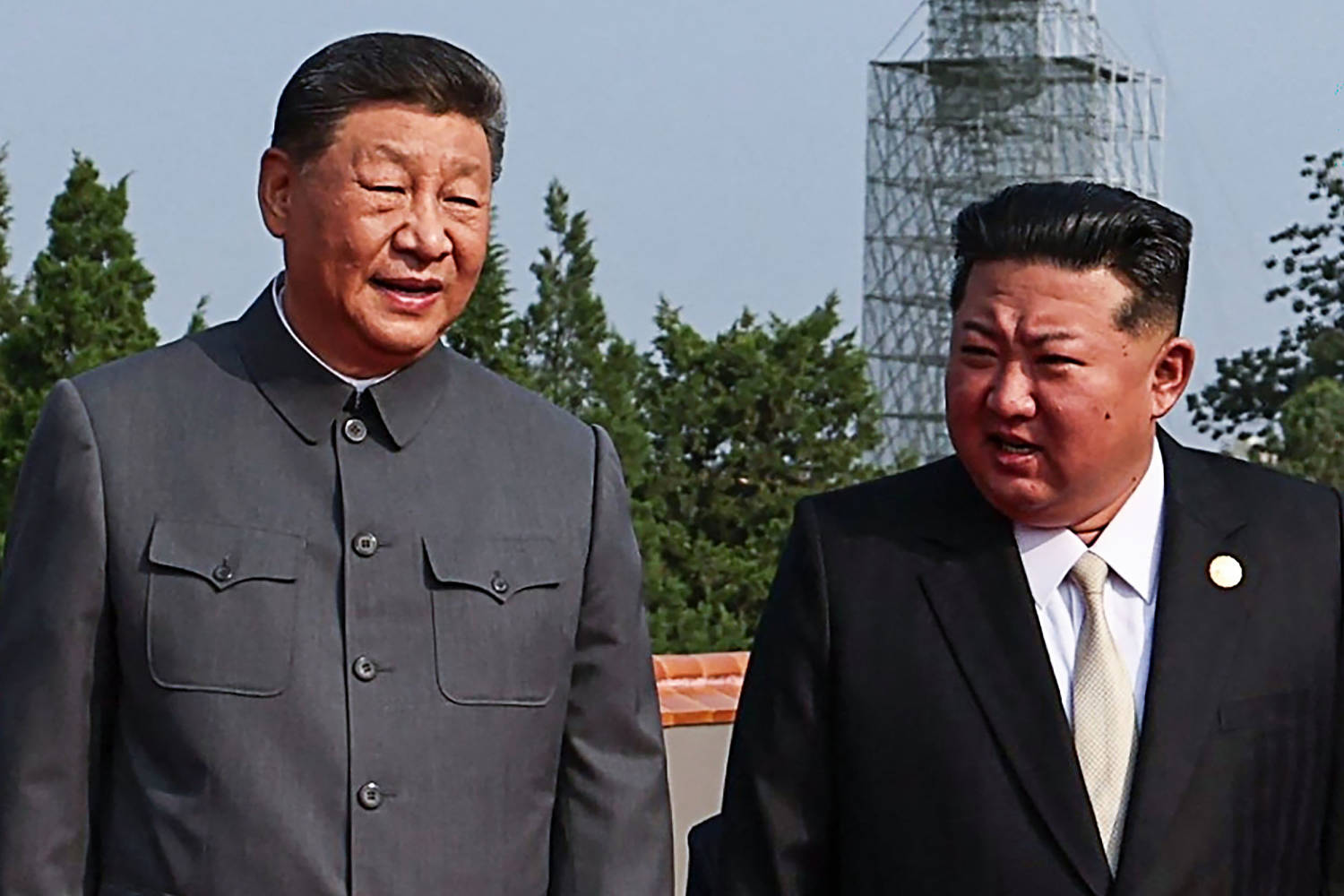
The heavy silk curtains of the Kumsusan State Guest House muffle the sounds of Pyongyang, but they cannot deaden the tension in the air. Inside, two men sit across from each other. The tea between them has gone cold. For years, this particular meeting followed a rigid, predictable script. One man arrived as the absolute patron, the economic lifeline, the reluctant protector. The other sat as the supplicant, nodding respectfully while calculating exactly how much food, fuel, and diplomatic cover he could squeeze from his towering neighbor.
But scripts burn.
When Xi Jinping meets Kim Jong Un today, the oxygen in the room feels different. The subtle shifts in body language tell a story that official state communiqués try desperately to hide. Kim no longer leans forward with the eager deference of a junior partner. He sits back. His posture is relaxed, almost casual. For the first time since he assumed power as a young, untried heir in 2011, Kim is not looking at Beijing as his only window to the survival of his regime.
He has found another window. And it opens toward Moscow.
To understand the profound shift shaking the geopolitics of East Asia, one must step away from the sterile analysis of missile blueprints and satellite imagery. Look instead at the human reality of a regime that has spent decades trapped in a corner. Imagine the psychological weight of knowing your entire country’s survival hangs on the whim of a single neighbor who views you less as an ally and more as a buffer zone. That was Kim’s reality. Beijing controlled the taps. If North Korea misbehaved too loudly, China could simply tighten the border, dim the lights in Pyongyang, and wait for the compliance that hunger inevitably brings.
Dependency breeds a quiet, simmering resentment.
The turning point did not happen in a grand summit room in Beijing. It began with the rumble of munition trains moving north and west across the Eurasian landmass. When Vladimir Putin found himself isolated by the West, his conventional military stockpiles depleted by a grinding war of attrition in Ukraine, he looked across the border to a nation that had spent seventy years doing only one thing exceptionally well: preparing for total war.
North Korea is no longer just a liability or a charity case. It is a factory.
The transaction is simple, brutal, and highly effective. Millions of artillery shells and ballistic missiles flow from North Korean warehouses to the front lines of Europe. In return, the riches of a desperate superpower flow back into Pyongyang. We are not just talking about crates of cash or shipments of grain, though those are vital to a population long starved by international sanctions. The real currency is knowledge. Satellite technology. Advanced telemetry. Submarine propulsion systems. The very secrets that Western intelligence agencies spent decades trying to keep out of Kim’s hands are now arriving via direct transfer.
Consider what happens next to the balance of power.
For decades, China maintained a careful, frustrating monopoly on North Korea’s loyalty. Beijing’s grand strategy was always about stability. They did not want a nuclear war on their doorstep, nor did they want a collapsed regime that would send millions of refugees streaming across the Yalu River, potentially bringing a unified, American-allied Korea right to their border. China wanted Kim contained, dependent, and quiet.
Now, Kim is loud. And he is rich in options.
The Patron’s Dilemma
The view from Zhongnanhai, the leadership compound in Beijing, must be agonizing. Xi Jinping prides himself on total control, on reshaping the global order through disciplined, long-term strategy. Yet, by slipping the leash of Chinese dependency, Kim has introduced a chaotic wild card into Xi’s carefully calculated calculus.
Every time North Korea tests an intercontinental ballistic missile or flaunts its new Russian-assisted satellite capabilities, it provides the perfect justification for the United States, Japan, and South Korea to tighten their own military alliance. Washington sends nuclear-powered submarines to Busan. Tokyo revises its pacifist constitution. Seoul openly debates developing its own nuclear deterrent. None of this serves China’s interests. In fact, it is Xi’s worst nightmare realized: a ring of highly militarized, deeply hostile democracies right on his maritime flank.
Yet, what can Xi actually do?
If China cuts off economic aid to punish Pyongyang, Kim can simply ask Moscow to fill the gap. Putin, locked in an existential struggle with NATO, has shown that he cares very little about Chinese discomfort or UN Security Council resolutions that he himself once signed. Russia needs shells today; tomorrow's regional balance in Asia is a luxury Putin can afford to ignore.
This is the invisible leverage Kim now wields. He has played two nuclear superpowers against each other, exploiting the cracks in their "no-limits" partnership to secure his own absolute freedom of maneuver.
The Human Cost of High Stakes
It is easy to get lost in the grand chessboard of global strategy, to view these movements as bloodless pieces shifting across a map. But the true weight of this shift is borne by human beings who will never see the inside of a diplomatic guest house.
For the average citizen in North Korea, the arrival of Russian technology and wealth does not mean a sudden transition to prosperity. It means the reinforcing of the concrete walls that enclose their lives. A wealthier, more secure Kim Jong Un is a Kim who feels no pressure to reform, no need to open his borders to the outside world, and no incentive to bargain away his weapons for sanctions relief. The desperate hope held by millions—that economic isolation would eventually force the regime to blink, to choose bread over bombs—has evaporated. The bombs are now buying the bread.
On the other side of the demilitarized zone, the anxiety is palpable. Walk through the bustling, hyper-modern streets of Seoul, and you can feel a subtle, underlying dread. For a generation, South Koreans lived with the comfortable assumption that China would ultimately restrain North Korea from doing anything truly catastrophic. Beijing was the adult in the room.
That comfort is gone.
If Kim no longer answers to Beijing, who holds the brakes? A rogue state with an unchecked nuclear arsenal, backed by a vengeful Russia and no longer constrained by Chinese caution, is a reality that entirely rewrites the psychological contract of survival in East Asia.
The Changing Face of the Table
The dinner is served in Pyongyang, a lavish display of state hospitality designed to show that despite decades of Western pressure, the regime lacks for nothing. Xi Jinping looks across the table at his host.
Years ago, during their first meetings, Kim appeared almost anxious, a young leader seeking the blessing of the elder statesman of the communist world. Today, the smile is different. It is the smile of a man who knows that his guest needs him just as much as he needs his guest. China still needs that buffer zone. China still cannot afford to let North Korea fall. Kim knows this. He understands that he has achieved the ultimate geopolitical alchemy: he has turned his vulnerability into absolute invulnerability.
The old world, where Washington, Beijing, and Moscow could agree on the basic rule that North Korea must not be allowed to become a mature nuclear power, is dead. In its place is a fractured, opportunistic landscape where old animosities are traded for immediate survival.
Xi Jinping raises his glass for the mandatory toast to eternal friendship and ideological solidarity. The cameras flash, capturing the image of two powerful men standing shoulder to shoulder against the West. It is a beautiful, expensive illusion.
As the glasses clink, both men know the truth. The leash has snapped, and the junior partner is no longer taking orders.
The fire in Europe is casting very long shadows across the palaces of Pyongyang.