The dust in the borderlands never truly settles. It clings to the lungs of children. It crusts over the eyes of those waiting for a knock on the door that signals the end of a long, terrifying watch. For decades, the rhythm of life in this corner of the globe has been dictated by the whistle of incoming fire and the subsequent scramble for concrete bunkers. It is a life measured in seconds of terror and lifetimes of grief.
Then, word arrived.
It did not come with the usual fanfare of diplomatic summits or the dry, sterile language of international treaties. Instead, a new entity—the Board of Peace—asserted that an agreement had been brokered. The goal: nothing less than the total disarmament of Hamas.
To those living under the constant shadow of violence, the news landed with the jarring force of a physical blow. Hope is a dangerous thing in a place where it has been systematically harvested for so long. It feels like a betrayal to feel it. Yet, the air in the streets seems to have shifted. It is thinner. Sharper.
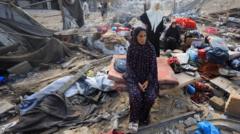
Imagine a woman named Leila. She has spent the better part of her forty years cleaning the same stubborn grit from her windowsills in a town where the power flickers like a dying pulse. She has lost brothers to the cycle. She has raised children who learn the geometry of blast radiuses before they learn the multiplication tables. When she hears about this disarmament accord, she doesn’t check the news feeds for the legalese. She goes to the market, buys a slightly better cut of meat than she usually can afford, and watches the faces of the soldiers on the corner.
She is looking for a change in the tension of their shoulders. She is looking for the moment the hunt ends.
The announcement regarding the Board of Peace is, on its surface, a bureaucratic milestone. But beneath the headlines, we are talking about a fundamental unraveling of a militant infrastructure that has defined the status quo for a generation. Disarmament is rarely about the mere collection of hardware—it is about the psychological evacuation of a battlefield. It is the transition from a state of total mobilization to the slow, agonizing process of civil reconstruction.
History teaches us that peace deals are often fragile paper kites. In the Middle East, such papers have been shredded by reality more times than we can count. Skepticism is not just a healthy reaction; it is a survival mechanism. If you believe everything you read, you lose your mind. If you believe nothing, you lose your soul. The challenge here is determining whether this specific agreement carries the weight of genuine intent or if it is merely another tactical pause in a war that has forgotten its own beginning.
Consider the complexity of the logistics. Disarmament involves untangling a web of underground tunnels, hidden caches, and a command structure that is designed for invisibility. It requires the surrender of ideology as much as the surrender of weaponry. When a faction agrees to lay down its arms, it is effectively admitting that the previous path has led to a dead end. That is a concession that ripples through every level of a society that has staked its existence on a platform of armed resistance.
Some analysts argue that such agreements are performative. They point to the history of broken promises, the shifting alliances, and the fact that influence in this region is often bought in blood rather than contracts. They might be right. But consider the alternative. Without the mechanism of a formal disarmament, the cycle continues exactly as it has. The rocket remains in the tube. The drone remains in the sky. The mother remains in the bunker.
We are caught in the uncomfortable middle ground between cynicism and aspiration. It is tempting to write this off as another footnote in a long, dark history book. Yet, we cannot ignore the sheer necessity of the moment. The infrastructure of conflict has become an existential weight that has crushed the potential of millions. If the Board of Peace has indeed found a lever to move this mountain, the mechanics of how they achieved it matter less than the fact that the mountain is finally moving.
There is a specific, haunting quality to the silence that follows a cessation of hostilities. It is not peaceful. It is a ringing sound, a sudden absence of the noise that has formed the soundtrack of your entire existence. It makes you feel exposed. It forces you to look at the rubble and wonder if you will ever be able to build on top of it.
Whether or not this disarmament holds, the act itself changes the nature of the conversation. It forces every player at the table to reconcile their stated goals with the harsh realities of their own survival. It puts the burden of proof squarely on those who have promised a new path. We are no longer discussing the inevitability of war. We are now forced to discuss the agonizing, fragile possibility of the end of it.
For Leila, the woman with the dusty windowsills, the future is no longer a closed door. She is not celebrating. She is simply waiting. She is watching the horizon, not for the flash of an explosion, but for the first time in her life, she is looking for the sun. The machinery of war may be grinding to a halt, but the real work—the work of stitching a broken people back together—is only just beginning.
There are no shortcuts here. There are no guarantees. But in the quiet that has settled over the border, one thing is undeniably clear: the story is no longer being written by the munitions. For the first time in a very long time, the ending is still unwritten.
The wind picks up, carrying the smell of rain across the dry hills, and for a fleeting, terrifying, and beautiful second, the world seems almost still.