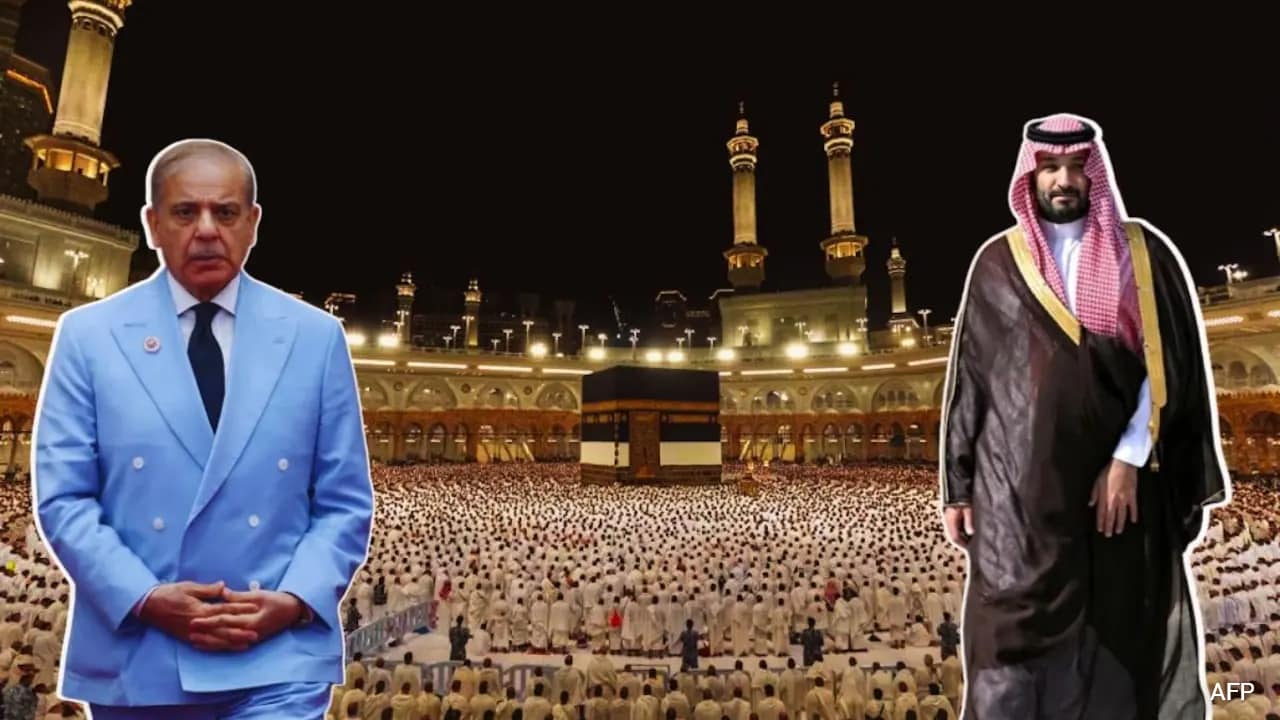
Dawn in Islamabad does not break with a trumpet. It creeps in through the haze of the Margalla Hills, a pale gray smear that turns the concrete monoliths of government offices a dull, exhausted iron. Inside the Ministry of Foreign Affairs, the air smells of old paper, cardamom tea that has boiled too long on a hotplate, and the specific brand of quiet panic that only comes when a nation realizes it is standing on a trapdoor.
Outside, the streets are waking to the usual symphony of sputtering motorcycle exhausts and vendors shouting over the diesel roar. But thousands of miles away, past the arid expanse of the Empty Quarter, past the smoking shipping lanes of the Red Sea, a shadow is stretching. It points directly toward the black curtain of the Kaaba.
When a missile arcs out of the rugged Yemeni highlands, propelled by Houthi hands and guided by architectures whispered from Tehran, it does not merely cross a border. It crosses an invisible red line etched into the conscience of every Muslim nation on earth. And Pakistan—nuclear-armed, structurally fractured, and perpetually walking a tightrope over its own fiscal precipice—is currently attempting the most dangerous balancing act in its history.
How do you explain to a population of over two hundred million devout believers that your official defense policy is to look away?
To understand this silence, you have to step into the shoes of a military strategist staring at a ledger of vulnerabilities. Let us call him General Tariq—a composite of the men who sit behind mahogany desks in Rawalpindi, nursing lukewarm tea while satellite feeds flicker on encrypted monitors. Tariq is not a coward. He has spent thirty years navigating the violent convulsions of South Asia. But he looks at the map and sees a grim equation.
If Pakistan commits ground forces or aggressive air assets to the Saudi-led coalition in Yemen, it enters a quagmire with no clean exit. It invites sectarian fracture onto its own domestic streets, where Sunni and Shia populations coexist in a delicate, often bloody equilibrium. It drains foreign reserves that are currently being drip-fed by international bailouts. And crucially, it alienates Iran—a powerful, aggrieved neighbor sharing a porous, volatile frontier of more nine hundred kilometers.
Yet, staying out of the fight carries its own terrifying moral and strategic cost.
For decades, the relationship between Islamabad and Riyadh has been sustained by a tacit, profound pact. Saudi Arabia provides the financial oxygen—oil credits, emergency loans, cash infusions that keep the Pakistani state from flatlining. In return, Pakistan has historically offered a security umbrella, an unspoken promise that its battle-hardened military would stand as a shield for the Kingdom if the worst came to pass.
When Houthi drones and ballistic projectiles began testing the perimeter of the Two Holy Mosques—when the sky above Taif and Khamis Mushait flickered with the brutal orange blooms of Patriot interceptors—that pact was tested to its breaking point.
The public rhetoric from Islamabad has been a masterclass in diplomatic gymnastics. They call it "operational caution." They speak of protecting regional stability, of mediating rather than escalating, of keeping troops inside national borders for defensive readiness. They hide behind procedural semantics. They deploy carefully worded statements that sound like robust defense while carefully avoiding any kinetic entanglement in the southern Arabian Peninsula.
Behind closed doors, the reality is starker. The political leadership knows that if a Houthi projectile were ever to breach the defenses and strike the sanctuary of Mecca or Medina, the political fallout in Pakistan would be radioactive. Millions of citizens would view inaction as apostasy. Yet, jumping into the furnace of the Yemeni civil war alongside Riyadh risks pulling the nation into a regional conflagration it cannot afford to fight.
So they hide behind operational euphemisms. They send trainers, they share intelligence quietly, they maintain a polite, arm's-length posture that satisfies neither the Saudis who want an ironclad sword nor the critics who demand absolute neutrality.
Consider what happens when statecraft becomes an exercise in holding your breath.
The average citizen in Lahore or Karachi wakes up to the price of wheat skyrocketing, the rupee sliding against the dollar, and electricity bills that swallow half a monthly salary. To them, the missiles over the Red Sea feel like distant thunder. They have their own immediate demons to wrestle. Inflation is a daily violence. Unemployment is a slow-motion eviction from dignity.
Yet, geopolitics has a way of violently intruding upon domestic survival. When Riyadh demands loyalty, it is not asking in a vacuum. It holds the ledger of Pakistan's economic survival. When Islamabad demurs, citing operational constraints and regional balance, it is playing a game of chicken with its primary financial lifeline.
The tragedy of the modern Pakistani state is that it is perpetually caught between the sacred and the solvent. Its people's hearts belong to the spiritual geography of Arabia, but its treasury belongs to the brutal arithmetic of global debt.
We look at the map today and see a world fragmenting into transactional loyalties. The Houthi threat is not just a localized insurgency; it is a stress test for regional alliances. It exposes the fragility of nations that try to ride two horses with opposing destinations.
When the next missile leaves the launch rails in Yemen, tracing a fiery parabola across the night sky toward the west, the sirens will wail in Riyadh, but the echoes will vibrate loudest in the quiet, tense rooms of Islamabad. The silence from the Pakistani capital is deafening, but it is not empty. It is filled with the sound of a government calculating how much longer it can pretend the fire is not burning at its door.
The horizon darkens. The calculus grows narrower. And the holy stones remain under a sky that has forgotten how to rest.


