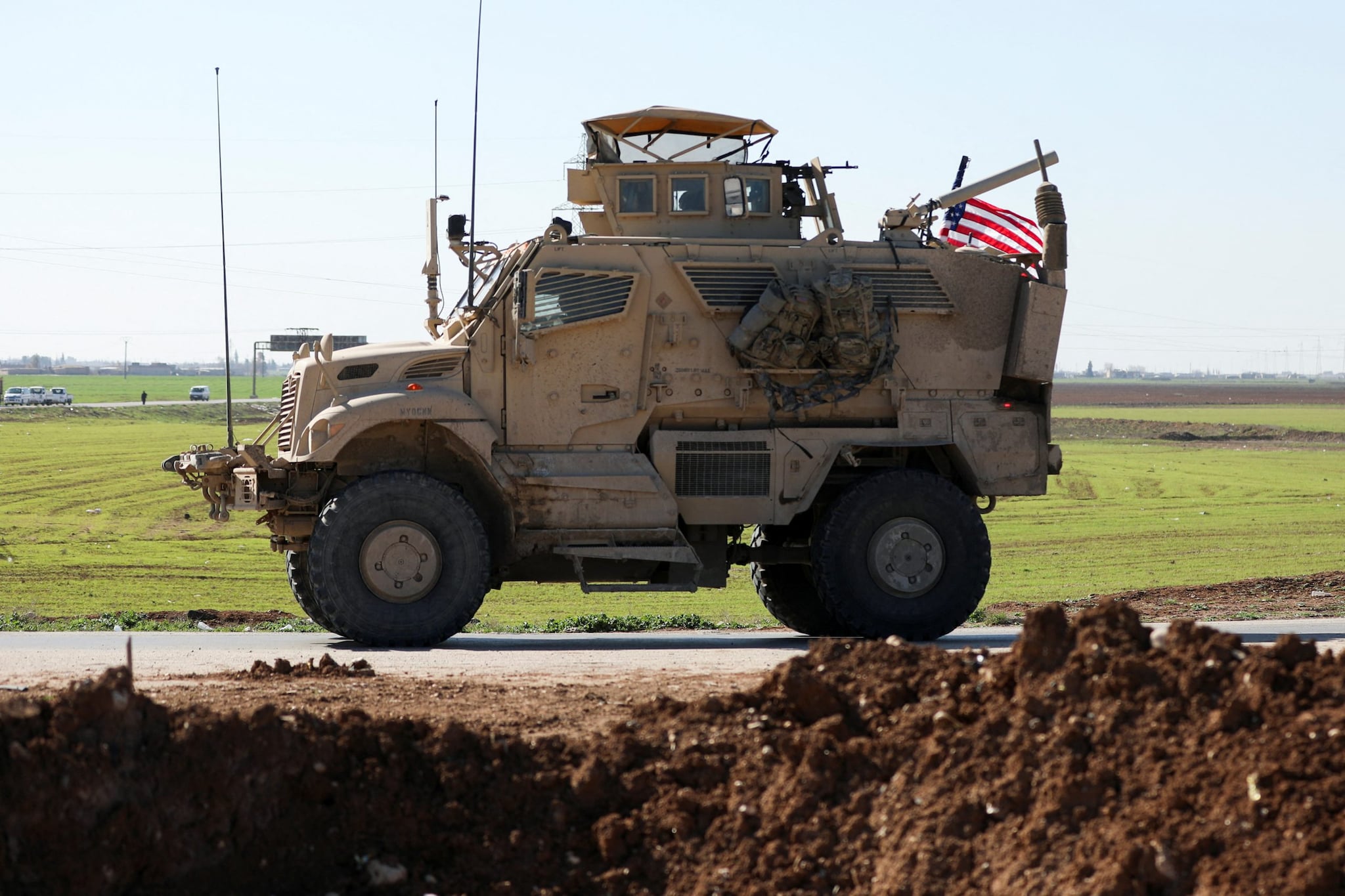
Reports are surfacing from local monitors and regional intelligence networks that the United States has begun a quiet, staggered withdrawal of personnel and equipment from its primary logistics hubs in northeast Syria. While the Pentagon maintains that its mission remains the enduring defeat of ISIS, the physical movement on the ground suggests a different reality. Convoys of heavy transport vehicles have been sighted crossing the Al-Waleed border point into Iraq, carrying hardware that has anchored the American presence in Al-Hasakah for years. This is not a sudden collapse, but a calculated thinning of the line.
The immediate trigger appears to be a shift in the regional risk-to-reward ratio. For years, the U.S. presence acted as a tripwire, preventing a full-scale Turkish incursion against Kurdish forces and keeping a lid on Iranian expansion. However, the cost of maintaining these outposts has spiked. As local sources report the dismantling of communication arrays and the departure of non-essential contractors from the Kharab al-Jir base, the geopolitical vacuum is already beginning to pull in surrounding powers.
The Logistics of Departure
Moving a military force out of a landlocked, hostile environment is a nightmare of engineering and diplomacy. This is not as simple as turning off the lights. The withdrawal involves the extraction of sensitive intelligence equipment, the decommissioning of hardened structures, and the relocation of hundreds of specialized troops who provide the backbone for the Syrian Democratic Forces (SDF).
Observers in the region note that the pace of these movements has increased over the last seventy-two hours. This isn't just about personnel. It’s about the heavy lifting. The removal of M-ATVs and specialized radar units indicates a long-term shift rather than a routine rotation. When the high-value tech leaves, the boots usually follow.
The logistical strain is compounded by the fact that the M4 highway—the primary arterial road for the region—is a patchwork of checkpoints controlled by a dozen different factions. To exit safely, the U.S. must coordinate, either directly or through intermediaries, with actors who would normally be considered adversaries. This creates a precarious window where the withdrawing force is at its most vulnerable.
The Kurdish Dilemma
The SDF, the primary ground partner for the U.S. in the fight against the caliphate, now finds itself looking at a horizon without its most powerful guarantor. For the Kurdish leadership, this withdrawal is the realization of a perennial fear. They have built a semi-autonomous administration under the umbrella of American airpower and special operations support. Without that shield, they are caught between the anvil of a hostile Turkish military to the north and the hammer of a resurgent Syrian Arab Army to the south.
History in this region is a cycle of abandoned alliances. The Kurds know that Washington’s priorities are shifting toward the Pacific and the containment of peer competitors, leaving the messy, localized conflicts of the Middle East to simmer or boil over on their own. The "enduring defeat" of ISIS becomes a secondary concern when the primary concern is avoiding a direct kinetic confrontation with regional heavyweights.
Internal memos from local administration officials suggest a frantic scramble to open channels with Damascus. If the Americans are truly leaving the main bases, the Kurds have only one card left to play: a reconciliation with the Assad government in exchange for some level of local protection. It is a desperate move, but in the absence of U.S. patrols, the alternative is likely a total Turkish takeover of the border strip.
The Iranian Influence Gap
Tehran is watching these convoy movements with intense interest. For Iran, the U.S. presence in northeast Syria, particularly near the Al-Tanf garrison and the Hasakah bases, has been a persistent "bone in the throat." It blocked the so-called land bridge connecting Tehran to the Mediterranean via Baghdad and Damascus.
As the American footprint shrinks, the Islamic Revolutionary Guard Corps (IRGC) and its affiliated militias are already positioning themselves to fill the space. We are seeing increased movement of pro-Iranian units in the Deir ez-Zor province, moving closer to the lines of control that were previously off-limits. They aren't rushing in with tanks; they are moving in with social services, reconstruction funds, and small, mobile cells.
This is a soft-power invasion that precedes the hard-power takeover. By the time the last U.S. C-130 leaves the tarmac, the political and social infrastructure of the region may already be tilted toward Tehran. The irony is that a withdrawal intended to reduce American exposure in the Middle East may actually necessitate a more violent re-intervention later if Iranian-backed groups secure a permanent stranglehold on the Euphrates river valley.
The ISIS Shadow
The most dangerous variable remains the tens of thousands of ISIS detainees held in makeshift prisons across the northeast. These facilities, like Al-Hol, are essentially ticking time bombs. They are guarded by the SDF, but that guardianship is contingent on American funding and logistical support.
If the U.S. withdraws from its main bases, the guards will eventually be redeployed to the front lines to fight for their own survival against Turkey or the Syrian government. The security of these prisons is the first thing to fail when a central authority retreats. A mass breakout isn't just a possibility; it is a mathematical certainty if the current trajectory continues.
A resurgent ISIS would not look like the 2014 version. It would be a leaner, more underground insurgency, focused on targeted assassinations and the exploitation of the chaos left behind by the departing Americans. They don't need to hold territory to be effective; they only need the absence of an organized opposition.
The Economic Aftershocks
Northeast Syria is the breadbasket and the oil patch of the country. The U.S. presence has effectively kept these resources out of the hands of the Damascus government, providing the SDF with the leverage needed to fund their administration. The withdrawal from the main bases signals a shift in the control of these resources.
Without the protection of U.S. forces, the oil fields of Rumeilan and Al-Omar become indefensible against a determined state actor. The loss of these revenues would lead to the immediate collapse of the local economy, triggering a new wave of displacement and refugees.
The move to withdraw is often framed in Washington as "ending forever wars," but for the people on the ground, it is the beginning of a new, perhaps more brutal chapter of economic warfare. The currency is already reacting, with the Syrian Pound hitting new lows as the market anticipates the end of the dollar-backed stability that the U.S. military footprint provided.
Tactical Reality vs. Political Narrative
There is a significant gap between the official statements coming out of the Pentagon and the tactical movements observed by regional analysts. The official line is "posture adjustment." The reality is a systematic dismantling of the infrastructure required for sustained operations.
When you see the removal of HESCO bastions and the clearing of fuel bladders, you are seeing the end of a mission. You don't remove those items if you plan on staying through the winter. This is a cold, hard assessment of a mission that has run out of political capital back home.
The U.S. military is incredibly efficient at departing when the order is given, but it is less efficient at managing the chaos that follows. The withdrawal from the main bases in the northeast is being conducted with more professionalism than the exit from Kabul, but the strategic outcome may be remarkably similar.
The geopolitical map of the Middle East is being redrawn in real-time. The ink isn't dry, but the American pen is being put away. Those who remain are left to negotiate with the wolves at the door, using the scraps of an alliance that served its purpose and was then discarded.
Watch the border crossings. The number of trucks leaving vs. the number of trucks entering tells the only story that matters. If the current rate of extraction continues, the U.S. presence in northeast Syria will be reduced to a skeleton crew by mid-summer, leaving the region to a fate determined by those with the most to gain from its instability.
Contact your local representatives to demand a clear accounting of the security plan for the ISIS detention centers before the final extraction is complete.