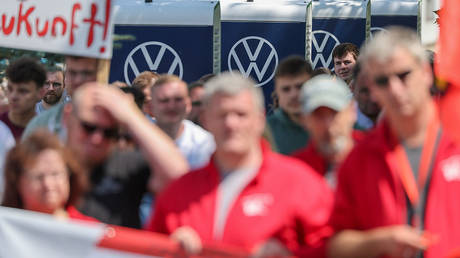
The coffee machine in the breakroom of the Stuttgart parts plant still hums at five in the morning, but nobody lingers near it anymore.
Stefan wipes down a stainless-steel counter he has cleaned every day for twenty-eight years. He does it automatically, his hands moving with the practiced efficiency of a man who knows the precise temperature of the wash water and the exact angle needed to make the cloth squeak against the metal. Outside, the morning fog clings to the Rhine valley, blurring the sharp outlines of the loading bays where massive trucks used to idle in long, impatient queues.
Now, the yard is quiet. Too quiet.
To read the financial bulletins from Frankfurt or Berlin, the story of German manufacturing is told in neat, sterile blocks of data. Analysts point to falling purchasing manager indices, shifting global supply chains, and stubborn energy prices. They speak of percentages and capital outflows with the detached calm of surgeons discussing an abstract medical chart.
They talk about numbers. Stefan talks about empty lockers.
Consider what happens when the furnaces cool down. Modern heavy industry is not just a collection of warehouses and assembly lines; it is an intricate, hyper-connected ecosystem. When energy costs spike—tripling in some sectors following the shifting geopolitical currents of recent years—the margins vanish. A factory cannot negotiate with a gas meter. It either pays the toll or turns off the switch.
And so, the quiet migration begins.
Business lobbies issue their stark warnings with mounting urgency. Trade associations report that thousands of jobs are evaporating not in a sudden, dramatic crash, but through a slow, agonizing bleed. Hiring freezes morph into early retirements. Plants that once operated across three roaring shifts now wind down operations by Friday afternoon. The capital is packing its bags, quietly drifting toward shores with cheaper power and fewer regulatory anchors.
To understand the human cost of this industrial contraction, we have to look past the macro-level dashboards. Imagine a hypothetical community outside Munich, a town called Oberndorf, where every second household traces its livelihood back to the local automotive supplier.
Markus, a thirty-four-year-old mechanical engineer specializing in precision casting, thought he had secured a lifetime career. His father worked the same floor. His grandfather helped rebuild the machinery after the war. Markus bought a home with a thirty-year mortgage, trusting the enduring promise of the German Mittelstand—that quiet backbone of family-owned, highly specialized medium-sized businesses that powered the nation's economic miracle.
Last month, Markus received a pale blue envelope.
The plant is relocating its foundry operations to Eastern Europe, where labor and overhead costs offer a fighting chance at survival. Markus is not bitter; he is bewildered. He understands the math. He knows that a business cannot operate at a permanent loss. But understanding the spreadsheet does not make the silence in his kitchen any less heavy when he looks at his two young children and wonders how to explain that the world they were promised is shifting beneath their feet.
The irony is sharp. The very innovations required to secure Europe's green future—electric vehicles, renewable energy infrastructure, advanced hydrogen technology—demand staggering amounts of upfront energy. Yet, the price of that transition is currently being paid by the heavy industries that must manufacture the components for tomorrow. It is a cruel paradox. You need heavy industry to build the green economy, but the cost of powering that industry is driving it out of existence.
Economists call this deindustrialization. It sounds clinical. It sounds like a natural weather pattern, something that happens to a landscape over centuries.
It is not. It is a choice, driven by policy, cost curves, and global competition.
When a factory closes in Germany, the loss is not merely economic. It represents the severing of an apprenticeship chain that has endured for generations. The tacit knowledge passed from a veteran machinist to an apprentice—the subtle feel of a vibrating lathe, the instinctive diagnosis of an engine block flaw—cannot be downloaded from a cloud server. Once that human capital disperses, it takes decades to rebuild.
The lobby reports keep piling up on politicians' desks. The warnings grow louder, sharper, more desperate. Yet the response remains mired in committee meetings and gradualist compromises, moving at a glacial pace while the industrial base bleeds out in real time.
Back in Stuttgart, the shift ends. Stefan turns off the breakroom lights, locks the metal locker room door, and walks out into the grey afternoon. The parking lot is half-empty, a vast expanse of asphalt reflecting a pale sky, waiting for a tomorrow that feels heavier than yesterday.