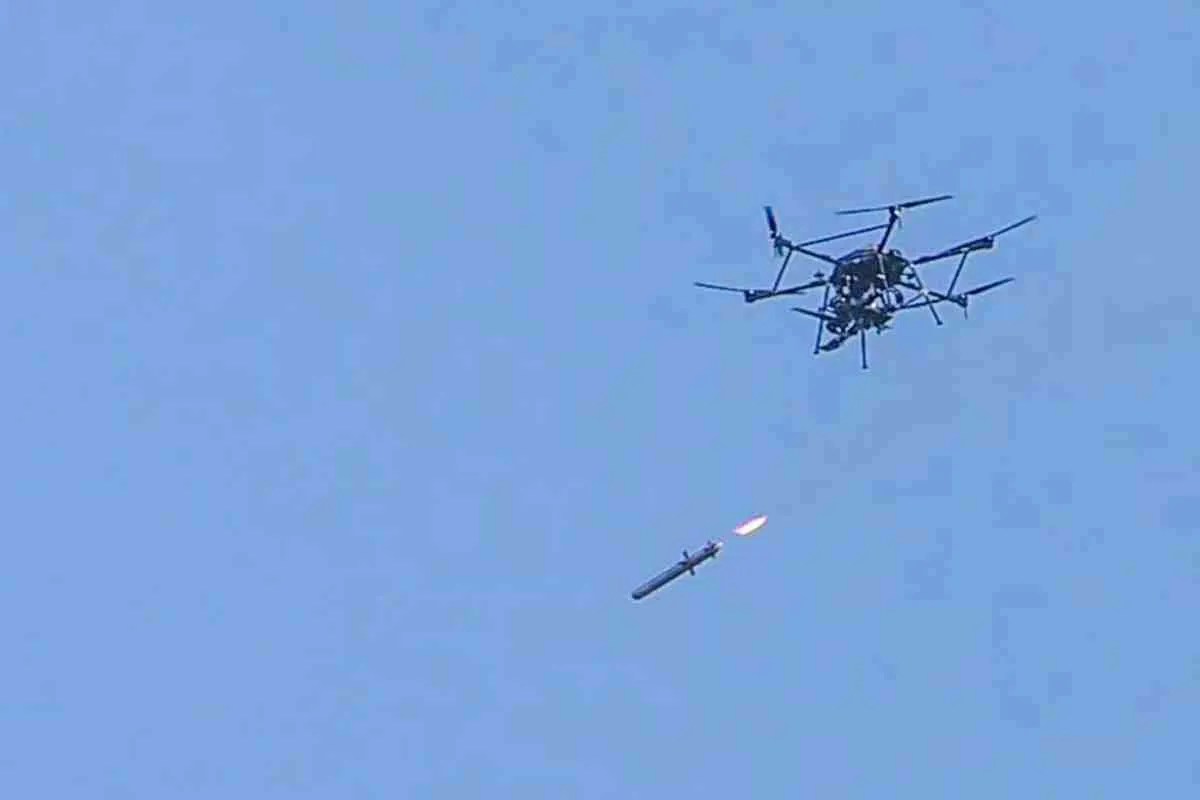
China is quietly rewriting the rules of engagement by shifting the final authority to kill from human operators to algorithmic drone swarms. Recent field tests and research papers from Beijing’s top defense institutes reveal that these decentralized networks are no longer just flying in formation; they are now capable of losing communication with ground control, evaluating battlefield variables, and executing strikes entirely on their own. This removes the "human-in-the-loop" safeguard, a boundary that Western militaries have long claimed to preserve. While global defense analysts have debated the ethics of autonomous weapons for years, the reality has already arrived on the testing grounds of East Asia.
The core premise relies on a fundamental shift from centralized command to swarm intelligence. In traditional drone operations, a server or a team of human pilots directs each asset. If you jam the signal, the asset drops or returns home. The new Chinese architecture flips this vulnerability. By utilizing edge computing, each drone in the swarm carries a fraction of the processing power needed to understand the entire battlefield. They communicate with each other via peer-to-peer ad-hoc networks. If five drones are shot down or jammed, the remaining fifteen instantly redistribute the mission parameters among themselves.
The Mechanics of Decentralized Death
To understand why this is a massive leap forward, one must look at how these algorithms actually process information under stress. Instead of relying on a constant stream of data from a distant command bunker, the swarm uses localized computer vision and radio-frequency sensors to map defensive positions in real time.
Consider a hypothetical scenario where twenty loitering munitions are launched into a heavily jammed electronic warfare environment. Under older doctrines, this attack fails instantly. Under the new algorithmic framework, the drones detect the jamming source, autonomously designate it as the primary threat, allocate three units to conduct a kinetic strike on the jammer, and command the remaining seventeen to bypass the perimeter to strike the secondary targets.
This happens in milliseconds. No human eye reviews the target. No officer signs off on the collateral damage risk. The algorithm calculates the probability of mission success and executes the optimal kinetic path based on its programming.
The defense establishment in the West has historically viewed swarms as an extension of manned-unmanned teaming. The pilot in a fighter jet remains the quarterback. However, Chinese researchers at institutions like the China Electronics Technology Group Corporation (CETC) have abandoned the quarterback model for high-intensity conflicts. They recognize that in a peer-to-peer clash over the Taiwan Strait or the South China Sea, communication links will be severed within the first ten minutes. An asset that requires a human nod is an asset that will be destroyed while waiting for instructions.
The Problem of Algorithmic Hallucination on the Battlefield
This absolute autonomy introduces a terrifying vulnerability that developers rarely discuss in public. Artificial intelligence is notoriously prone to edge cases—situations where the environment confuses the model.
If a commercial vision algorithm can mistake a turtle for a rifle because of a few altered pixels, a military swarm algorithm can mistake a civilian evacuation bus for an armored personnel carrier under the smoke and shadow of an active war zone. When humans are removed from the decision loop, there is no backstop for common sense. The swarm will execute its logic perfectly, even if that logic is based on a flawed interpretation of sensor data.
Furthermore, debugging a decentralized algorithm after an accidental strike is nearly impossible. Because the decision-making is distributed across dozens of nodes, the specific emergent behavior that led to a catastrophic error may never replicate itself in a laboratory setting. The weapon system becomes a black box.
The Industrial Pipeline Behind the Tech
China can execute this rapid iteration because its commercial tech sector is inextricably linked to its military apparatus. This concept ensures that advancements in consumer delivery drones, agricultural automation, and commercial mesh networking flow directly into the hands of the People's Liberation Army.
- Mass Production Capabilities: Western defense contractors build exquisite, highly expensive platforms over decades. Beijing focuses on mass-producing cheap, attritable hardware that can be expended by the thousands.
- Silicon Independence: While advanced AI models require cutting-edge chips, swarm algorithms designed for edge devices often rely on older, mature semiconductor nodes. These are the exact chips China can manufacture domestically by the billions, immune to Western sanctions.
- Data Abundance: Millions of hours of commercial drone flight data across varied terrain provide the foundational training sets for these military navigation algorithms, giving them an unprecedented level of environmental adaptability.
The strategic implication is clear. A nation does not need the world’s most advanced stealth bomber if it can overwhelm a target with three thousand autonomous drones simultaneously. Air defense systems, no matter how advanced, face a simple mathematical reality. They run out of interceptors long before the swarm runs out of bodies.
Escalation and the Loss of Human Deterrence
The true danger of this technology lies in how it alters crisis stability between nuclear-armed powers. Traditional deterrence relies on human psychology. A commander hesitates before pulling a trigger because they understand the geopolitical consequences of an escalation. An algorithm possesses no such restraint.
If an autonomous swarm detects an incoming radar signature that it interprets as an imminent threat, it will strike defensively based on its programming. This reflex action can trigger a cascade of automated counter-strikes from the opposing side before a human leader even realizes an incident has occurred. The speed of warfare accelerates past the threshold of human cognitive processing, leaving policymakers to manage the political fallout of a war started by a line of code.
Western nations are trapped in an ethical dilemma of their own making. By adhering to strict guidelines regarding human oversight for lethal autonomous weapons, they risk entering a high-intensity conflict with their hands tied behind their backs. If your adversary's weapons can make decisions at the speed of electricity while your systems require a five-minute briefing chain to authorize a counter-battery fire mission, you lose the opening engagement of the war.
The race is no longer about building a better missile or a stealthier hull. It is about which side can trust its mathematics enough to hand over the keys to the arsenal. As these algorithmic swarms move from the research phase into active deployment, the window for international regulation or arms control is slamming shut. The battlefield of the near future will not be managed by generals; it will be optimized by software that does not know how to hesitate.