Silence.
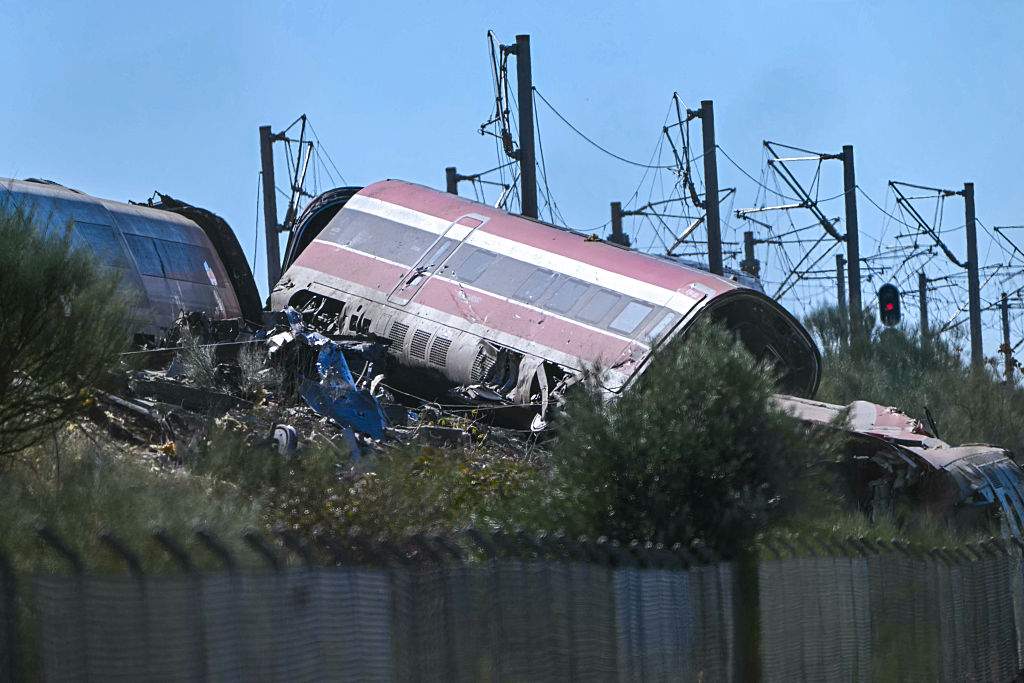
That is what follows the scream of twisting steel, a heavy, suffocating quiet broken only by the hiss of escaping air brakes and the distant, confused cry of a stranger calling out in a language you only half-understand. When a high-speed train leaves its tracks, the physics of modern convenience turn violent in less than three seconds, reducing seventy tons of aerodynamic engineering into a jagged maze of shattered glass and buckled aluminum.
For most people reading a wire dispatch over morning coffee, a headline noting that six Canadians were injured in a Spanish train crash that killed sixty-eight is a passing tragic statistic. A quick wince. A thumb scrolling down to the weather forecast. Yet behind that sterile diplomatic tally—confirmed by a Canadian minister speaking from an air-conditioned podium thousands of miles away—lies the terrifying reality of what happens when ordinary people step off the edge of the map they thought they knew.
The Architecture of a Normal Wednesday
Consider a hypothetical scenario that mirrors the exact rhythm of thousands of North American travelers crossing Europe every summer. Picture a retired couple from Ottawa, or perhaps two university friends from Vancouver backpacking on a tight budget, boarding an Alvia express train bound for the historic pilgrimage city of Santiago de Compostela.
They have done everything right. They booked their tickets weeks in advance, arrived at the platform twenty minutes early, hoisted their rolling suitcases onto the overhead racks, and settled into plush, reclining seats. Outside the tinted window, the green hills of Galicia blur into soft streaks of emerald and granite. Inside, the air conditioning hums softly. Someone is reading a paperback novel; someone else is scrolling through photos of tapas eaten the night before in Madrid.
We buy train tickets because we believe in an unspoken contract. Unlike driving a rental car on unfamiliar mountain roads, rail travel feels passive, protected, and mathematically predictable. Steel wheels sit on steel rails. Computers monitor every kilometer. You surrender control of your body to a massive, state-run machine, trusting that the curve ahead has been calculated to the millimeter by engineers you will never meet.
Then, just outside the city limits, the floor tilts.
In the real-world tragedy near Santiago de Compostela—the deadliest rail disaster in Spain in four decades—an eight-car train entered a sharp curve known as A Grandeira traveling at roughly double the posted speed limit of eighty kilometers per hour. Physics does not negotiate with vacation plans. Centrifugal force tore the carriages from the track, sending coaches sliding across the ballast and slamming into a concrete retaining wall.
When Distance Becomes a Second Injury
Surviving a catastrophic crash is only the beginning of an ordeal that most travel brochures never mention. For the six Canadians pulled from the wreckage, the immediate aftermath was not a neat hospital room with English-speaking doctors and familiar insurance forms. It was chaos on a dusty embankment.
I have sat in foreign emergency rooms holding the hand of someone I love while trying to translate medical terminology through a fog of adrenaline and shock, and I can tell you that language barriers do not merely slow things down—they amplify terror. When a paramedic shines a flashlight into your pupils and asks rapid-fire questions in Spanish or Galician, your brain, already bruised by blunt-force trauma, struggles to process basic nouns. Where does it hurt? Are you allergic to penicillin? Who is the person sitting three rows behind you?
You pat your pockets for a phone that was thrown three carriages away. Your passport—the little navy-blue booklet that proves you belong to a nation with hospitals, families, and consular officers—is buried beneath a pile of strangers' luggage and torn upholstery.
Meanwhile, across the Atlantic, the machinery of consular crisis response grinds into motion. When a government minister steps in front of microphones to announce that six citizens are among the injured, that number represents dozens of frantic phone calls made in the middle of the night. It represents parents in Toronto or Calgary refreshing Spanish news websites they cannot read, staring at grainy television footage of burning train cars, praying they do not recognize a backpack or a jacket.
Why High-Speed Rail Fails at the Margins
To understand how sixty-eight lives can be extinguished in a single bend of track, you have to understand the blind spot built into almost every complex transport network. Think of a modern rail line like a state-of-the-art surgical suite where the world's sharpest scalpels are laid out on a table, yet the doors are left unlocked to the street.
The Spanish rail network boasts some of the most advanced high-speed corridors on earth, protected by the European Rail Traffic Management System—a digital nervous system that automatically applies the brakes if a train exceeds safe speeds. Yet on the specific stretch of track leading into Santiago de Compostela, that automated digital safety net ended just kilometers before the sharp curve. Responsibility shifted abruptly from an automated computer system to a single human driver relying on trackside signals and memory.
History shows us that disasters rarely stem from a single catastrophic failure; they happen in the seams between systems. Aviation safety experts call this the Swiss Cheese Model. Imagine stacking several slices of Swiss cheese together. Each slice is a layer of defense: automated braking, driver training, track design, speed signage. Each slice has holes—small vulnerabilities that are harmless on their own. Tragedy occurs only when the holes in every slice align simultaneously, allowing a hazard to pass straight through without resistance.
On that stretch of Galician track, the absence of automated speed control, the sharp geometry of the curve, and a momentary lapse in human attention aligned with lethal precision. Sixty-eight people paid the ultimate price for that alignment. Hundreds more walked away carrying invisible fractures that no X-ray machine can detect.
The Invisible Luggage Survivors Carry Home
The news cycle moves with ruthless efficiency. Within seventy-two hours, reporters pack up their satellite trucks, flags are lowered and raised again, and the world turns its gaze toward the next crisis. For the six Canadians who survived, however, the real journey is just starting.
Medical evacuation and physical recovery are straightforward compared to the psychological aftermath of surviving a mass-casualty event. Survivors of high-speed crashes often experience a peculiar, heavy guilt. Why did the person in seat 14A die instantly while the person in seat 14B walked away with a broken collarbone and bruised ribs? There is no moral logic to survival, no hidden virtue that spares one life while taking another. It is merely geometry and chance.
Back home in Canada, weeks later, the trauma surfaces in quiet, unexpected ways. It arrives in the sudden surge of panic when a commuter train brakes hard entering Union Station, or when a subway car screeches around an underground turn. The body remembers the sound of shearing metal long after the mind tries to file it away as a distant memory. Friends ask how the trip to Spain was, expecting stories about architecture and coastal seafood, and the survivor has to decide in half a second whether to smile politely or admit that they still wake up smelling diesel smoke.
What Every Traveler Owes Themselves Before Boarding
It would be easy to read about a tragedy like this and decide that staying home is the only rational choice. That would be the wrong lesson. Human beings have crossed oceans, mountains, and borders for millennia precisely because the richness of seeing the world outweighs the statistical risks of moving through it.
Yet the story of those six injured Canadians strips away the comforting illusion that modern travel is entirely foolproof. It reminds us that when we step onto a train in a foreign country, we are placing absolute trust in strangers, infrastructure, and systems we cannot see.
The least we can do is carry our own small layers of protection. Registering travel plans with consular services so an embassy knows you are in the region before a crisis strikes. Keeping emergency contacts and blood types written on a physical card inside a wallet, not locked behind a dead smartphone screen. Carrying comprehensive medical evacuation insurance that covers the staggering cost of flying an injured body home across an ocean. None of these precautions will stop a train from derailing, nor will they rewrite the laws of physics when steel meets concrete.
They simply ensure that if the unthinkable happens on a quiet afternoon in a distant country, someone knows your name, someone holds your hand, and someone is already on the way to bring you home.
Outside Santiago de Compostela, the twisted wreckage was cleared away within days, the ballast raked smooth, and new steel rails bolted into place. Trains still run along that curve today, carrying fresh carriages full of pilgrims, students, and tourists gazing out at the green hills of Galicia, trusting the track beneath their feet as the city spires rise into view.