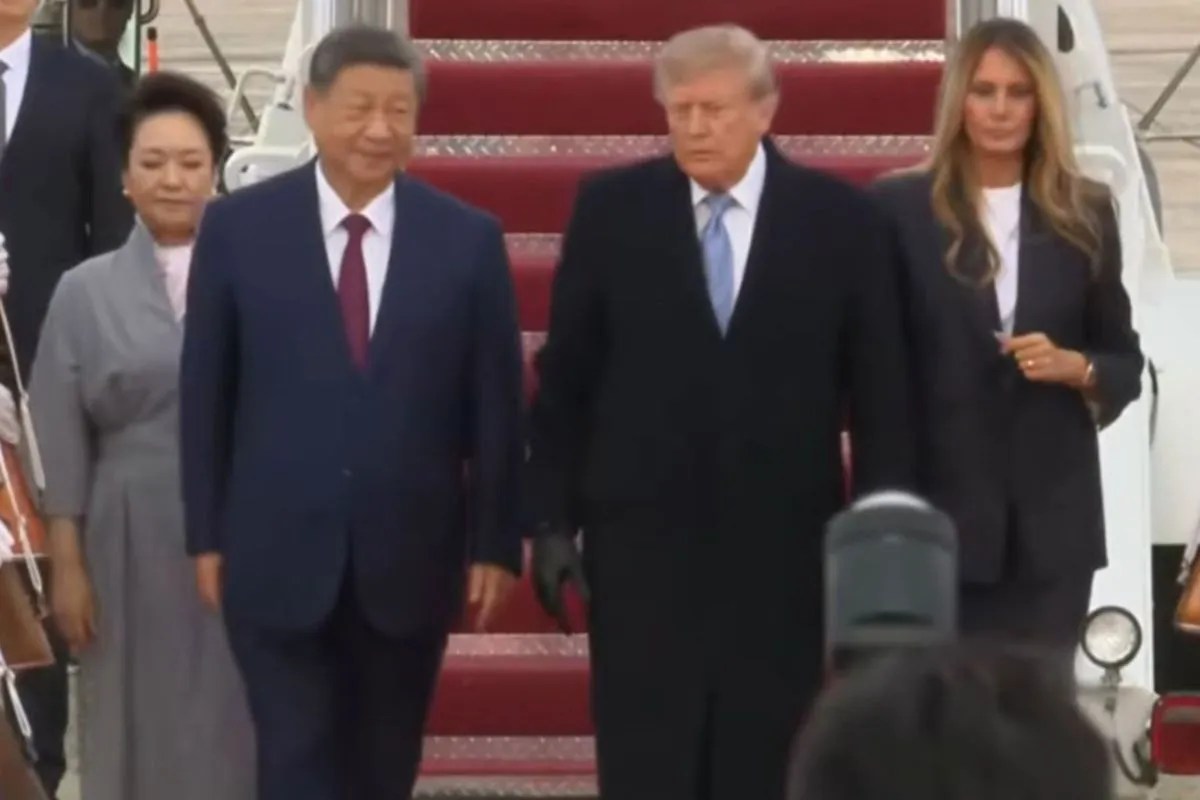
The brass band in Beijing did not miss a single note.
Picture the scene on the tarmac, or in the cavernous marble halls where history is staged for television cameras. Red carpets rolled out with millimeter precision. Honor guards standing so motionless they look carved from jade. And there, beneath the blinding camera flashes, stands Donald Trump, smiling broadly, praising Chinese President Xi Jinping for a welcome ceremony that felt less like a diplomatic greeting and more like a coronation.
It is intoxicating theater. It is meant to be.
When two men who hold the levers of the global economy shake hands for three seconds longer than protocol demands, the television pundits immediately dissect the grip, the smiles, the warmth of the toast. They talk about chemistry. They talk about personal rapport. And then, tucked neatly into the third paragraph of every standard news dispatch, comes the actual substance of the meeting.
The US-China trade truce has been extended by two months.
Sixty days.
Read that number again. Two months is barely enough time for a cargo ship loaded with soybeans in New Orleans to cross the Pacific, clear customs in Shanghai, and return with a hold full of consumer electronics. Yet, in the rarefied air of international statecraft, sixty days is being sold as a triumph of personal diplomacy, a breathing room earned through lavish banquets and mutual flattery.
To understand what those sixty days actually mean, you have to leave the banquet hall behind. You have to smell the diesel fumes at the Port of Long Beach at four in the morning, or stand inside a fluorescent-lit machine shop in Ohio where a man named Arthur is staring at a spreadsheet that no longer makes mathematical sense.
Arthur is a hypothetical composite, though if you walk down any industrial corridor in the Midwest, you will meet a dozen men with his exact calluses and his exact insomnia. He runs a mid-sized operation stamping precision steel components for agricultural equipment. For three years, Arthur has lived his life in ninety-day and sixty-day increments, dictated entirely by the moods of men who have never operated a hydraulic press.
When the news flashes across Arthur’s phone—Trump praises Xi’s welcome ceremony; truce extended by two months—Arthur does not feel relief. He feels the familiar, cold tightening in his stomach.
"Two months," Arthur mutters to his floor manager over the whine of the lathes. "I can't even order raw cold-rolled steel on a two-month horizon. By the time it arrives, the tariff could be twenty-five percent again."
This is the invisible chasm between geopolitical pageantry and economic reality. Diplomats trade in gestures; businesses trade in certainty. And certainty is the one currency neither Washington nor Beijing is willing to print.
The Architecture of the Stall
Why sixty days? Why not two years, or a permanent treaty signed with gold pens?
To answer that, you have to understand the mechanics of leverage—or rather, the illusion of it. Think of the US-China trade relationship not as a negotiation between two lawyers drafting a contract, but as two heavyweights leaning against each other in the twelfth round of a brutal fight. Neither has the stamina to throw a knockout punch without leaving his own jaw wide open. Neither wants to step back first, because stepping back looks like surrender to the crowd watching at home.
So they clinch. The referee lets them hold on for a sixty-second breather. That is what a two-month trade truce is. It is a clinch.
In the months leading up to this ceremonial handshake, the numbers told a grim story beneath the political bravado. Billions of dollars in tariffs had acted not as a surgical scalpel, as promised, but as a blunt tax paid largely by American importers and passed silently down the chain to consumers buying everything from washing machines to winter coats. Meanwhile, across the Pacific, Chinese factories were quietly bleeding orders to Vietnam, Malaysia, and Mexico, even as Beijing pumped state subsidies into its domestic economy to keep the lights on and the unemployment figures artificially serene.
Both leaders needed a pause. Neither could afford to look like he asked for it.
Enter the welcome ceremony. In diplomacy, pomp is never accidental. Xi Jinping understands that for an American president who views leadership through the prism of stature, respect, and spectacle, a grand reception is worth more than a dozen policy concessions. By offering a display of unmatched imperial hospitality, Beijing gave Trump a victory he could broadcast immediately to his base: Look how much they respect us now.
In exchange, the threat of escalating tariffs was pushed back by eight weeks. The immediate cliff was avoided. The stock market ticked upward by a fraction of a percent, algorithm-driven trading desks cheered the absence of bad news, and the news cycle moved on to the next shiny object.
I remember sitting in a cramped logistics office near Chicago during the early days of the first tariff waves, watching a freight forwarder try to explain customs classifications to a panicked importer. The air smelled of burnt coffee and wet wool. Every time a new deadline loomed, shipping container rates would spike violently as companies frantically tried to beat the clock, stuffing warehouses to the rafters with inventory they didn't yet need, tying up millions in working capital just to dodge a midnight tax hike. Then, a truce would be announced, and the ports would go eerily quiet, leaving dockworkers with slashed hours and trucking companies with idle rigs.
It is a violent, unnatural rhythm. Supply chains are supposed to flow like rivers, carving steady channels over decades. Instead, they have been turned into tidal waves, surging and receding at the whim of a press release.
What the Red Carpet Hides
If you look closely at the core disputes between Washington and Beijing, you quickly realize why two months is an absurdly short window to solve them. The friction is not really about how many tons of pork or liquefied natural gas China agrees to buy. That is the easy part—the transactional window dressing that makes for great headlines.
The real war is over the architecture of the twenty-first century.
It is about intellectual property, forced technology transfers, and state-sponsored industrial dominance. For decades, the unspoken bargain of globalization was simple: American companies got access to cheap Chinese labor and a massive consumer market, and in exchange, they looked the other way while Beijing built an industrial juggernaut capable of competing with—and eventually eclipsing—Western tech giants.
When Washington finally decided to tear up that bargain, it discovered a terrifying truth. You cannot easily untangle two economies that have spent forty years fusing together at the molecular level. It is like trying to separate two coats of paint after they have already dried on the wall. Scrape too hard, and you pull the drywall down with it.
Consider the semiconductor supply chain, or the rare earth minerals buried in the mountains of Inner Mongolia that are essential for everything from electric vehicle batteries to F-35 fighter jets. China processes the vast majority of the world's rare earths. America designs the advanced software and high-end chips that run the modern world. If either side pulls the plug completely, the lights go out everywhere.
So, when Trump praises Xi's welcome ceremony, he is celebrating a truce in a cold war that neither side knows how to win without destroying its own living room.
And what happens during these sixty days? Teams of mid-level bureaucrats—trade representatives, agricultural attachés, treasury officials—will lock themselves in windowless conference rooms in Washington and Beijing. They will argue over enforcement mechanisms. How do you verify that a Chinese state-owned enterprise isn't subtly stealing a patented manufacturing process? What happens if Beijing promises to buy fifty billion dollars in American farm goods, and then quietly backs out when the political spotlight fades?
In past negotiations, the sticking point has always been trust—or the absolute lack of it. Beijing views American demands for strict verification as an infringement on its national sovereignty, a humiliating echo of the nineteenth-century "unequal treaties" forced upon China by foreign powers. Washington views Chinese promises without strict enforcement as worthless paper, having been burned by decades of unfulfilled commitments at the World Trade Organization.
You do not bridge a century of historical trauma and competing ideological systems in eight weeks. You barely have time to translate the drafts.
The Human Toll of Limbo
There is a dangerous habit in political journalism to treat geopolitics like a grand chessboard, where kings and queens glide across polished squares in bloodless elegance. It makes for clean analysis. It also erases the millions of ordinary people who get crushed beneath the pieces.
Let us return to the Midwest, not to a hypothetical machine shop this time, but to the very real soybean fields of Illinois and Iowa.
For generations, American farmers built their livelihoods on a predictable equation: plant in the spring, harvest in the fall, and ship a massive portion of the yield across the Pacific to feed China's booming hog industry. When the trade conflict erupted, that equation shattered overnight. Chinese buyers vanished, turning instead to Brazil, where farmers promptly burned down millions of acres of rainforest to plant new fields to meet the sudden demand.
Even when a truce is called, even when warm words are exchanged beneath crystal chandeliers in Beijing, those Brazilian fields do not magically turn back into jungle. The infrastructure—the new ports, the paved roads, the financing networks connecting South America to East Asia—is now permanent. The market share lost during the months of hostility does not simply snap back because a welcome ceremony went well.
Meanwhile, the American farmer sits in his kitchen, looking at debt-to-asset ratios that haven't looked this bleak since the farm crisis of the 1980s. Government bailout checks soften the blow, turning proud, fiercely independent producers into reluctant dependents of federal subsidies, a psychological wound that no trade envoy ever mentions at a press conference.
Across the ocean, in the sprawling factory towns of Guangdong province, the story is mirrored in Mandarin. Young migrant workers who left their rural villages to assemble smartphones and stitch sneakers find their overtime hours evaporating. Without overtime, factory wages in southern China barely cover rent and food. Boarding houses sit half-empty. Small noodle shops that once thrived on the midnight shift crowd close their shutters.
These are the people paying the real tariff. Not the men in tailored suits admiring the precision of a military honor guard.
The Illusion of the Quick Fix
I will admit something that most commentators are too proud to say out loud: nobody knows how this ends. Anyone who tells you with absolute certainty that a grand, permanent deal is right around the corner—or that a total, catastrophic decoupling is inevitable—is selling you a fantasy.
We are living through a profound historical realignment, the kind that usually takes decades to settle into a new equilibrium. For thirty years after the fall of the Berlin Wall, the Western world operated under a comforting delusion: that free trade would inevitably turn autocracies into democracies, that economic integration was a one-way street toward global harmony.
That theory is dead. What we are witnessing now is the messy, terrifying birth of whatever comes next.
In this vacuum, political theater becomes a narcotic. It feels good to watch a strong leader command respect on a foreign stage. It feels good to hear that tariffs are being held at bay, that catastrophe has been postponed for another sixty days. It gives us permission to stop worrying, to believe that the adults are in the room and that a brilliant dealmaker will somehow conjure a painless victory out of thin air.
But hope is not a business strategy. And flattery is not foreign policy.
When the camera crews pack up their tripods and the red carpets are rolled back into storage, the fundamental math remains unchanged. Two massive powers are locked in a structural rivalry for technological, economic, and military supremacy. Extending the clock by two months does not alter the trajectory of the collision; it merely buys a little more time to brace for impact.
Somewhere in Ohio, Arthur is still staring at his spreadsheet. He has sixty days before the next deadline. He cannot expand his factory. He cannot hire the two new machinists he desperately needs. He can only wait, watching the news from Beijing, hoping that the applause lasts long enough for him to survive the winter.
The band plays on, crisp and triumphant, echoing across the tarmac. And six thousand miles away, a lathe hums in the dark, waiting for a tomorrow that is never quite allowed to arrive.